Russian Armor Assault on Myrnohrad Ends In Disaster As Drones Wipe Them Out
Yeah, so about those Putin claims that Pokrovsk and Myrnohrad have been taken. Memo to Kremlin strategists: maybe don't believe everything your military commanders tell you.
Putin is just desperate to prove to Trump, Xi, Modi, Kim and every other autocrat he can collar that his Ukrainian victory is 'inevitable.' But it seems the only thing standing between him and that boast is a) the Ukrainian military, and b) his own military. Russian forces tried again to assault Myrnohrad this week with a heavily armored column of tanks and infantry fighting vehicles. All are now flaming wreckage. Ukraine's ostensible winter fog problem (as if winter fog hasn't been present since the invasion almost four years ago - and for millenia before that) has, like most other challenges, by Ukrainian ingenuity: ground drones with sensors, electronic hacking of Russian radio traffic and AI-enhanced aerial drones. It is safe to assume that Russia will now go back to small unit infiltration attempts until it can round up some new unroasted armor. JL
David Axe reports in Trench Art:
The Russian 40th Naval Infantry Brigade attacked with up-armoredturtle tanksand other vehicles on Tuesday, clearly hoping a low-clinging fog would obscure the mechanized assault from overhead surveillance and attack. It didn't work. The Russians were still kilometers from the wide no-man's-land when disaster struck. "One of the tanks got stuck in an anti-tank ditch, after which the column was quickly taken under fire control." The Ukrainians knocked out three tanks and eight other armored vehicles—a significant blow to Russian mechanized capability in the sector.
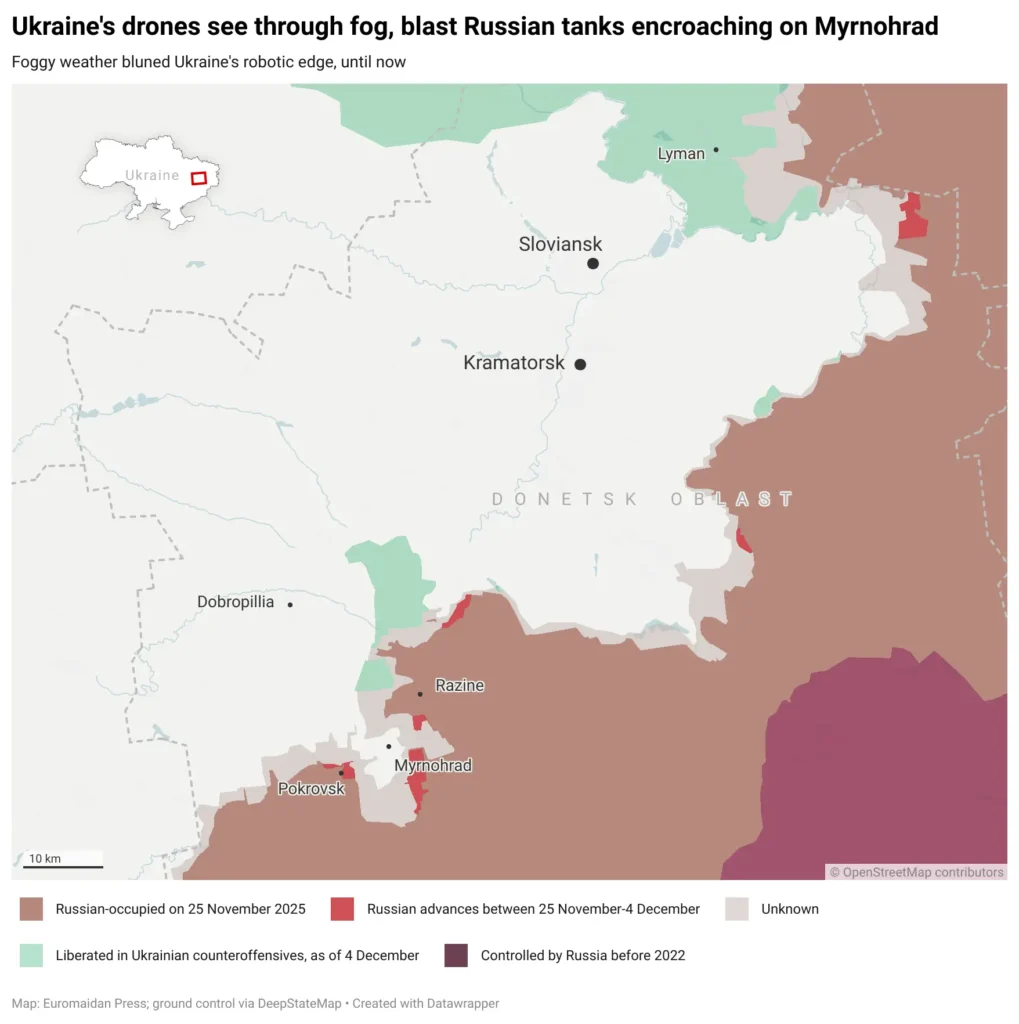
The Russians are redoubling their efforts to close the Myrnohrad pocket. Ukrainian forces are fighting hard to keep open a narrow escape corridor for troops still defending the former mining town with a pre-war population of 46,000.
With almost all of neighboring Pokrovsk under Russian control following a bloody yearlong siege, Myrnohrad is now one of the main focal points of fighting in eastern Ukraine. The town's fall would remove one of the last major urban obstacles between Russian forces and the twin cities of Kramatorsk and Sloviansk—the largest Ukrainian-held cities in Donetsk Oblast with a combined pre-war population of 400,000.
Five-to-one odds in Russia's favor
Around 150,000 Russians from the Center Group of Forces are relentlessly attacking the approximately 30,000 Ukrainian troops with the 1st Azov Corps and 7th Rapid Response Corps. The Russians are determined to capture or surround Myrnohrad as soon as possible in order to clear one of the last large urban strongpoints on the road to Kramatorsk and Sloviansk, 40 km to the north.
Turtle tanks in the fog
Russian infantry is abundant in and around Myrnohrad, but it wasn't infantry who led the most recent push to encircle the town from the north and cut across the barely 1-km Ukrainian-controlled corridor leading out toward the main defensive line.
Map of the situation near Pokrovsk and Myrnohrad on 4 December, via Deepstatemap
The Russian 40th Naval Infantry Brigade attacked with up-armored turtle tanks and other vehicles on Tuesday, clearly hoping a low-clinging fog would obscure the mechanized assault from overhead surveillance and attack. Winter weather has been aiding Russian advances across the front—morning fog and frozen ground facilitate movement while Ukrainian reconnaissance drones struggle to monitor enemy movements.
It didn't work. The Russians were still kilometers from the wide no-man's-land when disaster struck.
"The equipment was moving across the field," the 7th Rapid Reaction Corps reported. "One of the tanks got stuck in an anti-tank ditch, after which the column was quickly taken under fire control."
11 armored vehicles destroyed in single engagement
Drones from the 7th Rapid Reaction Corps barreled down. The Ukrainian 68th Jaeger Brigade's artillery joined in. The Ukrainians knocked out three tanks and eight other armored vehicles around the village of Razine—a significant blow to Russian mechanized capability in the sector.
How Ukraine sees through the fog
How the Ukrainians saw through the fog is unclear. The thick haze typical of Ukrainian winters can blind and ground many drones, but Ukrainian forces have been scrambling to develop new tactics and technology to counter the problem.
Ukrainian counter-fog innovations include:
Ground robots as spotters: Ukraine has been testing over 70 land drone models that can lie in wait, spotting passing Russian vehicles and passing their coordinates to drone pilots who fly blindly until their targets become visible at close range.
Signals intelligence: Ukrainian forces have employed signals eavesdropping to triangulate Russian locations by way of their radio chatter. Systems like the Eter mobile electronic warfare system can detect enemy signals and geolocate radio emitters.
Whichever method the Ukrainians used, it worked—for now. Myrnohrad remains contested despite the Russians' overwhelming manpower advantage and the foggy weather that typically blunts the Ukrainians' robotic edge.
One Ukrainian drone operator expects the mechanized assaults to continue. "There are no signs that they are going to stop," Kriegsforscher wrote about the Russian marines.
What comes next: tactical withdrawal or continued defense?
It's probably only a matter of time before the 7th Rapid Reaction Corps pulls its last troops from Myrnohrad and straightens out its defenses north of the settlement in the direction of the village of Dobropillia. "The withdrawal of elements of Ukrainian defense forces from Myrnohrad toward the Dobropillia area could affect the overall situation," the Ukrainian Center for Defense Strategies noted.
In the short term, Ukrainian positions would grow stronger from the redeployment of troops currently fighting a hopeless defense in Myrnohrad. In the longer term, the Russian tanks currently trying to encircle Myrnohrad could redirect their efforts—and begin pushing north toward Kramatorsk, the largest Ukrainian-held city in Donetsk Oblast and a critical anchor of the Donbas fortress belt
As a Partner and Co-Founder of Predictiv and PredictivAsia, Jon specializes in management performance and organizational effectiveness for both domestic and international clients. He is an editor and author whose works include Invisible Advantage: How Intangilbles are Driving Business Performance. Learn more...





0 comments:
Post a Comment