The company had been receiving consistent feedback from consumers that its beef patty was
subpar. McDonald’s determined the burger was too dry and
didn’t arrive hot enough, and executives discerned that the culprit was the flash-freezing. The patty
itself didn’t have to change, just the way it was handled. Keeping the
meat fresh and cooking each burger to order improves the eating
experience. “The game changer turned out to be serving it hot
off the grill." The never-frozen patties cook in
60 to 80 seconds—a minute faster than frozen ones
A cryptic missive went out last spring to all 3.6 million people who follow McDonald’s on Twitter. The tweet read, simply: “100% Fresh Beef + John Goodman = ASMR(ish)” and included a link to a video. In the split-screen clip, the Big Lebowski and Roseanne star stares into the camera and—somewhat unnervingly—whispers a carnal ode to the fast-food giant’s Quarter Pounder burger, accompanied by the sounds and visuals of an appetizing-looking patty sizzling on the grill. “Hey, you,” Goodman murmurs intently. “McDonald’s new fresh-beef Quarter Pounder is hotter and juicier. It’ll leave you speech-less. I can almost feel that juice sizzling. . . . Oh baby, the melted cheese is hugging every corner of that grilled patty. . . . That cheese is so hot, so melty.”
ASMR videos, named for autonomous sensory meridian response, typically star carefully primped young women tapping on objects and whispering into high-end microphones with the intent of creating a pleasant frisson in viewers, whereas this one featured a large man waxing near pornographically about a burger. But the spot was a viral hit, quickly racking up more than 3 million views. It was timed to the arrival—at every one of the restaurant chain’s 14,000 U.S. outposts—of fresh, never-frozen beef patties in its signature Quarter Pounder burgers, a change that execs say has been as seismic for the company as the introduction of all-day breakfast, in 2015, or even the drive-through window, which McDonald’s began experimenting with in 1975. (The new patty is also available in the chain’s more premium Signature Crafted Recipes line of burgers, but not yet in Big Macs or its basic ones.)
Over the course of interviews with five top executives, I never once heard anyone mention Shake Shack (110 U.S. locations) or In-N-Out (334 restaurants) by name, but McDonald’s has clearly been studying these chains—both of which serve fresh beef—along with their millennial customers who don’t find frozen patties appetizing. “We were hearing from consumers that our burger wasn’t good enough, and we’ve seen a lot of trends around expectations of high quality,” says the company’s new chief marketing officer, Morgan Flatley, who arrived at McDonald’s from PepsiCo a year ago. “To be able to deliver that at the speed and scale of McDonald’s was a unique opportunity for us,” she says.
Fresh beef is just one element of a massive transformation underway at McDonald’s. Steve Easterbrook—a McDonald’s veteran who had also run British casual-dining chains PizzaExpress and Wagamama—was elevated in 2015 from chief brand officer to CEO at a time of real crisis. The chain had been suffering losses for six straight quarters, with net income down 15% from the year before. The iconic billions served signs didn’t quite start rolling backward, but between 2012 and 2016, McDonald’s forfeited a stunning 500 million transactions in the U.S., both to its typical competitors and a new wave of fast-casual spots like Shake Shack and Sweetgreen. “We’d lost a meaningful connection with customers,” says Easterbrook, who sounds a bit like a younger Michael Caine. “They weren’t excited about what we were doing, and that would be fairly universal on a global basis. So we rallied around a turnaround plan.” McDonald’s stock is up 60% since Easterbrook took over, but it has listed downward for much of 2018 as same-store U.S. sales growth has cooled from 4.5% to 3%. Consumers and investors alike are demanding more.
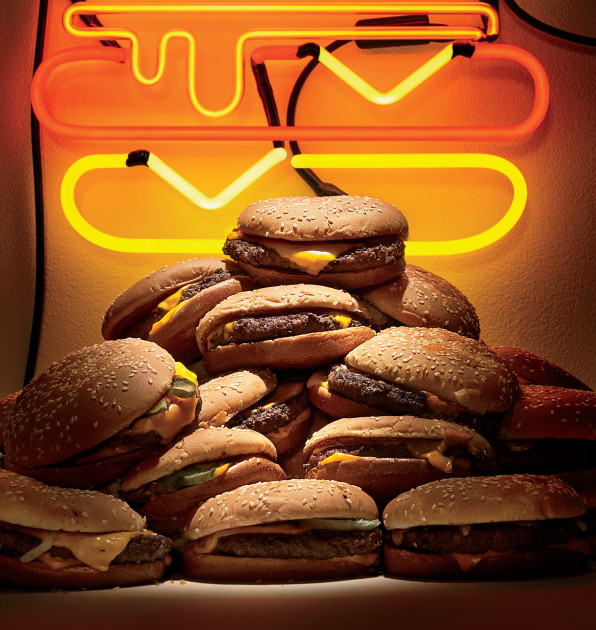
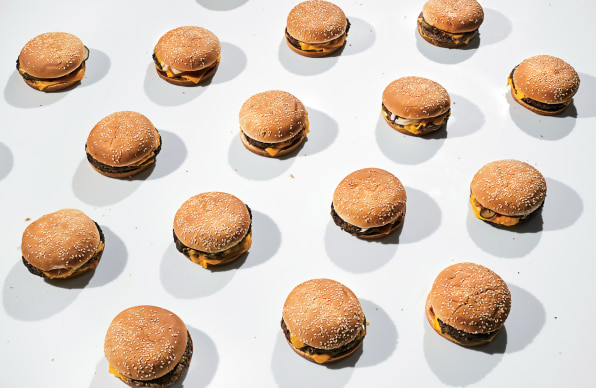
Now the company and its franchisees—owner-operators who typically sign a 20-year agreement for each restaurant and control more than 90% of the U.S. chain—are embarking upon its biggest innovation test in years with the rollout of the new Quarter Pounders. Can a company that’s famous for its predictability succeed in selling a fresh-beef hamburger—with all the logistical and food-safety risks that entails—at the scale, speed, and price its customers expect? [Photos: Joel Stans; Prop stylist: Taylor Horne at MHS Artists]
The brand-new headquarters of McDonald’s, a nine-story open-plan office tower, are in the rising Chicago neighborhood of the West Loop. From 1971 until this past June, the company operated out of a park-like campus in suburban Oak Brook, Illinois, 20 miles outside of the city. Now it’s on a stretch of West Randolph Street that is currently Chicago’s hottest restaurant row. “We felt like it would get us closer to our customers, closer to the competition, closer to the trends that are shaping society,” says Easterbrook. Plus, he notes, it’s good for recruiting: “The talent tends to be living downtown.” The young corporate employees toting Sweetgreen bags back across the street to their office during a recent lunch hour—because who can eat McDonald’s every day?—demonstrate that Easterbrook’s plan is already taking hold. Several told me excitedly about the expanded lunch options the new HQ will provide.
The McDonald’s café in the lobby of the building has one feature you won’t find anywhere else: a rotating selection of regional items from outposts around the world, including a spicy-chicken sandwich from Hong Kong. The limited availability of these items has turned out to be a canny marketing move, sparking a flood of social media interest and press coverage, but the space is also, clearly, a test lab. Menu chief Linda VanGosen, who joined McDonald’s from Starbucks last year, works closely with chefs and food scientists at McDonald’s suppliers and keeps a close eye on food trends, which have to reach a certain level of mass appeal to make sense for McDonald’s. She and her team also conduct ethnographic research, including shadowing customers to see how McDonald’s fits into their lives, and take what VanGosen refers to as food safaris, eating their way across America. “If we want to find great coffee, we’ll probably go to the West Coast,” she says. “For burgers, it’s probably somewhere in the South.”
A key insight she’s learned is that what consumers say they want, and what they actually buy, are two different things, which presents an interesting challenge. “That’s kind of the secret sauce,” VanGosen says. “What’s an emotional need you can answer?”
The company had been receiving consistent feedback from a wide range of consumers in recent years—both via focus groups and from unsolicited comments—that its beef patty, the cornerstone of its business, was subpar. But figuring out exactly what customers found unsatisfying took time. Eventually, McDonald’s determined that the burger was too dry and didn’t arrive hot enough, and executives discerned that the culprit in both cases was the flash-freezing process the patties had been subjected to. “We looked at a lot of things—raw material, fat content, grind—for the right taste and textural elements,” VanGosen says, noting that this work began well before her arrival.
They found that the patty itself didn’t have to change, just the way it was handled. Keeping the meat fresh and cooking each burger to order improves the eating experience immensely. “The game changer turned out to be serving it hot off the grill,” she says, adding that the never-frozen patties cook in 60 to 80 seconds—about a minute faster than frozen ones—which also helps offset the added time it takes restaurant workers to start cooking each burger as soon as it’s ordered. McDonald’s declines to reveal the costs associated with the new patty, beyond saying that it is not appreciably more expensive to produce than the frozen version, and that consumers won’t see an increase in price. “I haven’t seen data on this, but if I had to guess based on other restaurants, I’d say it costs McDonald’s a little more,” says industry analyst Mark Kalinowski, of Kalinowski Equity Research. “But we’re getting a lot of evidence that they are selling well.” Kalinowski says that the average McDonald’s does twice the business of an average Burger King or Wendy’s. (Wendy’s, which has long served never-frozen patties, recently took the opportunity to mock its bigger competitor on Twitter: “Hey @McDonalds, heard the news. Happy #NationalFrozenFoodDay to you for all the frozen beef that’s sticking around in your cheeseburgers.”)
McDonald’s began testing fresh-beef Quarter Pounders nearly two years ago at restaurants in Tulsa, Oklahoma, and Dallas, markets selected because they are serious burger country. The response was conclusive: More than 90% of customers distinctly preferred the new burger. It’s been a hit with critics too. “The meat was tender, it tasted fresh and delicious, with that classic whiff of black pepper McDonald’s uses,” said one Food & Wine review. “To boot, there was a nice bit of char around the edges. Simply put, there was no disguising the fact that this meat is a fairly significant upgrade from McDonald’s as usual.”
In addition to taste, today’s restaurant-goers increasingly care about the provenance of the food they consume. At Sweetgreen (91 locations), for instance, an employee writes the names of the farms that supplied the season’s ingredients on a chalkboard in the restaurant. Shake Shack published a cookbook last year that highlights its local purveyors. While moves like these are impossible at the scale of McDonald’s, the chain has been taking gradual steps in these upstarts’ direction. The company committed in 2015 to using exclusively cage-free eggs by 2025. Its chicken is now free of most antibiotics, which has been the policy in the U.S. since last year (though the Humane Society thinks these changes don’t go far enough). McDonald’s also recently announced it would stop using plastic straws in the U.K. by 2020 and begin testing alternatives in the U.S. Generally, the company has become more transparent about its sourcing in the post–Fast Food Nation era, distancing itself from the industrial food processes it formerly employed that had so disgusted consumers, including incorporating “pink slime”—beef castoffs treated with ammonia—into its burgers. [Photos: Joel Stans; Prop stylist: Taylor Horne at MHS Artists]But fresh beef is many orders of magnitude more challenging than any menu update thus far, and more significant to the company overall. “We thought, How do we make the biggest difference to the most customers in the shortest possible time?” says Easterbrook. Rather than playing defense against critics by adding a healthful—and potentially unpopular—option to the menu, the company has homed in on its essential product: a hamburger, the biggest, burgeriest hamburger McDonald’s sells.
On a late-spring Tuesday, not long after the new patty began being served nationwide, Christa Small, one of the company’s top operations executives and the person whose team was responsible for coming up with the procedures that make fresh beef possible, visits a McDonald’s near the old campus in Oak Brook. It’s hard to imagine anyone you’d trust more with the task of making sure the biggest restaurant chain in the world can safely sell a potentially pathogen-carrying product to millions of customers a day. Small is friendly but intensely focused, with a tiny Golden Arches pin on her lapel. She’s worked for McDonald’s her entire career, beginning with a “crew member” position at a restaurant in suburban Chicago, followed by a corporate internship the summer before her freshman year at University of Michigan, where she studied electrical engineering (she also has a master’s in computer engineering). She has served in a wide variety of roles at the company, from the IT department to helping develop the automated beverage machine.
Food safety, especially in the wake of Chipotle’s disastrous E. coli outbreaks in 2015 and 2016, which hurt both its business and its brand, is clearly a priority for McDonald’s. The company’s suppliers have spent around $60 million to enhance equipment and systems, including new refrigeration and food-packing technology. (Lopez Foods, which supplies restaurants in the Texas and Oklahoma region, led the pilot program to develop a process to produce, pack, and ship fresh patties.) The distribution centers and cold trucks were also revamped, to ensure that the patties would be kept appropriately cool yet at no point be exposed to freezing temperatures, rendering the whole fresh-meat initiative moot.
The main equipment investment McDonald’s franchisees have had to make for the fresh-beef switch is a squat, two-drawer refrigerator. (“Do [franchisees] like writing big checks?” Easterbrook asks. “Of course they don’t! But if there’s a strong business case behind it, they’ll naturally want to invest.”) Small’s group also developed new “small wares” for the process, including trays and tongs that are only used with the new patties. Most crucially, she and her team developed a mandatory curriculum for the handling, cooking, and serving of fresh-beef patties. “It’s the most intensive training process we’ve ever done for a new product,” she says. “We really want to make sure we maintain our reputation in regards to food safety.”
In crafting the new Quarter Pounder, McDonald’s has made subtle improvements to the entire sandwich, adjusting grill time and the bun-toasting process, for example. But the biggest change is in the labor process to prepare it. McDonald’s switched from batch cooking to preparing each Quarter Pounder when ordered. This required fundamental shifts in kitchen culture and training. “It takes them a minute to understand that I want them to react as soon as a customer orders,” Small says of employees. “I want you to get the patty down, I want you to act with a sense of urgency. When you have to change the behaviors of hundreds of thousands of people, that’s not a small thing.”
To demonstrate, Small takes me to the other side of a McDonald’s counter and asks an associate for a Quarter Pounder. As soon as the order enters the system, a cowbell sound—unique to the new burger—alerts the grill cook, who pulls on a fresh pair of blue gloves and grabs a patty from a sterile bag contained in a blue tub in the special fridge, which is labeled raw fresh beef only/solo carne. fresca cruda. (The combination of the plastic bag and the plastic tub provides two lines of defense against the escape of “purge,” which is the unappetizing word for the juices that the raw burger releases in the packaging. “That’s where your main risk of cross-contamination is,” says Small.) As the grill cook’s burger hits the grill, he lowers a clamshell top, which flattens the patty and allows it to cook on both sides at the same time. In another area of the kitchen, the prep team pops a bun in the toaster and, as soon as it’s ready, applies condiments. When the patty is done, the clamshell automatically floats open. The grill cook seasons the burger with salt and pepper and passes it on a tray to a short conveyor belt, where the prep squad unites the patty with the bun and condiments and packs it all in a cardboard box. The whole process takes less than two minutes. And the finished product? It is, indeed, hotter and juicier. John Goodman’s whispers are not lies.
The new beef patties have a 14-day shelf life from the time they are formed at one of the company’s meat purveyors until the moment they’re served. But there are many factors that could prevent them from getting to a customer at all. The refrigerated trucks McDonald’s uses, for instance, are constantly temperature-monitored: If the interior temperature goes even one degree too high or low, the entire load is discarded. There’s also, for the first time, a question of supply. After all, ground beef is a seasonal agricultural product, and even if you are one of the biggest purchasers of it on the planet, as McDonald’s is, you still need to plan ahead for the arrival of barbecue season. “We’re competing with retail on fresh beef, and we need to make sure we can access the supplies we need,” says Marion Gross, the head of the U.S. supply chain and a 25-year veteran of the company. “This is new for us, and we’re coming into our first grilling season and it’s going to test the robustness of our supply chain. But so far, so good!” To better anticipate purchasing needs across the entire business, Gross’s group is making significant investments in computer learning and researching emerging technology like the blockchain. “We’re looking at all those kinds of things seriously,” she says, “so we can better manage the data we have.” She adds, laughing, “We have a lot of data.”
McDonald’s has put all of this energy into fresh beef because it really needs the burger to succeed. The chain’s stalwartly low prices are the result of razor-thin margins and massive sales volume, so keeping costs down and getting more customers through the doors—or onto its highly regarded ordering app—is paramount. To this end, the company announced another step in its ongoing restructuring in June, closing regional field offices and further shrinking the management structure. All told, it plans to reduce expenses by $500 million by the end of 2019. And it’s begun looking into a host of potential new offerings, from plant-based meat alternatives (like the Impossible Slider that White Castle has begun testing in certain markets; see sidebar) to restaurants that recognize diners upon entering and prompt them with their favorite orders. “Customer expectations are ever increasing,” Easterbrook notes. “What used to be convenient 10 years ago, those rules get rewritten based on the Amazons and Ubers and the Netflixes. Just because we’re large doesn’t mean we have to be slow.”
About a month into the fresh-beef rollout, things are definitely bustling during the dinner rush at a McDonald’s on Manhattan’s Upper West Side. A few minutes after a touch-screen-kiosk order for a Quarter Pounder with Cheese is placed, a young female employee brings it to my table. Have things been busier since the rollout? “Oh yeah,” she says, already speeding back to the counter. “Everybody tells me how much they love this burger.”

No comments:
Post a Comment