On Ukraine's Drone Wall: Annihilating Russia's Mad Max Biker Attacks
Through technology, intelligence and discipline, Ukraine has largely made up for its shortage of infantry with attack drones.
But the Russians are both numerous and relentless so the stress of taking them out never ends. JL
David Kirichenko reports in Trench Art:
In the past year, thekill zonehas expanded greatly; now, anything withinnine milesof the front is fair game for enemy drones. In a far larger web of electronic warfare tools that Ukraine isracingto deploy across the front, one Kyiv-based firm,Kvertus, is working to create a1,500-kilometer “drone wall” made up of thousands of detectors and jammers. But building a wall of jammers is only half the battle. “It’s a constant cat-and-mouse game. Frequencies on the battlefield are not static. Along the roads leading to the front line, trucks, civilian vehicles and heavy armor crawl forward under makeshift cages and welded plating—protection against the ever-present drone threat. It's a scene from Mad Max.
Past midnight in near-total darkness, Andrii prepares for a resupply run to a drone unit on the 700-mile front line of Russia’s 42-month wider war on Ukraine.
Andrii, call sign “Drunya,” is a driver for the Unmanned Systems Battalion of Ukraine’s 110th Separate Mechanized Brigade. He loads a pickup truck with first-person-view drones and explosives. His truck is fitted with a radio-jammer to guard against incoming enemy FPVs.
Once the truck is ready, the dash to the front begins. Along the roads leading to the front line, trucks, civilian vehicles and heavy armor crawl forward under makeshift cages and welded plating—protection against the ever-present drone threat.
It’s a scene from Mad Max, but it’s also a stark reflection of how small, cheap drones have reshaped modern warfare.
With me is Ryan Van Ert, a filmmaker from Los Angeles. We met on a previous trip to Ukraine—and he decided to join this mission. Last year, I spent nearly a week embedded with a drone unit in Chasiv Yar, getting as close as two miles to Russian lines.
But in the past year, the kill zone has expanded greatly; now, anything within nine miles of the front is fair game for enemy drones. Before setting out, Andrii warns us: if the truck stops for any reason, don’t bother grabbing anything—just run for cover under the nearest treeline.
Wearing body armor and helmets, we speed down pitted country roads. In the passenger seat, a soldier keeps his rifle ready, prepared to shoot down any enemy FPVs that dive toward us. Fiber-optic FPVs lying in wait along the roadside have become a deadly hazard for both sides.
Andrii cues up music on the bluetooth speaker, each song somehow amplifying the tension in the air. I stare out the window, imagining Russian drones circling above, watching us from the darkness.
As we near the front, Andrii switches off the headlights, slips on his night-vision goggles—and drives the rest of the way in pitch black.A patchwork of Ukrainian drone units is dug in along a battered stretch of the Donetsk front, near the border with Dnipropetrovsk Oblast. Russian assaults have intensified in recent months as Moscow pushes to widen the battlefield and sap Ukrainian defenses.
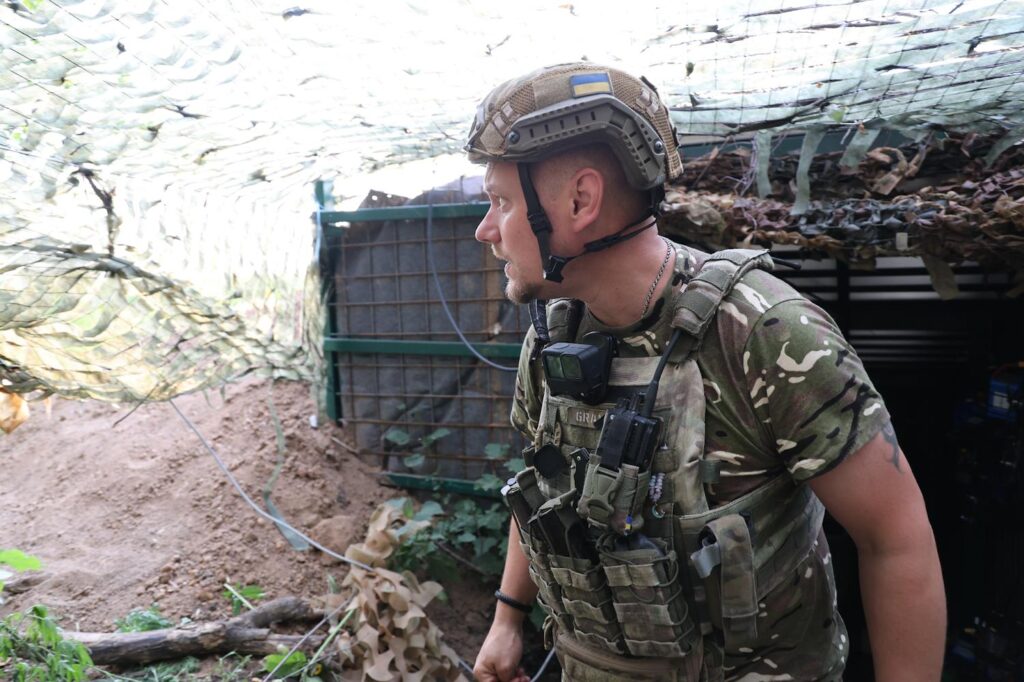
From makeshift bunkers and trenches, drone operators now work around the clock to fend off infantry advances and fast-moving motorcycle charges.
Precision jamming from underground dugouts
Deep inside a narrow dugout, Vladyslav – known by his callsign “Vitamin” from the 141st Separate Mechanized Brigade – monitors the generator powering an electronic warfare system known as “Damba,” designed to disrupt incoming enemy drones.
“This device is used against [First-Person View] FPV drones,” he explains. “When a Russian drone is flying, the guys in the RPU intercept its frequencies and take over control. They switch on Damba and jam it.”
Vladyslav, who transferred to this position in March after serving with the 87th Battalion, now monitors and maintains the Damba system.
“My task is to make sure it’s running. If there’s a failure, they message me in the chat. I’ll go reset it or check if a branch hit the antenna.”
The system, he adds, isn’t overly complicated to manage, but it’s essential.
“The work isn’t hard, but it’s necessary. At minimum, it takes two people. You can’t be here alone.”
Above ground, in camouflaged bunkers nearby, a small crew sits behind computer monitors, mapping the skies.
“They adjust the altitude, intercept the video feed, and calculate the direction. One handles the video, another tracks location, and a third jams the signal,” says Vladyslav.
Typically, the system targets FPV drones flying at altitudes of around 150 meters. “They set it to 160, and that’s it. It hits them.”
More from the frontlines
Inside the secret workshops where Ukraine’s hipster engineers build killer drones
Frequency coordination and tactical risks
But even as they jam Russian drones, they must tread carefully to avoid interfering with their own. “Our drone guys ask us not to touch certain frequencies. They’re flying too. We leave those untouched.” When properly coordinated, electronic warfare systems like Damba won’t disrupt Ukraine’s own drone flights.
“You can’t jam everything at once – it only works on certain frequency bands,” explains Lyuba Shipovich, CEO of Dignitas Ukraine.
Still, there’s a risk. “The Russians might see which frequencies we’re not touching and guess where the system is placed,” he admits. “But Damba can hit from 200 meters to 2 or 3 kilometers away. It’s designed so they can’t pinpoint where it is.”
The team is operating from a fresh position with newly deployed equipment. “These are two new Dambas. We’ve never been at this spot before,” he says. “This is our fifth day here.”
Building Ukraine’s 1,500-kilometer electronic warfare wall
Serhii from the Unmanned Systems Battalion of Ukraine’s 110th Separate Mechanized Brigade heads outside the bunker to prepare an FPV for a bombing mission in Donetsk Oblast. Photo: David Kirichenko
They are just one node in a far larger web of electronic warfare tools that Ukraine is racing to deploy across the front. One Kyiv-based firm, Kvertus, is working to create a 1,500-kilometer “drone wall” made up of thousands of detectors and jammers.
Known as Atlas, the system would offer a unified battlefield picture and the ability to jam incoming FPV drones at scale.
The company’s Mirage jammers were designed after operational experience with foreign systems showed limitations. Each unit can disrupt signals from 0 to 6,000 MHz and can run for up to 20 hours. Importantly, they operate autonomously and don’t require soldiers to manually activate the jamming.
“Too many people have died like that,” says Serhii Skoryk, a former officer who now helps lead Kvertus. “Even the smallest drones can fly at 80 miles per hour, so every minute counts.”
The constant cat-and-mouse frequency game
But building a wall of jammers is only half the battle. “It’s a constant cat-and-mouse game,” says Shipovich. Frequencies on the battlefield are not static. “They can change within a single day. If the enemy sees that a frequency range like 5.2 GHz isn’t jammed, they’ll start using it.”
Even within a single frequency band, there are thousands of combinations to account for and power matters. “If your radio signal is stronger than the jammer’s, it can still overcome interference,” she adds.
“Both sides are trying to build an EW wall,” Shipovich says, “but it’s not a literal wall, it’s a contested network of jammers that must constantly evolve to survive.”
Ukrainian units are also combining jamming with direct attacks.
“We’ve had missions where fiber-optic drones were used to strike targets after deploying EW beacons,” said Bohdan, also known as “Bandera,” a drone pilot from the Unmanned Systems Battalion of Ukraine’s 110th Separate Mechanized Brigade.
From camouflage specialist to electronic warfare operator
Bohdan, a drone pilot from Unmanned Systems Battalion of Ukraine’s 110th Separate Mechanized Brigade prepares for an FPV bombing mission in Donetsk Oblast. Photo: Ryan Van Ert
For Vladyslav, the enemy threat remains constant on the front. “Same strikes, same shelling,” he says with a shrug. “It’s not scary anymore. I’ve gotten used to it.”
His first deployment in early 2024 was much different. Back then, he was part of an engineering battalion working in Zaporizhzhia Oblast. “I was a camouflage specialist. It was the scariest time,” he recalls. “There were no bunkers, nowhere to hide. We just ran.”
One time, he says, he got caught in barbed wire and couldn’t free himself. “I had to cut myself loose with medical scissors. Sliced up my pants.”
Now the nature of war has changed.
“This isn’t a traditional war. It’s a war of drones,” he says. “A war of technology.”
Drones are everywhere, and soldiers like Vladyslav can’t sleep without the background noise of explosions. “I can’t fall asleep if it’s quiet,” he admits. “When I went back home for a few days, I couldn’t sleep the first night.”
What scares him most isn’t what he sees. It’s what he doesn’t.
“The worst sound is the one I don’t know where it’s coming from. If I’m in a bunker and can’t tell where the danger is, that’s when it’s scary.”
Tanks are terrifying in their own right, he adds, but in a different way. “You don’t hear the shot. You only hear the impact. You don’t know when it’s coming.”
He laughs about it now, but only half-seriously. “I’m not scared when our tank is working. That’s fun. But then it leaves. And the Russians don’t know it’s gone. So they fire back.”
As the interview wraps up, the system beeps. “There, it activated,” he says, pointing to the Damba. “They’ve set the altitude. That means a drone is either in the air or about to be.”
Then, calmly, he adds, “It’s being jammed already.”



No comments:
Post a Comment