
Stefan Korshak reports in the Kyiv Post:
We are seeing a very clear pattern: Russians infiltrate, Ukrainians counter with assault infantry and drones, the Ukrainians inflict a bunch of casualties, and eventually the Russians lose most but not all of the ground. We’ve seen this in Pokrovsk, Dobropillya, Kupyansk and now Hulyaipole. In the last six months we’ve seen a pretty important change: When the Russians infiltrate into a place, it is by no means a sure thing they will hold a place. More Russians surrendered in 2025 than in 2022-23 combined. Their physical standards have slipped, and the majority have criminal records.Yes, I’ve seen all the top-level appointments and re-appointments. For space will cover that later, but in general it looks to me like Zelensky is shuffling people for better efficiency and also to keep potential political rivals from getting too high a profile in their present job(s).
Hulyaipole lost by Ukraine – sort of
In late December the Telegram channels and then the Ukrainian mainstream media reported an Armed Forces of Ukraine (AFU) command post in Hulyaipole was abandoned without a fight, allowing infiltrating Russian infantry to reach the center of the city against pretty much zero resistance. Next couple of days all manner of video and stills appeared of soldiers waving Russian flags from well inside the city. Which, we should note, had been a bulwark of defenses in the southern sector since the first days of the war.
The Russians duly put on the internet video of a “battalion” command post with mobile phones, documents, computers, military equipment and so forth abandoned inside. It doesn’t look fake and it’s pretty clear the Ukrainians that were in there left in a very big hurry.
Reports are mixed as to the who/why part of that development, but most evidence points to elements of a territorial defense battalion, possibly of the 106th Brigade. There has followed an impressive wave of accusations and counter-accusations along the lines of “bad morale” vs. “bad support from higher-up” vs. “Russian spetsnaz did its thing” vs. “the weather sucked and that shut down the Ukrainian drones” vs. “it wasn’t a huge mass of Russians it was a few guys with some flags.” The Russian rah-rah media reported a giant breakthrough and the AFU complained people were panicking and that in general the situation was under control.
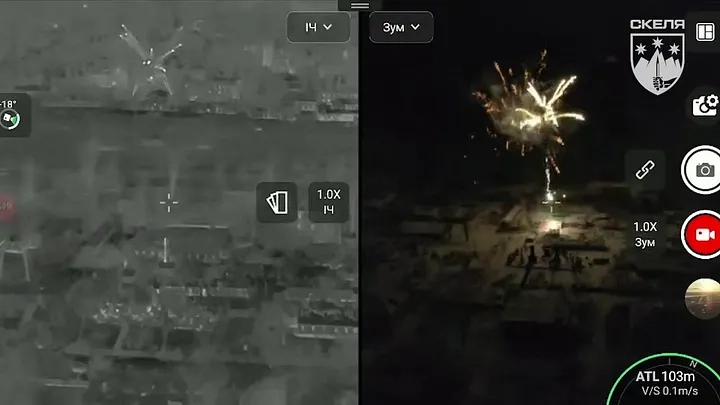
Over the next week at least two of Gen. Oleksandr Syrsky’s fire brigade units – the 425th Assault Regiment and 1st Assault Regiment – deployed elements to the city, and according to them it’s now a standard mop-up situation. I’ve also seen reports that 225th Assault infantry are there or heading there as well. The Ukrainian Unmanned Systems Forces (USF) deployed strike teams to the area and video is duly appearing of Ukrainian drones hunting down Russian infantrymen in courtyards and cellar entrances. Troops set off some New Year’s fireworks in a gray zone of the Pokrovsk sector, Jan. 1 2026 (Screenshot from video published by 425 Assault Regiment “Skelya”)
AdvertisementDmytro Filatov, Commander of the 1st Separate Assault Regiment, in some internet comments blamed the 106th TDF for running without a good reason and said that it seems to him and his mates that the unit was badly commanded, that frontline troops weren’t supported, and evidence points to the mess all starting when three Russian scouts heard a generator running in the dark, tracked the noise to the HQ, opened fire on it, and then the couple of dozen Ukrainians inside just upped and ran. It wasn’t a concerted Russian assault, the Russians had no local support, and none of it would have happened had the Ukrainians just fired back.
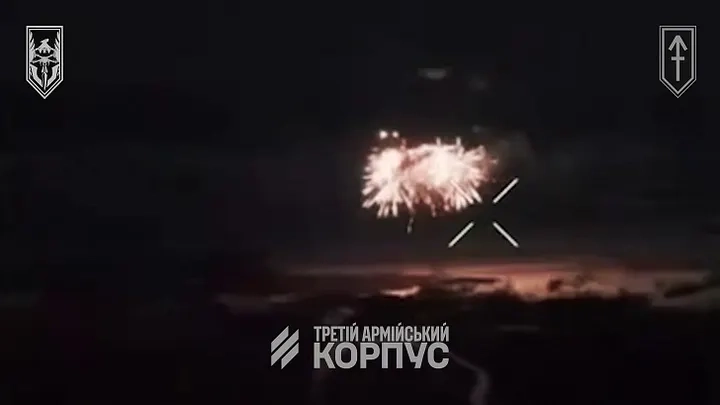
(Screenshot from drone video published by 1st Battalion, 3rd Assault Brigade, 3rd Army Corps, Jan. 1 2026) The current situation is that “small groups” of Russians are scattered all over the town and now the Ukrainians have to hunt them down and kill them, which will take time, he said. The latest reports I’ve seen, along with drone video, show signs of fighting in districts across the city, east and west, both sides of the Haichur River. On Jan. 1 and 2, video appeared of dozens, yes dozens of Russian infantrymen caught out in the open by drones, supposedly on roads in the vicinity, and being just murdered. There’s reports saying the same thing, but strictly speaking, heavy Russian casualties in this battle aren’t confirmed. Several days later a new report from 225th Assault Infantry comes in: the Russians around Hulyaipole are pinned down, they can’t move, there are heavy Ukrainian drone forces in the area, for the Russian infantry it’s “drone Hell.” The Black Swan drone unit is in the area and scoring kills, they say.
AdvertisementWhat is confirmed is that we are seeing a very clear pattern: Russians infiltrate, Ukrainians counter with assault infantry and drones, the Ukrainians inflict a bunch of casualties, and eventually the Russians lose most but not all of the ground. We’ve seen this in Pokrovsk, Dobropillya, Kupyansk and now Hulyaipole. People trying to decide how the war is going need to bear in mind that in the last six months we’ve seen a pretty important change: When the Russians infiltrate into a place, it is by no means a sure thing they will hold a place. Sometimes they do (see below). But not always.
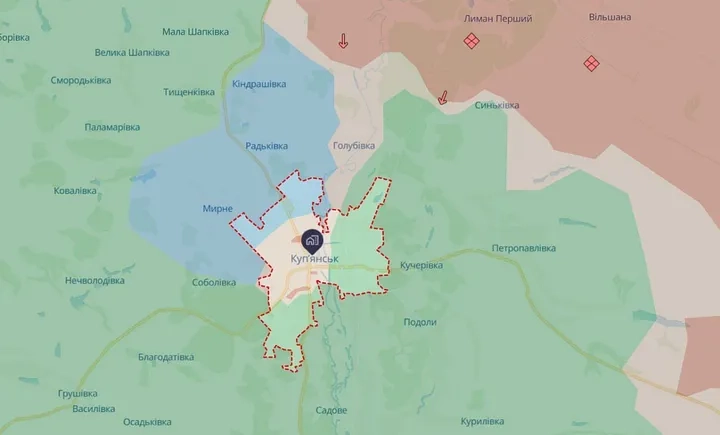
Map of Kupyansk sector published by Deep State on Jan. 4 Advertisement
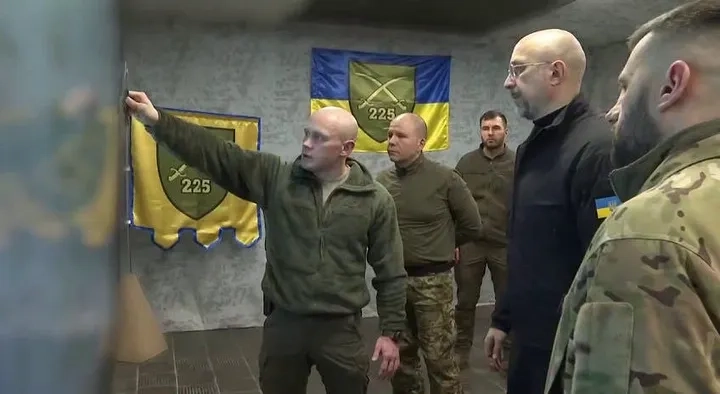
(Screenshot from video published by 225 Assault Regiment of operations planning) Pokrovsk – the line about how this battle is over is wearing pretty thin
I guess we are up to about three months from the time this city was supposedly captured by the Russians, and it’s been nearly a month since a bunch of Ukrainian marines were supposedly cut off and wiped out in a satellite town to this city, a place called Myrnohrad. Yet the fighting goes on. This, I think, is the point.
Latest reports, this from the 210th Assault Infantry Regiment, is that districts held in and around Pokrovsk have been relatively stable the last week or so, that is, Ukrainians hold the north, the Russians the south, and the center of the city is a gray area that is really too dangerous for either side to send troops into. Whereas Myrnohrad, to the east, is the scene of pretty active fighting with the Ukrainians attempting to clear buildings and expand the area they hold. There are also reports that Ukrainian HUR/special ops infantry is operating here, which is usually a sign higher command is serious about clearing Russian troops out of a built-up area.
AdvertisementNormally, when units are surrounded and wiped out, there is an unmistakable wave of warnings, reports, complaints, calls for help and finally accusations and finger-pointing as it happens; the battles of Avdiivka and Vuhledar are good examples. In the Myrnohrad fight, so far, I haven’t seen it.
The two reasonable explanations are either the marines are still dug in and fighting (basically, the Ukrainian General Staff stance) or that the marines got out cleanly and now the AFU is just fighting a delaying/attrition action in Myrnohrad (Ukrainian milblogger general opinion). I don’t know which one it is, but I do know if there are still firefights, grenade drops and FPV strikes in Myrnohrad, then somehow it’s not decided who controls the place. Some reports say the Russians come into the gray area at night, get hunted during the day, and then more try to push in at night.
Among other units in the area, Ukrainian side, I read are 68th Jaeger and 4th National Guard Rubizh. Both their news feeds tell of continuing Russian pressure and more vehicles and less foot infantry attacks than in the past. According to those sources, the Russians aren’t gaining ground and Russian casualties are high. Clearer weather making it easier for drones to target is confirmed by both sides.
(Photo Ukrainian Armed Forces General Staff) Siversk Lost and Commanders Sacked – Maybe for Cause, Maybe as Scapegoats
Last review recorded the Ukrainian loss of the city Siversk, roughly at the south end of the Serebryansky Forest high ground along the left bank of the Siversky Donets River in the extreme north of the Donetsk region. Big picture, the main cause was shortages of Ukrainian ground troops and drone forces to back them up.
But on the “drill down” level, shortly before New Year the news came out that the commanders of the 54th and 10th brigades are or have already been sacked. The Ukrainian news platform breaking the report, Ukrainska Pravda, said that the basic grounds was that in both cases those units had lied about the state of their defenses to higher command, and even concealed it from inspectors.
The 11th Army Corps, under whose operational subordination the 54th and 10th were located, according to the UP, trusted the brigades and was sure that their reports were true. Inspectors from the corps regularly visited the units, but did not detect problems or inconsistencies in the reports with the real situation on the battlefield, because, as the UP’s interlocutors assure, this was constantly hidden.
I’ve also seen a report that the “East” group of troops sacked the 11th corps commander Gen. Serhiy Sirchenko, and that now there’s a “new” tactical grouping in the area called tactical group “Soledar,” which is headed by a former 54th brigade commander, and now recently transferred former commander of the Desna training center, Brig. Gen. Denys Maistrenko. He’s a veteran officer and as far as I know doesn’t have a poor reputation, but, I think we all can agree this kind of command and unit shuffling is not a sign of a healthy army firing on all cylinders. Ukrainska Pravda writes the entire mess boils down to the 54th Brigade running out of men and drones to keep the Russians at bay.
The 54th is a mech brigade that has struggled for much of the war with morale and manpower problems, and probably also, because it’s not from a big city or a wealthy region so it has to depend largely on supply and support from the AFU, and if this war has taught us anything about sustaining a unit in the field the AFU all by itself can do it, but not really well. Excepting the special forces and the air force, pretty much, there is NO I mean NO unit in the AFU, that is well-supplied and properly efficient, that doesn’t have its own sources of support. The 54th Brigade is from Bakhmut, which has been completely flattened and under Russian control now for most of a year. I am aware of command quality problems, as in, soldiers complaining directly to me their commander sucks.
The 10th Mountain is home-based in far western Ivano-Frankivsk, in the mountains, but the region is poor. They have tough guy training and when they have time they do group climbs of mountains in their district. They are trained as light infantry and a couple of years ago they were accounted a fairly solid unit. But times change and without proper sustainment you can wear any unit down, this is my guess what happened with the 10th. The names of the colonels sacked are 54th BDE Colonel Oleksiy Konoval, and 10th BDE Colonel Volodymyr Potyeshkin. I don’t know the details inside either unit, but, this is very likely an excellent example of the AFU firing experienced commanders it really needs, it’s not like the war just ended.
(Photo by Ukraine Marine Infantry Corps, Jan. 4) The Russian Christmas missile raids – Dec. 26-27, and again on Jan 4-5
People had been waiting nervously for massed Russian strikes designed to ruin New Year’s but it didn’t happen. If you ask me why, I would say my best guess is that the Russians are running short of big missiles for sure, and maybe even drones.
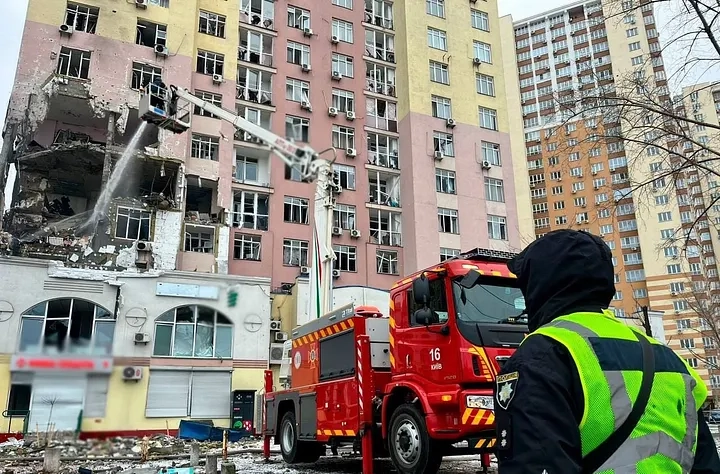
For the Dec. 26-27 strike Kyiv was the main target. It seems like the Russians were targeting the power grid but as always they also hit homes. No one killed, 28 injured, 8 hospitalized in the capital. One missile hit a Renault car dealership and killed one and injured three. It was a big attack but not quite of record scale. In terms of weapons mix it was nothing really new and Ukrainian air defenses turned in a pretty standard performance: 6 of 10 Iskander/Kinzhal ballistic missiles shot down or decoyed, 4 of 7 Iskander-K and/or Kalibr cruise missiles shot down, 19 of 21 Kh-101 air-launched cruise missiles shot down, 0 of 2 Kh-22 hypersonic missiles, and 474 of 519 Shahed drones. Reports are the F-16s had an excellent night and accounted for most of the cruise missiles. The only really unique aspect of the attack was that it came in driblets and off-an on; the capital was under air raid warnings for nine hours.
(Photo published by Kyiv Emergency Situation Ministry, Dec. 27) The previous big strike was Dec. 22-23, so, as the New Year rolled around, everyone was waiting for the Russians to lower the boom with a really big attack that would put millions of Ukrainians in air raid shelters and darkness during the biggest family holiday of the year.
But what happened was 50-100 Shahed drones nightly for the next week. No missiles, no major attacks, no major blackouts, and every day 24/7 the Ukrainian power grid guys were repairing damage.
Since Russian mercy to Ukrainian families isn’t really a rational explanation, the question naturally came, where did the crippling holiday missile attacks go?
Next development came on Jan. 4-5, the Russians launched about 150 drones and a measly 10 ballistic missiles and – tellingly, I think – about half of them reportedly were S-300 missiles, which as most of us have long ago learned are anti-aircraft missiles used in a surface-to-surface role, inaccurate and shorter range, but they can still kill people. According to reports all five of the S-300s got launched at Kharkiv, and given the poor accuracy the only reasonable explanation is that it was “standard” terror bombardment.
But why S-300s? Why use an anti-aircraft missile to blast a city? We don’t know, but based on past performance, when the Russians use them like that, the only real explanations can be they feel like they are just swimming in S-300 missiles – which they aren’t – or that they have decided that the AFU has become efficient enough at hunting down S-300 radars and/or launchers that using the systems to defend air space is just going to get the systems destroyed, so why not just use the missiles to bombard something, or, final option, the Russians don’t have proper ballistic missiles to shoot at the Ukrainians at the moment and see the need to bombard them with something,
I checked, the last time we can be sure the Russians fired at least a pair of S-300 anti-aircraft missiles, at ground targets, in a single night, was way back in Jan. 2024. This is a pretty good indicator of how much the Russians DON’T prefer to hit ground targets with S-300s: Every time they do, that’s one less missile to deal with the waves of Ukrainian drones and even strike aircraft.
So, why they chose to repeat the tactic two years later I can’t say for sure. But my instinct is, it’s because other missiles aren’t as available as the Kremlin wants, and the default mode for the Kremlin bombardment of Ukraine is that it’s better to make terror strikes than none at all.
[Editor’s note: since the writing of this blog, Russia launched hypersonic missiles at Ukraine. Read about it here.]
Ukraine bombarding Russia
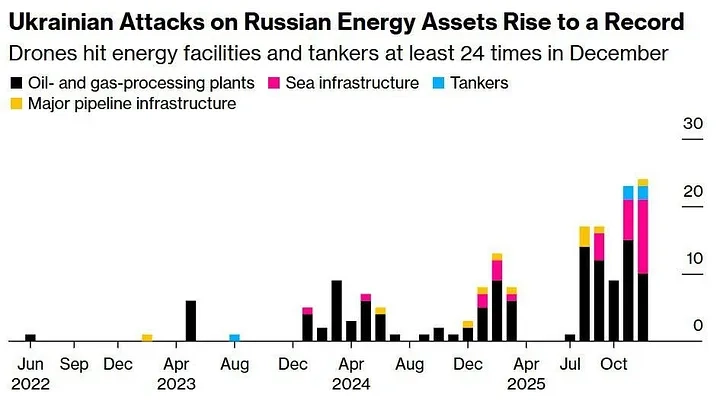
The pace of Ukrainian strikes against deep targets in Russia has been pretty consistent; two or three targets hit nightly, energy infrastructure is the main target, air defenses are hunted to create attack corridors, and there are also isolated strikes against Russian military production, material, or personnel. This isn’t a complete list but it notes most of the attacks of the past from Dec. 26 to Jan. 7 days:
260. Volgograd, power transmission stations, Dec. 26
261. Volgograd, power transmission stations, Dec. 27
262. Moscow, probable harassment flights, Dec. 27-28
263. Syrzan, Yuganskneftegaz oil refinery, explosions and fires Dec. 28
264. Crimea, Chernomorske, radars, sea drone launch site, Dec. 28
265. Black Sea coast, Tuapse, fuel storage site, fires and explosions, Dec. 30
266. Moscow region, Ramenskoye oil refinery, drones, fires, Dec. 30
267. Luhansk region, Rovenky, fuel storage site, fires, Dec. 31
268. Donetsk region, Olenivka, air defense radar and special ops base, Dec. 31
269. Yaroslavl region, Rybinsk fuel storage site, big fires, Dec. 31
270. Kaluga region, Liudonovo oil storage site, explosions, Jan. 1
271. Ilsky oil refinery, Krasnodar, multiple fires, Jan. 1
272. Tartarstan, Almetyevsk, oil terminal, Jan. 2
273. Samara, oil refinery, fires, Jan. 2
274. Crimea?, Nizhnegorod, village Zhelyabovka, probable S-300/400 hit, Jan. 4
275. Yalta, gas pipeline explodes, three villages without gas, Jan. 4
276. Moscow, harassment drones over airports, Jan. 4
277. Lipetsk region, Elets missile parts factory, smoke and fires, Jan. 5
278. Donetsk region, S-300 radar, Jan. 5
279. Penza, Biomintez factory, Jan. 6
280. Tver, air defenses engaged, Jan. 6
281. Lipetsk region, Usman, Gerkon Plus oil storage base set on fire, Jan. 6
282. Sterlitamak?, Bashkorstan, six hits, explosions, Jan. 6
283. Kostroma region, Nenya village, 100th central ammo dump, Jan. 6
284. Yaroslavl, explosions near refinery, Jab, 6
285. Leningrad region, compressor station near Berzhki village, probably shoot down, Jan. 6
286. Belgorod region, Staroskolsky oil base, Jan. 7
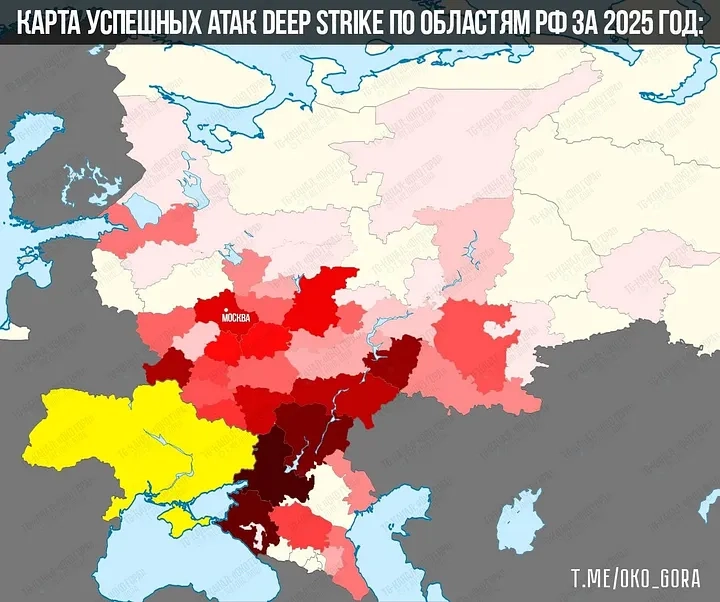
Ilsky refinery burns again (Photo is Jan. 6 screen grab from Russian social media video) I draw your attention to the repeats; the Ukrainians are very visibly following up where they see the need and opportunity. Russia is getting hit daily, damage is accumulating, and there is no evidence that I can see that would make one suspect the Russians can turn the trend around.
Useful map showing intensity of Ukrainian strikes against Russia in 2025 (Graphic published Jan. 5 by source in image)
Graphic is by Bloomberg published on Dec. 31 Fun ammo fact that once again mentions 155mm artillery shells und Rheinmetall
Here’s something entertaining: Right now it’s pretty probable that Ukraine is manufacturing more 155mm artillery shells – the bread and butter, most basic and most-needed single munition in any conventional army’s artillery capacity – than the United States of America.
Although the drone forces tell us every chance they can about 36 percent of all Russian casualties are caused by drones, it is only fair to remember that means there is 64 percent that is not, and by every report and source that I know of, that is still overwhelmingly mortars and artillery. The way artillery is used has changed from the old days, but in terms of actually hurting people, a steel tube hurling something a long distance and then exploding and sending shards of metal all over the place, and being in the vicinity, is still the most common way of dying or getting hurt in this war.
According to Ukrainian news on Dec. 27, in 2025, the company “Ukrainian Armor” delivered 300,000 rounds of 155mm caliber NATO-standard artillery shells to the AFU, up to 100,000 rounds of 105mm caliber NATO-standard shells, and up to 240,000 mortar rounds of various calibers of NATO-standard ammunition. Obviously, none of this production even existed as a plan in 2022.
Comparison with shell production in the US is, well, illuminating. (Get it?) If you believe the Pentagon, currently, the US produces about 40,000 155mm shells a month, a rate only achieved this summer. I couldn’t find estimates of 105mm production but past ratios and the low use of the 105mm in the US inventory definitely points towards no more than 10,000/month and probably 2,000-3,000 a month. The US Army had intended to get to 75,000 155mm shells/month by April 2025 and 100,000/month end of 2025. Those deadlines have been missed due to bad management and components shortages.
In other words, in four years of war Ukraine went from being a country that produces no NATO-standard artillery shells, to being a country that, rough numbers, now produces artillery shells at least on par with the US, and probably outstripping it.
Big conventional wars are excellent for historical irony. I’m sure most of you reading this recall that when the US cut Ukraine off from arms deliveries in February, it was because the White House reasoned that if they didn’t donate arms and weaponry to Ukraine, then Ukraine would be forced to sue for peace on Russia’s terms, because Ukraine wouldn’t have anything to fight Russia with. I think we can safely say that strategy has blown up (get it?) in the White House’s face.
It is also worth noting that a single German company, Rheinmetall, over the same four years jacked up its 155mm shell production to about 700,000/year. Contrast this with White House rhetoric about effete, incompetent, peacenik Europeans.
There was nothing mystical or magic about how the Germans did this, Rheinmetall forced the Bundestag to make big commitments to long-term orders, and then threw substantial capital into upscaling production in Spain in a big way, expanding production in Hungary somewhat less, and building a brand-new shell factory in Lower Saxony where German labor is the cheapest. More Rheinmetall artillery shell component factories are going up in Romania and Bulgaria.
So could someone please explain to me, again, how it is that the US is a “critical” ally to NATO? Or to Taiwan/South Korea/Japan/Philippines?
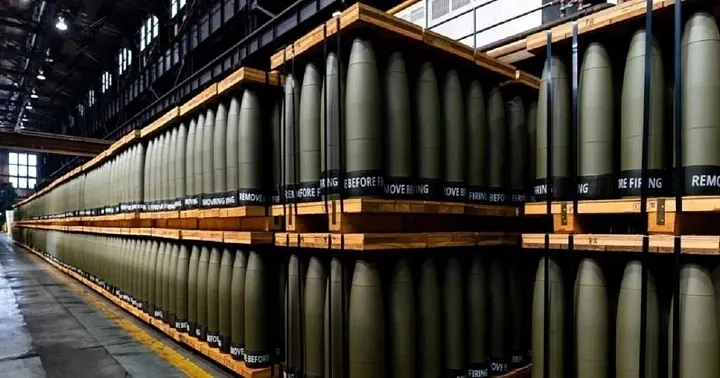
155mm shells in quantity (Photograph published by Tsaplienko_Ukraine Fights on Jan. 7 2026) If you look at artillery ammo production, the US is shockingly inefficient, and the US military seems very poorly adapted to sustained war against a peer adversary. Sure, it’s capable enough against a fifth-rate power like Venezuela. But in, you know, a real conventional war where the stakes are serious and the fighting lasts more than a couple of weeks US war-fighting capacity looks like a joke. In conventional war artillery is really important and artillery without shells isn’t worth much.
To anticipate the counternarrative from the likes of the Pentagon and the frat boy Pete Hegseth, sure, it’s possible to argue the US, if it was ever in a real war, would tool up manufacturing because it’s the US/’Merica and hooah/beer bong!
But in the real world, it’s been four years since Russia invaded Ukraine a second time, the performance of German private industry vs. US government contracting is a matter of the public record. Chinese shell production is roughly comparable to Europe+Ukraine but could surge to about three times that.
(Screenshot from Nov. 25 South Park episode satirizing Pete Hegseth) So we can’t really say the US is really preparing itself to be a credible adversary to China, if it comes to artillery. And if there is one thing the Russo-Ukraine War has taught us, it’ s that you don’t deter military aggression with words, you need materiel and an army fully capable of fighting.
Maybe, if it came to it, the Americans could figure out a way to buy surplus shells from the Ukrainians...
Some statistics on Russian POWs
This report surfaced around the New Year. According to Ukrainian army stats, around 10,000 Russian soldiers have already been in Ukrainian captivity, with more surrendering in 2025 than in 2022-23 combined.
Here’s some bullets from the report auto-translated with some additions:
- Most of the prisoners are contract soldiers. Mobilized (i.e. reservists forced to serve mostly, technically this can’t be conscripts) soldiers make up about 19%.
- Conscripts make up almost 5%, although officially conscripts do not fight in foreign wars. The assumption is these casualties are in Kursk region where the Ukrainians hold Russian territory, or possibly, conscripts that got sent to Ukraine “illegally” by Russian law.
- The typical Russian prisoner is a private without a higher education, usually with a criminal record. I can vouch for this personally.
- 40% of the prisoners that were former inmates, had been serving sentences for theft, drugs, robbery, and murder.
- Foreigners make up about 7% of the prisoners, and their number is growing. Here’s a link to a report on Kupyansk which gives details on a Cuban national that got taken prisoner:
- HIV/AIDS, hepatitis B and C, tuberculosis, diabetes, mental illnesses, particularly schizophrenia – people with these conditions are very often captured.
- Over time physical standards are slipping; wounds that once would have qualified a man for a full pension on disability now rate hospitalization and return to the front. Deafness, poorly-functioning organs, limited physical ability no longer disqualify. There was a report over Jan. 5-6 in which troops from a unit in Kaliningrad were being sent to the front, some being sent were on crutches.


No comments:
Post a Comment