
Stefan Korshak reports in the Kyiv Post:
Long-range drone attacks on a key Kremlin military logistical route in southern Ukraine have demolished dozens of trucks and military vehicles, forced Russian authorities to issue travel advisories, and infuriated locals, angry that Russian air defenses seem unable to protect them. The remains of at least 30 burnt heavy trucks were visible on the side of the road along the Donetsk-Mariupol H20 highway, and 15 were seen on the Rostov-Crimea M-14 highway. The density of heavy vehicles is so high that tourist traffic will be at risk from drone attack no matter how much distance a civilian driver tries to keep from the vehicles Ukrainian drone pilots are hitting.Long-range drone attacks concentrating on a key Kremlin military logistical route in southern Ukraine have demolished dozens of trucks and military vehicles, forced Russian authorities to issue travel advisories, and infuriated locals, angry that Russian air defenses seem unable to protect them, weekend news and social media reports from occupied areas of the Zaporizhzhia and Kherson regions showed.
According to data compiled by the Ukrainian drone operations news platform Shraik News, as of Saturday evening, the remains of at least 30 burnt heavy trucks were visible on the side of the road along the Donetsk-Mariupol H20 highway, and 15 were seen by motorists on the Rostov-Crimea M-14 highway. Kyiv Post geolocation confirmed 28 of the attack sites, and others were highly probable, researchers found.
Reportedly, dozens more destroyed vehicles have been towed along those routes since early April. The most common targets in that content were fuel carriers, closed-trailer semis, and military trucks. All but a few were destroyed by fire.
“The road to Crimea, the Donetsk-Novoazovsk and Donetsk-Mariupol highways, the Donetsk outskirts, etc. – all roads in the DPR are now under daily massive attacks by Hornet [unmanned aerial vehicles] UAVs, also known as Martian-2. These attacks are escalating daily… They are especially fond of fuel tankers,” complained the Donetsk-based military blogger 1.infantry on Sunday. “Hornets patrol freely over the DPR’s [the unrecognized Donetsk People’s Republic] highways… Simply leaving your home has become unsafe.”
Most Russian military and summer vacation traffic moving between the Russian Federation mainland and the Russian-occupied Ukrainian territory of Crimea moves through the cities of Mariupol and Melitopol along the M-14 highway. The four-lane highway is on average about 70-80 kilometers (44-50 miles) distant from probable Ukrainian drone launch sites.
Ukraine’s General Staff in March announced it would soon field new types of drones and more drone units that would extend the reach of persistent drone observation and attacks in Russian-controlled regions from a belt reaching to approximately 20-25 kilometers (12-16 miles) from front lines, to as much as 100 kilometers (62 miles) from the front lines.
Robert Brovdi, commander of Ukraine’s Unmanned Systems Forces (USF), in an April 27 announcement, said the deep attack campaign was running well and that “there will be enough birds” for the expanded attacks.
Developed by the US company Swift Beat, Hornet (called “Martian-2” in Russian sources) is a fixed-wing, one-way attack drone costing about $5,000-10,000 dollars, with a rated range of 150 kilometers (93 miles). Ukraine’s USF first flew experimental Hornets in late 2025, with mass production kicking off and combat debut performances in spring 2026.
Ukrainian UAV pilots in mid-May interviews told Kyiv Post the aircraft is easy to fly, resistant to jamming, and reliably able to stop and set afire any vehicle operated by Russia smaller than a tank.
Local Russian officials have downplayed the effects of the Hornet-tipped deep attack campaign in occupied southern Ukraine while Russia’s national media and the Kremlin have effectively ignored it.
On May 22, Volodymyr Saldo, a Ukrainian official transferring loyalties to Russia in 2022 and currently heading the occupation government in part of Ukraine’s Kherson region, was the first to issue a formal travel advisory to Russian motorists considering driving into territories overflown by Ukrainian drones, banning civilian vehicle use of some highway stretches and civilian automobile travel at night.
A chorus of non-official Russian sources has criticized Saldo’s order, with some pointing out that an order banning civilian vehicles from certain highways would make it easier for Ukrainian drone pilots to find real targets. Some veteran motorists have dismissed such warnings, accusing occupation authorities of pretending Ukrainian drones aren’t that dangerous and issuing useless travel advisories.
Oleg Volodin, administrator of the Russian-language motorist-focused Telegram Channel Land Route to Crimea, in a Sunday comment, said that Ukrainian drones are systematically targeting military vehicles and large cargo- and fuel-hauling trucks, and not attacking automobiles and buses.
Volodin warned that the density of heavy vehicles is so high that tourist traffic will be at risk from drone attack no matter how much distance a civilian driver tries to keep from the vehicles Ukrainian drone pilots are hitting.
“Stay away from fuel trucks, trucks, and military personnel? At the end of the day, they travel by the land route in huge numbers. More than half of all transport is made up of them. This is nonsense, self-deception, and burying one’s head in the sand.” Volodin warned prospective travelers.
“This instruction was drawn up by an idiot. Someone who’s never even been on this highway. Let him drive by and try to stay away from the trucks and fuel tankers, and not tailgate anyone. When it’s just an endless train of trucks and military vehicles,” he said.
Fresh Russian dash cam video published by Petro Andriushchenko, a former mayor of the Russia-occupied Zaporizhzhia region, Melitopol, showed, Russian S-400 (NATO: SA-21 “Growler”) anti-aircraft systems, trucks pulling low-boy trailers loaded with T-72 tanks, and Russian army Kamaz flatbeds carrying construction materials on regional highways, side-by-side with heavy trucks and private automobiles.
The popular pro-Kremlin military blogger Voenniy Osvedomitel (600,000+ followers) in a Sunday write-up on security and military logistics along highways connecting the Russian mainland with the Crimea peninsula via highways crossing Ukraine’s Russian-occupied Donetsk and Zaporizhzhia regions said that traffic moving along those routes was no longer safe from attacks by Ukrainian drones.
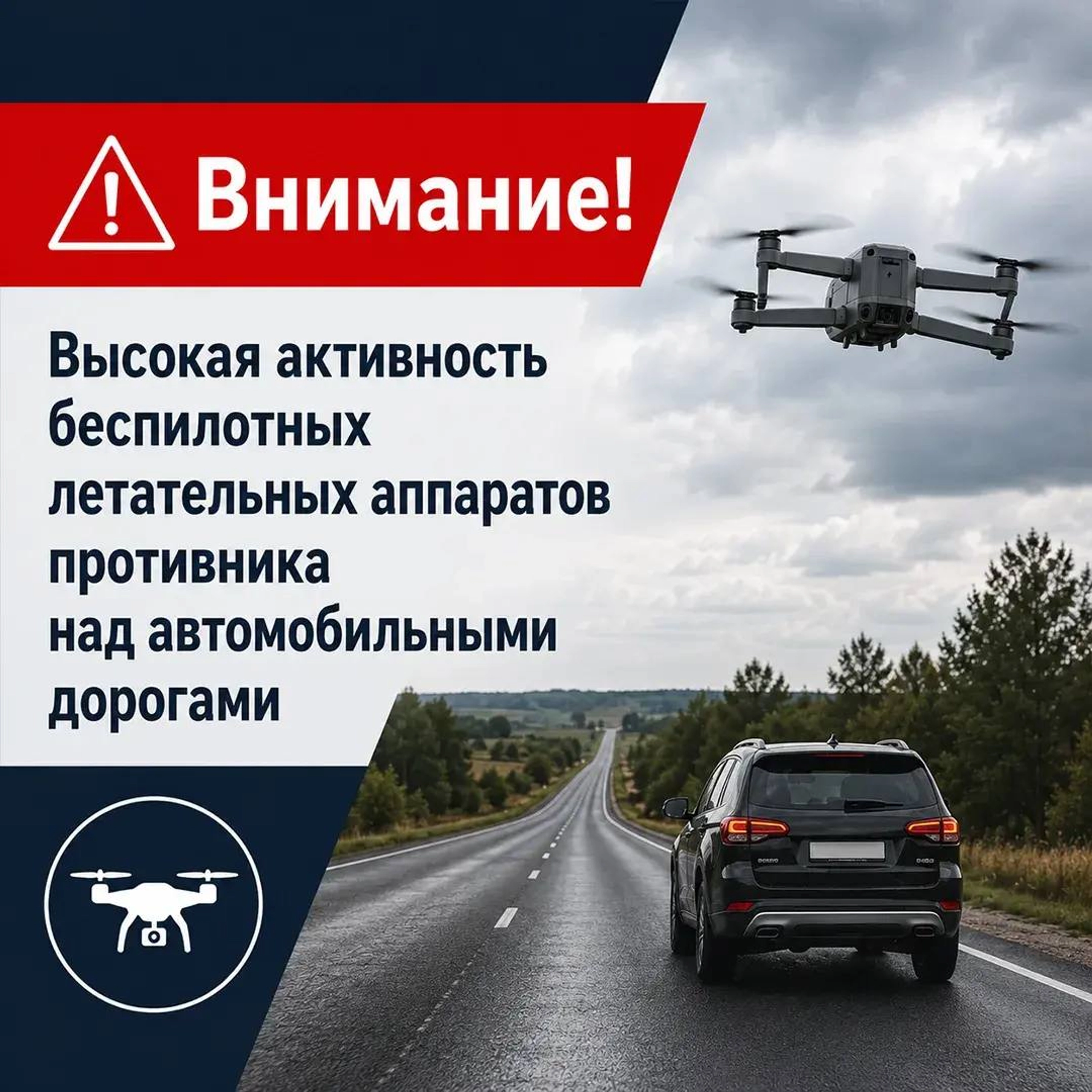
This warning to motorists published on Sunday by the Moscow-loyal occupation authority in the southern Ukrainian city Bedyansk informs travelers heading to or from Crimea for a summer vacation, or to other destinations, that their trip might be interrupted by a Ukrainian drone attack. (Image published by the Berdyansk city government) “Thousands of vehicles move along this route… The cost of movement along the land corridor will increase due to destroyed vehicles, drivers will have to be paid much more, and some may refuse to use such a dangerous route altogether,” the article said in part.
“It will be necessary to install anti-drone nets on the roads, organize safe night stops for vehicles, and deploy fire teams along the routes to cover the movement. An additional problem may be the need to transfer extra air defense systems, which are already needed everywhere and are in short supply.”
Ukrainian military analyst Evhen Istrebin, in a Saturday YouTube analysis of Russian military supply in occupied southern Ukraine aid offered the same conclusions, saying:
“Ukraine has taken control of the key highway in the south… This highway is a lifeline for supplies to occupied territories, Donetsk, Kherson and occupied Crimea… You can see how seriously the Ukrainian drones are cutting the occupier’s [Russian Federation] logistics.”
Voenniy Osvedomitel issued a downbeat summary of future prospects for road users in southern Ukrainian territories occupied by Russia:
“Ukraine already has the resources to complicate logistics to Crimea and the new territories. In the future, this pressure will only increase and will require more and more financial and military resources to contain the problems, which will inevitably affect other areas as well.”
No comments:
Post a Comment