A Blog by Jonathan Low


Nov 16, 2013

Infinitely Comprehensible: The Cultural Imperative of the To-Do List

People who makes lists are prone to paranoia. They're afraid they'll forget something or someone, of course, which is what leads them to write stuff down in the first place.

But they also worry about themselves and what others think of them: is this list-making evidence of early-onset obsessive-compulsive disorder or, as their siblings, spouses, room-mates and cubicle buddies are probably wont to tell them, are they simply annoying?

List makers should take heart, however. As the following article explains, making lists is a cultural imperative borne of the genetic urge to be infinitely comprehensible and therefore able to attract more adherents, dominate other cultures and prevail eternally. Amazing how significant such a routine and mind-numbing act can be. And you thought it was just you! JL

Belle Cooper reports in Fast Company:

We pack all the madness and ambiguity of life into a structured form of writing. In short making lists is a great way to increase our overall happiness and feel less overwhelmed.

Facebook Isn't, Probably Never Was - and Doesn't Have to Be: Why Not Being Cool Is More Profitable Than the Alternative

Yeah, we can't ever seem to get entirely away from the social imperatives imposed on us in high school.

But that may not mean as much as it once did.

Given the choice between the cool-kids and everyone else, Facebook will reflexively choose everyone else. 

Because Facebook, when all is said and done, is a business. And while some businesses, like Apple, get style points, those benefits only accrue when they are translated into sales and profits. That is ultimately how private enterprises are judged. So those metrics are the only sustainable - and meaningful - measures that matter.

Facebook is taking a lot of grief for having become the nexus of baby-pictures, recipes and reunions. Whatever happened to all the people with tatts and 'tudes (that's tattoos and attitude for the uninitiated)? Who cares is probably the more relevant question.

Facebook is making more money than ever - and especially from mobile apps - with or without the approval of those in the know. This is not to say that it will endure forever or become an essential part of our culture. So good luck to Snapchat and Instagram and all the other anti-Facebooks, as the following article describes them. Remember flip phones, steel mills, bell bottoms? Facebook may become iconic or it may be transitory, but it continues to attract people, lots of them, which attracts advertisers, who generate income. And for a business, that's pretty good. JL

Will Oremus comments in Slate:

I’ve never been impressed by the assertion, routinely advanced by tech pundits, that Facebook “isn’t cool anymore.” Of course Facebook isn’t cool anymore. It hasn’t been cool for years, if it ever was.

Myers-Briggs Myopia: The Economic Dominance of ENTJs and Other Easy Assumptions

Myers-Briggs is beloved. It's very human appeal centers on our continued search for convenient shortcuts to understanding. And given how complex most people really are, it is helpful to have an easy explanation for otherwise inexplicable behavior.

For those who may not have worked in an organization of more than one person in the last 30 years, the Myers-Briggs typology identifies four characteristics which, when blended together, purport to identify a defining personality type.

Institutions, too, have embraced the Myers-Briggs approach as a quick-and-dirty means of both assessing and characterizing those human capital assets who might otherwise prove somewhat harder to manage and, when necessary, to counsel out of the organization.

As a harmless exercise in establishing a facile sort of self-awareness, there is nothing wrong with this. But if taken to extremes, as this socio-economic polity is wont to do - there are a number of justifiable concerns, as the following article explains.

The biggest problem is that Myers-Briggs is that it is a preference, not a genetically implanted marker. People's ratings change, sometimes every time they take the test. You can be introverted at some times and extroverted at others. You can also be either sensing or feeling - and a whole lot of other types besides.

The point is not to denigrate the MB scale: it's fun, it has some usefulness, it raises interesting questions that people are well inclined to explore and it connects rather than alienates by providing a shared reference. But it is neither definitive nor sustaining. As much as we seek easy answers to difficult questions, there is often more insight to be gleaned from the complex than from the superficial. JL

Priceconomics reports:

If Myers-Briggs's utility is oversold, its longevity has much to do with its appeal to Human Resources departments as a reassuringly scientific crutch - and its moneymaking potential.

Nov 15, 2013

You Are My Sunshine: Why Google and KKR Are Teaming Up to Buy Big California Solar Projects

First, don't be evil. But if you have to be evil, make a ton of money doing so.

Ok, that was totally snarky and possibly unfair. But when a company as profitable as Google partners with a company as, um, well, not exactly public-spirited as KKR (previously known as Kohlberg, Kravis and Roberts, the leveraged buy-out kings, now sanitized as private equity specialists) two questions have to be asked: who's making money and who's paying?

The answers, in order: they are, and you are.

One might argue that Google and KKR are motivated by a combination of perfectly reasonable business and humanitarian concerns: the impact of providing energy to run all those servers, the associated cost to consumers over time, deep-seated worries about environmental degradation. And there are probably some people in each of those organizations that feel that way. But it appears that the real impetus is the sunset provision built into US solar power tax advantages that will end in a few years. So Google and KKR are doing a tax-advantaged deal to buy solar arrays which will produce power for whose output customers in the form of public utilities have already signed long-term contracts. Pretty sweet.

There is nothing illegal and, one might argue, immoral or unethical in any of this. The US, as a nation, has willingly handed this sort of financial advantage over with the understanding, however incomplete, that the society will benefit in the long term. And hey, maybe it will. If more private money is flowing into solar, that is probably a good thing. But in the meantime, this is another case of public risk supporting private benefits. It is not clear how much more of this US consumers can afford. But until the public and their representatives see fit to change the equation, Google and KKR will be, as the Rivieras sang in 1964, 'out there a-havin' fun in that warm California sun.' JL

Todd Woody reports in Quartz:

The power plants qualify for a 30% federal tax break for renewable energy projects and three utilities have already signed long-term contracts to buy the electricity.

Low Tech Logic: The US Government's Human Price Scanners

People? There are processes that still use people to collect data in this day and age?

Aren't the machines all supposed to be talking to each other, figuring everything out and then sending the final results to Sri Lanka, Bangladesh or some other ultra-cheap entrepot for final tabulating? 

Well, actually, people come in pretty handy, as the following article explains. As anyone who has worked in retail will tell you, pricing is tricky: it changes frequently, is subject to instantaneous promotions, incentives and discounts which are hard to track - and the companies that manage all this, from the product manufacturers to the merchants behind the cash registers - regard the information as proprietary and competitively sensitive. They will, under duress or the influence of an adult beverage or two, admit that providing disinformation has been known to happen - or so they've been told...

Good decisions require reliable data, whether the issue is the Federal Reserve Bank's assessment of inflation or your local supermarket's special on bananas. And in a global economy getting accurate data fast may best be done by people armed with mobile technology - and the common sense to ask a few more questions when the first answer they get sounds a bit too simple. Amazing what the human brain is capable of producing. JL

Emily Wax-Thibodeaux reports in the Washington Post:

Automating the system may be tougher than it sounds.

Yes, Being a Young Adult Is a Financial Nightmare

And the hits just keep on coming, as they say on the radio, though these feel more like body blows than musical interludes.

Young people's mobility (eg, ability to pick up and move to a new location for education, work or whatever) is at a 50 year low. 41 percent of young adults will spend at least a year earning less than 150 percent of the poverty line, which is a polite way of saying they'll be subsisting on Ramen noodles and Taco Belle Ten-Packs. And on the data goes.

So, to bring it home in a real way, back in 1963, when people wore skinny ties and snap-brim fedoras without the irony - or the tattoos - it was easier to get around the US of A by bus and train to start a new life than it is today.

To what do we attribute this diminished sense of opportunity? Let us count the ways: a generation's worth of stagnant household incomes, the absence of private sector hiring (or public and not-for-profit, either), impossible-to-achieve job specifications, dramatic inflationary increases in the cost of food, shelter, transportation and any other Maslowian necessities and, if we are being truthful, globalization, technology and the end of the US' thirty year WWII winner's advantage.

The problem is, as eons of boring graduation speakers have been fond of intoning, these people are the future. Being young has always been a bit of sleigh ride; getting started at anything, especially adult life, is rarely smooth, but from an historical standpoint, we appear to be making things particularly tough for exactly the people on whom society will depend in the future. And that's not smart. JL

Jordan Weissman reports in The Atlantic:

Poverty is an astonishingly common experience here in the world's richest country. Almost 40 percent of American adults experience it for at least a year by age 60.
But you know who poverty is especially common among? Young adults.

Nov 14, 2013

Imperfect Knowledge: The Economic Case for Admitting You Just Dont Know

What if it's not that economic and financial models have been incorrectly conceived? What if the question is more fundamental, as in, what if modeling just doesn't work?

What if we are engaged in a self-satisfying but ultimately delusional attempt to predict a future that can not accurately be ascertained?

This question would be fascinating, if controversial, if it were simply being tossed out there by attention-seeking politicians or angry small business owners or any of the other frustrated managers and executives who are trying to make sense of the world around them.

But what if they are the least of it? What if that question is being posed by economists themselves?

Such would appear to be the case, as the following article explains. The sudden self-doubt, if it can be called that, is the result of critical reassessments to which the profession/science is being subjected from both inside and out. Questions are being raised about the ethics of accepting payment for academic, business and political judgments rendered by experts who are trading on their professional status and affiliations. Challenges are also being raised to the very notion that the future is somehow comprehensible, let alone predictable, at least as a data-driven construct.

There may not be answers to these contentions, let alone good ones. But in an age in which the search for knowledge has been enhanced by access to new and prolific sources of data, it is probably healthy to examine our sources and processes before we start plugging new information into outdated systems. JL

Brendan Greeley comments in Business Week:

Ideas are important. The powerful adopt the ideas that most please them, but the ideas have to come from somewhere.

Microsoft Axes Controversial Employee Ranking System as Yahoo Embraces It

Employee evaluations are always fraught: bias, favoritism and questions of evaluator competence, to say nothing of fairness, are never far from the surface.

Institutions have embraced 'systems' for their ostensible objectivity and, on advice of counsel, because they can help deflect the inevitable legal challenges that ensue.

The most famous - or infamous - system depending on your point of view (and probably your personal experience) was embraced by former GE CEO Jack Welch. He was popularly known as 'Neutron Jack' due to his reputation for acquiring assets but firing most of the employees associated with them. He believed deeply in the so-called 'stack ranking' system which demanded that employees be ranked relative to each other - and that the bottom ten percent be culled, or to put it in a more genteel fashion, 'counseled out.'

The problem with this system is that it pits people against each other out of sheer survival instinct, rather than inculcating the sort of collaborative culture now deemed essential to a multi-cultural economy.

Microsoft imported this system at some point. Despite his recent reputation for generosity and global good fellowship, Bill Gates was a ruthless business executive and his successor, Steve Ballmer, attempted to follow suit. Stack ranking has always been controversial there, as the following article explains, for all of the usually pertinent reasons: it can impede rather than encourage innovation, cooperation and growth.

Now that Ballmer has announced his retirement, the stack ranking system is being replaced with an approach more in tune with the changing economic reality in tech. Since Microsoft has come catching up to do, it can no longer afford to be quite so cavalier with the people it attracts. They have too many other good options and MSFT is no longer even the largest employer in Seattle, its home time. That position belongs to the younger (and not noticeably more indulgent) Amazon.

Interestingly, just as Microsoft abandons this approach, reports have surfaced that Marissa Mayer may be installing it at Yahoo. Smells like consultants have sold this package to her, but based on the MSFT experience, it could be a signal that she's moving on. Whatever the reasoning, this is not the system managers want when their enterprise already suffers from reputational deficiencies. As one observer noted, management should not be wasting time ranking employees from 1 to 5, but should be figuring out how to make every employee a 5. JL

Julianne Pepitone reports in CNN/Money:

Microsoft is getting rid of its much-maligned "stack ranking" method of reviewing employees. The system forced managers to rate a certain percentage of workers as underperforming, no matter what.

Chinese Tech Firms Are Buying Knowledge and Access Through Silicon Valley Investments

Meet the latest Chinese export: venture capital investments in US tech firms.

The US, Europe and much of Asia may feel threatened by China, but from the Chinese perspective, they're the ones who are getting squeezed.

China is fearful that its innovative and entrepreneurial instincts have been quashed or at least hindered by cultural and societal pressures. They understand that they are losing smart people to Silicon Valley, where the civil liberties and money-making opportunities are freer. To catch up, Chinese companies have attempted to acquire foreign ones, but US and European regulatory authorities routinely deny permission for Chinese firms to acquire entire companies. Even the takeover of Smithfield, a company that primarily produces pork products, has been contested.

In searching for alternatives that will not generate accusations of spying and rejections on national security grounds, Chinese firms have discovered that taking minority financial positions in tech firms seems to work just fine. As the following article explains, the Chinese are hiring US and European nationals to lead this effort and have benefited from the participation of Chinese financial specialists, many of whom - to no one's surprise - learned their trade at Goldman Sachs.

The benefits are mutual: China gains access to US business and begins to learn how globally scaled innovations are fostered, developed and brought to market. The US and European companies that agree to these investments get abundant lower-cost capital and potential access to the Chinese network of regulatory officials, institutions and consumers. The belief is that eventually such cross-border alliances could break down the wall of suspicion and fear that currently influences such relations. And that, in itself, has considerable value. JL

Evelyn Rusli and Paul Mozur report in the Wall Street Journal:

Chinese firms, which have little consumer business outside their home market, are unloading small fortunes on startups as they strive to understand and eventually gain a foothold in the elusive U.S. market.

Nov 13, 2013

Why Selfish People Cooperate

Humans' obsession with economic well-being notwithstanding, it is difficult to find people who are solely motivated by the desire to maximize their utility. Especially since so many are having trouble in this economy figuring out what that utility might be or even whether they have any utility at all.

There is an evolutionary basis for cooperation and collaboration that overawes even the most narcissistic, egomaniacal personalities. As the following article explains, there are a number of genetically coded reasons for the urge to work with others, despite the sometimes shrill - and false - claims that Frank Sinatra's 'I did it my way' is some sort of exalted natural state.

The reality is that collaboration is our default condition. Most effective organizations came to that realization a generation ago. The onset of the technologically driven global economy ended any fantasies about the ability of the Lonesome Stranger to take on the world and prevail. The benefits are not just operational but reputational. We know not only that we need each other but that we need to be known as good partners. Enterprises coerce collaborative behavior where it is not naturally present and even institutions frequently at each others' throats recognize that they are in a permanent state of fraternization with their 'frenemies' who may be more significant to each other as customers, suppliers and allies than they are as competitors.

Although the old saw that work would be great if it werent for customers and employees remains popular, the fact is that we know we are nodes in a network and that we need to optimize those natural variables if we are to survive, let alone prevail. JL

Alex Mayyasi comments in Priceconomics:

People do not survive and thrive by themselves. The related approach of group selection explains altruism, generosity, and cooperation by whether it helps the group as a whole, especially in circumstances of populations fighting or competing over scarce resources. 

Hyperlocal: Big Data's Little Brother

Hyperdata collectors started with a simple premise: apply the wonders of technology to making daily, local living more convenient and fun.

Now, however, enterprising users are reversing field: using hyperlocal data to draw broader implications about global trends.

This makes great sense. Enough local information had to be collected before global wisdom could be gleaned from what were, initially, anecdotal reports. But now that those onesies and twosies can be aggregated into a more complete and complex whole, it is possible to see the proverbial forest.

Consumer oriented businesses are an obvious beneficiary of this trend. But more importantly, governments and supra-governmental organizations may now be able to plan and react with greater accuracy and speed, addressing global economic issues with more chance of success.

There will continue to be ideological opposition to the role of government from those primarily concerned with their own advantages relative to others. The availability of good data, however, especially from private sector sources, will make it increasingly difficult for anyone to challenge the accuracy of the data or the findings. JL

Quentin Hardy reports in the New York Times:

Start-Ups Are Mining Hyperlocal Information for Global Insights.

Tacit Knowledge: New UPS Software Inputs Driver Wisdom

If we only knew what our organization knows.

 That plaintive cry made the rounds of management conferences for years as executives charged with making the enterprise more efficient or tightening its supply chain or enhancing its value or building its brand equity struggled with how to achieve their amorphous but urgent goals. 

The convergence of better data, mobile computing and improved organizational design may now be delivering solutions to address those needs.

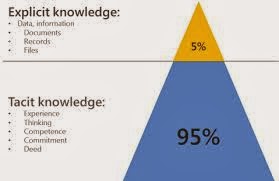
The focus has much to do with the design and application of knowledge. But it also has to do with changing the psychology of management processes. The 'Daddy-Knows-Best' approach to IT, in which a small priesthood of annointed experts does the thinking for the rest of the institution is being supplanted by a more inclusive approach that recognizes the wisdom accumulated through years of experience. Sometimes called tacit knowledge, this method actively incorporates the thinking of those who do the actual work.

It is, in its way, revolutionary, because it acknowledges the intelligence of - in the UPS case - the driver while also implicitly communicating that the organization trusts the employee with sharing the enterprise's best interests. And this in a company where all of the drivers are members of the Teamsters Union.

The larger implication is that for globally competitive institutions, no information can be ignored or wasted, whatever the source. JL

Mohana Ravindranath reports in the Washington Post:

UPS unveils software that would infuse a computer-generated route with driver feedback, among other sources.

Nov 12, 2013

Don't Bother Me With the Facts: Austerity's Unnatural Endurance

For an ostensibly data-driven economy, we remain curiously devoted to ideological arguments which are long on emotion and short on substance.

The austerity policies favored by many western governments appear to be particularly exempt from the sort of withering skepticism to which public policies are now commonly subjected. As the following article explains, by any objective measure, austerity has failed to deliver its promised ration of discipline-led growth.

In fact, the global capital markets swoon every time the US Federal Reserve dares to suggest that it is reconsidering its sotto voce stimulus packages, known commonly as QE2 (QE means quantitative easing; it is not a reference to the United Kingdom's longest-reigning monarch or the ship named for her).

Despite the Fed's desperate gallops through the thesaurus to find an inoffensive term like 'tempering,' designed to ease the fears of those in the financial services who have become dependent on public stimulae, any mention of the word sends the markets into retreat. So much for the bracing benefits of self-reliance.

The reality appears to be that austerity reflects the desire for private benefit at public risk which the 2008 Financial Crisis so dramatically reflected. The question now appears to be whether, after five years of economic stagnation and unequal distribution of whatever gains were to be had, the public in Europe and the US may now be sufficiently frustrated that they are open to more significant change than their betters may have given them credit for considering. JL

Richard Wolff comments in The Guardian:

The accumulated evidence shows that austerity programs usually make economic downturns worse. Why, then, do they remain the preferred policy for most capitalist governments?

The Brilliant Strategy Behind Amazon's Sunday Package Delivery Partnership With the US Postal Service

The thing about strategy these days is that it is not enough just to advance your own ambitions: it only really works if you harm a competitor at the same time.

Amazon's announcement that it will partner with the perennially struggling US Postal Service works on so many levels it's a challenge to remember all of them.

Firstly, it should be noted that Amazon is going about this in a thoughtful way, using it as a controlled experiment. The initial markets in which it is available are New York and Los Angeles, where the concentration of customers and USPS assets makes it most cost effective. It is only being made available, at least initially to Amazon Prime customers, those who pay a premium for enhanced services. This rewards their loyalty, encourages further reinvestment in Amazon initiatives and adds to the company's coffers.

Second, this reinforces Amazon's already sizable advantage in delivering ecommerce convenience. Sunday delivery is not generally available, even before the holidays. And this is where the stick-it-to-your-competitor aspect becomes apparent: this option gives Amazon an advantage over most bricks-and-mortar retailers as well as Google, eBay, Apple, Facebook and anyone else hoping to grab a piece of the retail market, whether online or in traditional mode.

Finally, and this may be where its true genius becomes clear, Amazon gets to score some brand-burnishing points.  It has, in the past few years, lost its mojo as an internet darling. In fact, it is developing something of a reputation as more of a taker than a giver. Politicians, regulators and the general public have belatedly recognized that the company's success has come at the expense of retail businesses, especially small ones, as well as the jobs and tax revenues they provide. Support for Amazon's tax free status is rapidly disappearing as a result.

With this one gesture, Amazon invests in a publicly supported but chronically underfunded postal service, injecting much needed revenue while benefitting from two hundred years of government investment in infrastructure and people - and one which the tax payers still subsidize. In doing so, Amazon demonstrates a certain amount of public spiritedness, but at little actual cost to itself. Many politicians ideologically opposed to a government postal service have demonstrated they still feared the public's wrath if they voted to mandate USPS cut back Saturday deliveries but they are only too happy to support private sector partnering. 

Given the company's greater ambitions to grow beyond its current 'niche', this may help reduce the opposition to future initiatives requiring public acquiescence and regulatory approval. All in all, this may be one of the most masterful strategic, regulatory and public relations convergence successes in recent memory. JL

Jay Greene reports in the Seattle Times:

The online retail giant plans to deliver packages seven days a week, now in New York and Los Angeles, and in much of the country next year.

Does Bigger Data Lead to Better Decisions?

The tension between science and emotion continues to influence managerial decision-making and the outcomes that flow from it.

As a society and an economy, we purport to respect information, its distillation into knowledge and even its occasional reduction into wisdom. But more data, selectively chosen, has also served to heighten our emotions as the information served hardens previously held opinions or is rejected when deemed contrary to more deeply held beliefs.

We know that bigger is not necessarily better. But what enterprises attempting to manage the new-ish era of data abundance are beginning to learn is that the evolutionary advantage provided by diversity applies to information as well as biology.

Important industries like finance and pharmaceuticals have had access to big data for years, long before it became a thing. That has not stopped the financial services industry from creating crises or even from preventing failure. Really smart people backed by substantial resources and exceptional experience continue ignore information that contradicts their world view or interferes with attaining their goals.

The heterogeneity of sources and of those who interpret them may be as important as their accuracy. Just as the notion of five year plans, once considered essential, are now regarded as laughable, so the accretion of data for its own sake may soon be scrutinized warily if the processes by which it is vetted and applied do not produce appreciably superior outcomes.

Better decision-making, however an individual or institution may define that, is probably the result of a combination of factors that could be unique to that entity. More data may provide an advantage, but only if the processes by which it is evaluated are subject to constant improvement and the people who oversee such procedures are themselves conscious of their limitations and of the need to challenge their own assumptions.

We are, to some degree, in the panacea business. We want more power, more convenience and more success. But we are delusional if we think that any one tool or path will help us achieve those goals. JL

Theos Evgeniou, Vibha Gada and Joerg Niessing report in Harvard Business Review:

Big Data can lead to Big Mistakes. After all, the financial sector has been flooded with big data for decades.

Nov 11, 2013

Should Tech Designers Go With Their Guts - or the Numbers?

Most rational people are going to consider that choice and then ask themselves another question: why do I have to choose?

Given access to both, using every tool at your disposal seems logical, even imperative. In this economy, who can afford to risk leaving any advantage to chance?

Which brings us back to the question about instinct. In a world of supposedly objective - and objectified - data, doubts are being raised about 'mere' human inclinations. After all, this sort of thinking goes, what good is someone's opinion when we have credible numbers on which to rely. And numbers don't lie. Right?

Well, actually, the numbers don't provide revealed truth, either. Data is only as good as the people who interpret it and the context in which it is being applied.

Instinct, however, is based on training, experience and a certain proclivity to apply that combination of skills and attributes in a creatively powerful manner. It is the distillation of a complex set of inputs from which certain people - there is no nice way to say this -  can make informed judgments that are superior to those of others. Instinct, therefore is the received wisdom that results from the human brain's unique ability to take data, graphics, memory, sensory perceptions and a lot of other less tangible influences and make holistic sense of them. The important choice, as the following article explains, is about what knowledge to use and what not, rather than its source or nature. JL

Braden Kowitz comments in Wired:

When it comes to the future of design and technology, the uncomfortable question we bump into is: do human design instincts even matter anymore?

GDP Isn't Good Enough: Why We Need a Better Measure for the Real Economy

A year ago we had Hurricane Sandy. This week we are staring at images of the destruction wrought by Supertyphoon Haiyan. In each case, a central element of the debate about the lasting effect of the event centers on what the economic impact may be.

The data is in on Sandy: it supposedly raised GDP, meaning it was 'good' for the economy. It would not be surprising to find a year from now that Haiyan was 'good' for the Philippines.

In either case, one suspects, as the following article points out, that the thousands of people displaced or still grappling with the loss of loved ones, homes, jobs and cherished possessions are unlikely to share that optimistic mindset.

The reality is that GDP ignores environmental, social, emotional, entrepreneurial, political, educational, familial and a host of other factors that have a very real impact on the performance of the socio-economic structures involved. Most of these factors are intangible: they are recognizable and significant, but since they are not captured in the sclerotic accounting measures by which economic success or failure is measured, they are not reflected in the final tally.

We use crude and incomplete metrics because they are convenient: they have some history which provides a basis for comparison with the past and they are less likely to stir bitter ideological debates about what should be measured, arguments usually spurred by the moral and financial positions of those doing the jawing.

Until nations begin to capture this data and analyze it properly, pronouncements about impacts, effects and solutions will be as unrealistic as the assessments themselves. JL

Ben Beachy, Michael Shank and Justin Dorn comment in The Atlantic:

If Hurricane Sandy, which struck a year ago, was technically "good" for the country, we need a better way to measure national progress.

Amazon Feels Pressure to Lower Cost of Cloud Big Data Processing

Maybe we should call it the 'never good enough' economy. Records are made to be broken and there is no rest for weary, etc, but the relentlessness of the pressure to recalibrate what is acceptable to customers and the enterprises which supply them never appears to wane.

Even institutions with dominant positions providing hard-to-scale services such as Amazon does with cloud computing are feeling the pressure, as the following article explains.

Why this segment of the technology industry should be different from any other seems a reasonable question. And the answer is, that it shouldnt or perhaps more to the point, couldnt. There are too many smart, skilled and capable people working for would-be competitors looking for an edge in whatever corner of the services segment for anyone to rest on their laurels.

What may be new is the speed with this fall from comfort to threat occurs. The larger point is that no position is unassailable, no status sustainable in a world where the nexus of competition is intelligence, skill and ambition. JL

Jordan Novet reports in VentureBeat:

Maybe existing big data services on Amazon’s cloud — such as Elastic MapReduce for Hadoop, DynamoDB for hosted NoSQL database needs, and the Redshift data-warehouse service — aren’t enough.

Nov 10, 2013

Economic Impact: Most Etsy Sellers Make Less Than $100 Annually

It's easy to get down on Etsy, the cutesy, small business craft sellers network and the whole get-rich-by-doing-what-you-love fantasy that the internet promotes.

Yes, the fact that your friends have been telling you for years that your potholders are special is really nice, but no, that does not mean access to ecommerce makes it a business.

The more interesting question, however, is why such enterprises - Airbnb being another one - suddenly feel this compulsion to justify their economic impact and, by extension, their moral imperative.

Etsy and airbnb have both recently released reports detailing the positive influence they have on the economy. Which is pretty strange. Local coffee shops, printers and book stores have not appeared to feel this compulsion, nor any other local business for that matter. But clearly there's something happenin' here, as the Byrds once sang. And, to continue that thought, what it is ain't exactly clear.

There is evidently some guilt in the tech/ecommerce borderlands about all the money being made by the ebusiness creators and investors that is not finding its ways into the hands of the true believers. And there may be some concern that they are actually destroying employee-hiring, tax-paying businesses as they peddle this notion of hassle-free, low-cost commerce.

Whoever is feeling this odd compulsion, however, might be better served discussing the factors which are actually driving their success: the need for marginal survival strategies felt by a populace watching its household wealth dissipate even as it is losing the ability to find full time jobs, let alone those that pay a living wage. JL

Amanda Hess reports in Slate:

Etsy sellers may be collectively swapping $895 million annually, but most of them aren’t seeing much of that cash, and they’re not passing it on to any employees, either.

Food Stamp Cuts Add to Walmart's Woes

Unintended consequences r us.

Walmart's explicitly-stated strategy is predicated on the assumption that every day low prices will drive business to its stores.

But it's the unspoken presumptions that are of greater interest - and that have come back to haunt the world's largest retailer.

That strategy is based on the company's understanding that the US government will provide basic benefits in the form of programs popularly known as welfare (Aid to Families with Dependent Children or Temporary Assistance for Needy Families) and food stamps (SNAP - or supplemental nutrition assistance program). Since Walmart itself works assiduously keep prices low, in part by assuring that the majority of its employees can not possibly survive on their wages, these government programs provide the means by which its US employees and others similarly suffering from economic disenfranchisement can purchase its goods.

The company has heightened support for its outsourcing, low wage and benefit approach to a kind of moralistic imperative, insisting that it embodies the virtues of self-reliance and freedom, all the while depending upon the rest of the tax-paying public to make up the difference so that shoppers have something they can spend in its stores.

One can therefore imagine the discomfort the company must feel upon learning that ideologically-driven politicians, some financially supported by Walmart political action committees and its founder's children, took that libertarian belief just a tad farther than the company might have wished by dramatically slashing the benefits on which the chain's revenues are based. Talk about chickens coming home to roost... JL

Daniel Gross reports in the Daily Beast:

The retail giant is as dependent on SNAP benefits as the poorest Americans. Why new cuts will be a double whammy for Bentonville—and anyone with a mutual fund.

Culture Club? Mattel Introduces 'Violin Soloist Barbie' in China to Attract Ambitious Parents

Yes, American parents, having your children begin studying Mandarin rather than Spanish in grade school is probably a good way to get them focused on global realities. But as the following article suggests, you have a long way to go.

Mattel, the company that owns the Barbie brand and manufactures those ubiquitous dolls has run into some marketing issues in China. These are not the usual challenges posed by copyright infringement or charges of unfair working conditions - though both have arisen.

No, the real challenge for Mattel is that Chinese parents, by reputation notoriously focused on their children getting ahead, have turned their backs on the global girl's favorite plaything because it distracts their children from their studies and the other more serious strategic life pursuits their parents believe to be the only legitimate uses of their precious time.

Mattel is not alone in this: other western toy manufacturers are also learning that the Chinese market is different in many ways, not the least of which is that all those Tiger Moms and Dads appear to dismiss play and make-believe as detrimental to competing in the global marketplace for talent.

Given the size and potential of the Chinese market, manufacturers are pushing back by traditional means such as lowering prices and changing wardrobes to reflect regional tastes. But also in non-traditional ways such as lobbying the Chinese government on the benefits of play in stimulating creativity and innovation. Despite the eye-rolling this may incur from cynical westerners, the tactic may be having some impact given internal Chinese debates about the national proclivity to copy rather than create. Since 60 percent of American college students are now women, Mattel may find that it has far more global success with this model than it might have believed possible. JL

Laurie Burkitt reports in the Wall Street Journal:

Mattel Inc.  is making a new effort to sell Chinese on the impossibly proportioned all-American doll, with an appeal to Tiger moms who would rather have their children reading books than plugging body parts into Mr. Potato Head.