There are good reasons why the web is getting demonstrably slower. Part of it is you and it part of it is them.
You, the consumer, want more features, more information, more entertainment. You want it to replace your tv and your radio and your dvd player. Remember, all of you who may have actually owned such devices, how physically big and powerful they were and how much energy they sucked?
So concentrating all of that on a laptop or tablet or phone also concentrates the demands on the smaller devices' functionality.
And they - being the providers of all this excitement - want more information, which requires time to identify and then transfer.
This does not even take into account the internet service providers like AT&T who may be intentionally slowing speeds in order to get you to pay more for speed - assuming that unlike AT&T - they don't get caught.
So demand is meeting supply, but there is a bit of a traffic jam in the process. JL
Hope King reports in CNN/Money:
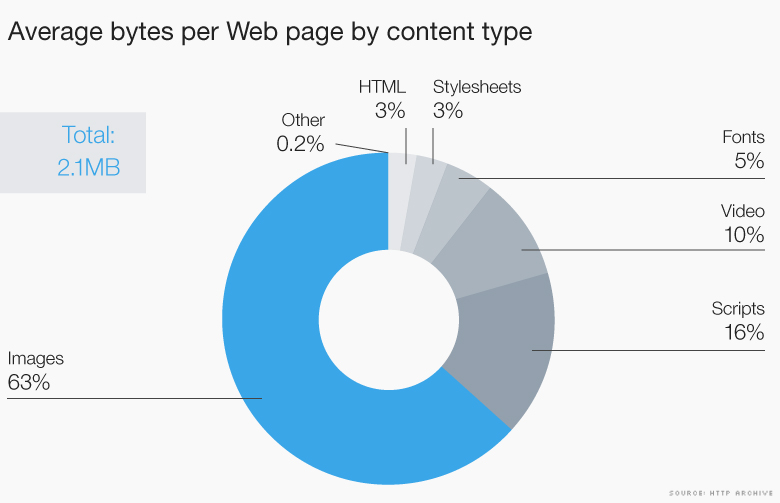
The average site is now 2.1 MB in size -- two times larger than the average site from three years ago. Sites also have ramped up their usage of tracking and analysis tools to learn more about their visitors. The spinning wheel of death never seems to stop turning these days.
It's not you. Web pages really are loading slower.
The average site is now 2.1 MB in size -- two times larger than the average site from three years ago, according to data tracked by HTTP Archive.
There are a few reasons for this added weight.
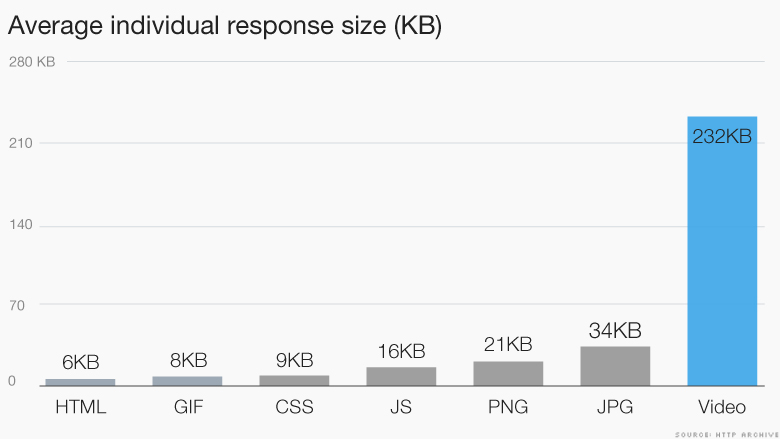
Websites are adding more attention-attracting videos, images, interactivity plug-ins (comments and feeds) and other code and script-heavy features that clog up broadband pipes and wireless spectrum.
Sites also have ramped up their usage of tracking and analysis tools to learn more about their visitors. Inserting third-party data trackers not only increases a website's weight, but also the number of separate data fetching tasks, which leads to slower load times as well.
Photos and videos continue to be the bulkiest part of websites, making up almost three-fourths their size. That proportion has stayed relatively constant over the past three years, even as the total size of websites has grown. But as more smartphones, tablets, watches and other gizmos are built to go online, developers have to create even more versions of websites and Web components to fit evermore formats. Some websites, for example, have more than 50 different image sizes which can be called upon to load depending on device. This additional complexity requires more code to run, and adds to a website's bulk.
"The shift from desktop to mobile requests and consumption have had the biggest impact on website performance," said Craig Adams, VP of Web experience products at Akamai, a content delivery network that services 15% to 30% of all online traffic daily. On top of all this, websites are using stronger encryption to make themselves more secure. Shielding themselves behind secured protocols requires more code and data crunching power, too.
The component that has grown the most in size, surprisingly, is custom fonts. Developers are creating unique fonts to differentiate themselves from everyone else online. Three years ago, font transfer size was less than 1% of a webpage's weight, and now the proportion is up to 5%.
There are a variety of other factors that lead to a slower browsing experience, such as network congestion, processing power, browser type, and the number of other programs and tabs you have open.
But all things being equal, the Web is slowing down. It's only slowing by a matter of seconds, but literally every millisecond counts. The slower a Web page loads the more likely it is we'll leave for a competitor's site.
As a Partner and Co-Founder of Predictiv and PredictivAsia, Jon specializes in management performance and organizational effectiveness for both domestic and international clients. He is an editor and author whose works include Invisible Advantage: How Intangilbles are Driving Business Performance. Learn more...





0 comments:
Post a Comment