Russia's Pokrovsk Incursion Backfiring As Ukraine Traps, Destroys Kremlin Units
What a difference a few days - and some lethal Ukrainian reinforcements - can make. From borderline panic earlier in the week due to scattered Russian infiltrations on the Pokrovsk front, to reports that not only have the Ukrainian forces contained the threat but that it may be backfiring on the Kremlin command as its small groups and units are being surrounded and either wiped out or surrendering.
With a combination of battle-hardened infantry and armored brigades riding tanks that have been further protected to survive drone attacks, the Ukrainians have eliminated the headline that Putin was hoping to use in Alaska. The risk to Russia all along was that they had neither the troops nor the weapons to mount a breakthrough following a breach, even one as small as this. The question now is whether Ukraine can use the Russians' thrust against them and counterattack to effect. Even if returning to the status quo is the result, it is yet another lost opportunity for the Russians. JL
David Axe reports in Trench Art:
The Pokrovsk incursion is backfiring on the Russians—an outcome some Russian observers feared as the salient was initially developing. The penetration near Dobropillya “is being contained” and even “cut off as a result of Ukrainian counteractions,” with the Azov Brigade claiming over 150 Russian dead and dozens of prisoners. The Ukrainians use tanksfearlessly, rollingthe vehicles from their drone-proof dugouts for close fights with infiltrating Russians. The Leopard 1A5 and Leopard 2A4 tanks that are helping to defend the Pokrovsk sector have proved that, with enough add-on armor, they can survive repeated drone strikes—and keep fighting. “Infiltration operations … have serious risks.”
The Ukrainian national guard’s 1st Azov Corps—a new multi-brigade force—claimed it’s clearing out the Russian infantry who marched right past empty Ukrainian trenches northeast of Pokrovsk last week, ultimately penetrating nine miles into Ukrainian territory and threatening a key supply line into Pokrovsk.
It’s possible the incursion is backfiring on the Russians—an outcome some Russian observers feared as the salient was initially developing. “Infiltration operations … have serious risks,” Russian war-blogger Military Informant warned.
The 1st Azov Corps, which oversees several elite brigade each with thousands of troops, led the Ukrainian counterattack a few days after Russian infantry were detected near Dobropillya, 10 miles north of Pokrovsk. There are just two main roads into besieged Pokrovsk, and one of them—the T0515—threads through Dobropillya.
“The coming days will show whether this penetration can be contained,” Tatarigami, the founder of the Ukrainian Frontelligence Insight analysis group, wrote on Tuesday. A day later, Tatarigami relayed rumors that the penetration near Dobropillya “is being contained” and possibly even “cut off as a result of Ukrainian counteractions.”
The 1st Azov Corps confirmed the rumors the same day. Ukrainian reinforcements are rushing to the Pokrovsk area in an urgent effort to defeat a Russian infiltration that threatens one of two main supply roads into the besieged city in Donetsk Oblast.
The reinforcements include one of Ukraine’s new multi-brigade corps—and at least one Leopard 1A5 tank.
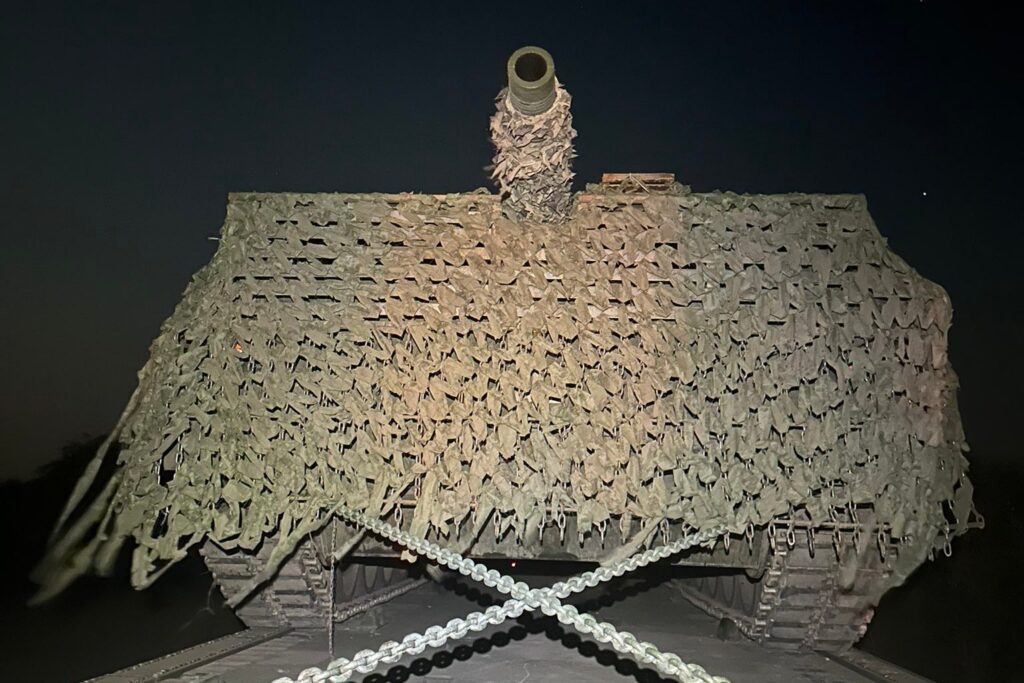
The Ukrainian army’s 508th Separate Repair and Restoration Battalion—which retrieves, repairs and returns armored vehicles—loaded one of the 40-ton, four-person Leopard 1A5 tanks onto a heavy transport truck and hauled the tank into the Pokrovsk sector under the cover of darkness on Wednesday.
“We’ve been a little quiet the last few days,” the battalion stated on social media, “but another Leopard 1A5 with full ammunition … is successfully delivered to one of the hottest places [in the] Pokrovsk direction.”
It’s obvious where the German-made tank wound up: somewhere along the roughly 10-km front stretching from Rodynske in the south to Nove Shakhove in the north. That front, just northeast of Pokrovsk, is the current locus of the fighting after Russian troops slipped past under-manned—or entirely empty—Ukrainian trenches last week and hooked left to threaten Dobropillya, which sits astride the T0515 road threading into Pokrovsk.
Two of the seven Ukrainian brigades that operate the 1980s-vintage—but heavily upgraded and up-armored—Leopard 1A5s are holding the line around Dobropillya: the national guard’s 4th Rubizh Brigade and the army’s 142nd Mechanized Brigade.
Each brigade probably owns a dozen Leopard 1A5s out of 170 that a German-Dutch-Danish consortium has pledged to Ukraine. Around 100 of the tanks have shipped; the Russians have knocked out at least 14 of them. Others have been damaged.
A Leopard 1A5 arrives around Pokrovsk. 508th Separate Repair and Restoration Battalion photo.
Repaired tank
It’s likely the Leopard 1A5 the 508th Separate Repair and Restoration Battalion sneaked into the Pokrovsk area was a damaged tank that the battalion fetched from the front line and fixed up at its workshop before hauling it back to its operator.
After losing around 4,000 tanks in action in the first 42 months of its wider war on Ukraine, Russia has all but ceased deploying heavy armor along the 1,100-km front line. Production of new T-90M tanks, and the restoration of old Cold War T-72s moldering in long-term storage, simply can’t make good all those losses.
Today, the Russians mostly attack on foot or on motorcycles, counting on these hard-to-spot and fast-moving forces to slip through thinly manned Ukrainian trenches and past Ukraine’s ever-present drones. The Ukrainians still use tanks, however, fearlessly rolling the hulking vehicles from their drone-proof dugouts for close fights with infiltrating Russians.
Ukrainian Pres. Volodymyr Zelensky insisted the Russian infiltrators threatening Dobropillya marched north and then turned west “only with weapons in their hands.” They’re lightly armed and poorly supplied, potentially making them easy targets for tanks. Assuming, of course, the tanks can shrug off any Russian drones patrolling the Russian salient northeast of Pokrovsk.
There’s a good reason for the Ukrainian tankers to be optimistic. The Leopard 1A5 and Leopard 2A4 tanks that are helping to defend the Pokrovsk sector have proved that, with enough add-on armor, they can survive repeated drone strikes—and keep fighting.
As a Partner and Co-Founder of Predictiv and PredictivAsia, Jon specializes in management performance and organizational effectiveness for both domestic and international clients. He is an editor and author whose works include Invisible Advantage: How Intangilbles are Driving Business Performance. Learn more...





0 comments:
Post a Comment