OpenAI Begins Testing Ads In ChatGPT As Financial Pressure Becomes "Enormous"
In 2024, OpenAI CEO Sam Altman declared that the company would only consider ads in ChatGPT as a 'last resort.' But as many in tech have learned the hard way over the years, last resorts have a way of becoming firsts faster than expected.
The issue for OpenAI is that its expenditures far outweigh its income and the path to profitability, which may come in 2030, could also be receding. Investors are not as patient as they were even a year ago, so the company has to do something to try to help close that profit gap - and also prove that the technology is a viable business proposition. JL
Benj Edwards reports in ars technica:
OpenAI will begin testing advertisements inside the ChatGPT app for some US users in a bid to expand its customer base and diversify revenue. The move represents a reversal for CEO Sam Altman, who in 2024 described advertising in ChatGPT as a “last resort." The advertising experiment reflects the enormous financial pressures facing the company. OpenAI does not expect to be profitable until 2030 and hascommittedto spend $1.4 trillion on data centersand chips for AI. OpenAI expects to burn through $9 billion this year while generating $13 billion in revenue. Only 5% of ChatGPT’s 800 million weekly userspayfor subscription. OpenAI’s approach appears to be a compromise between needing ad revenue and not wanting sponsored content to appear directly within ChatGPT’s written responses.
On Friday, OpenAI announced it will begin testing advertisements inside the ChatGPT app for some US users in a bid to expand its customer base and diversify revenue. The move represents a reversal for CEO Sam Altman, who in 2024 described advertising in ChatGPT as a “last resort” and expressed concerns that ads could erode user trust, although he did not completely rule out the possibility at the time.
The banner ads will appear in the coming weeks for logged-in users of the free version of ChatGPT as well as the new $8 per month ChatGPT Go plan, which OpenAI also announced Friday is now available worldwide. OpenAI first launched ChatGPT Go in India in August 2025 and has since rolled it out to over 170 countries.
Users paying for the more expensive Plus, Pro, Business, and Enterprise tiers will not see advertisements.
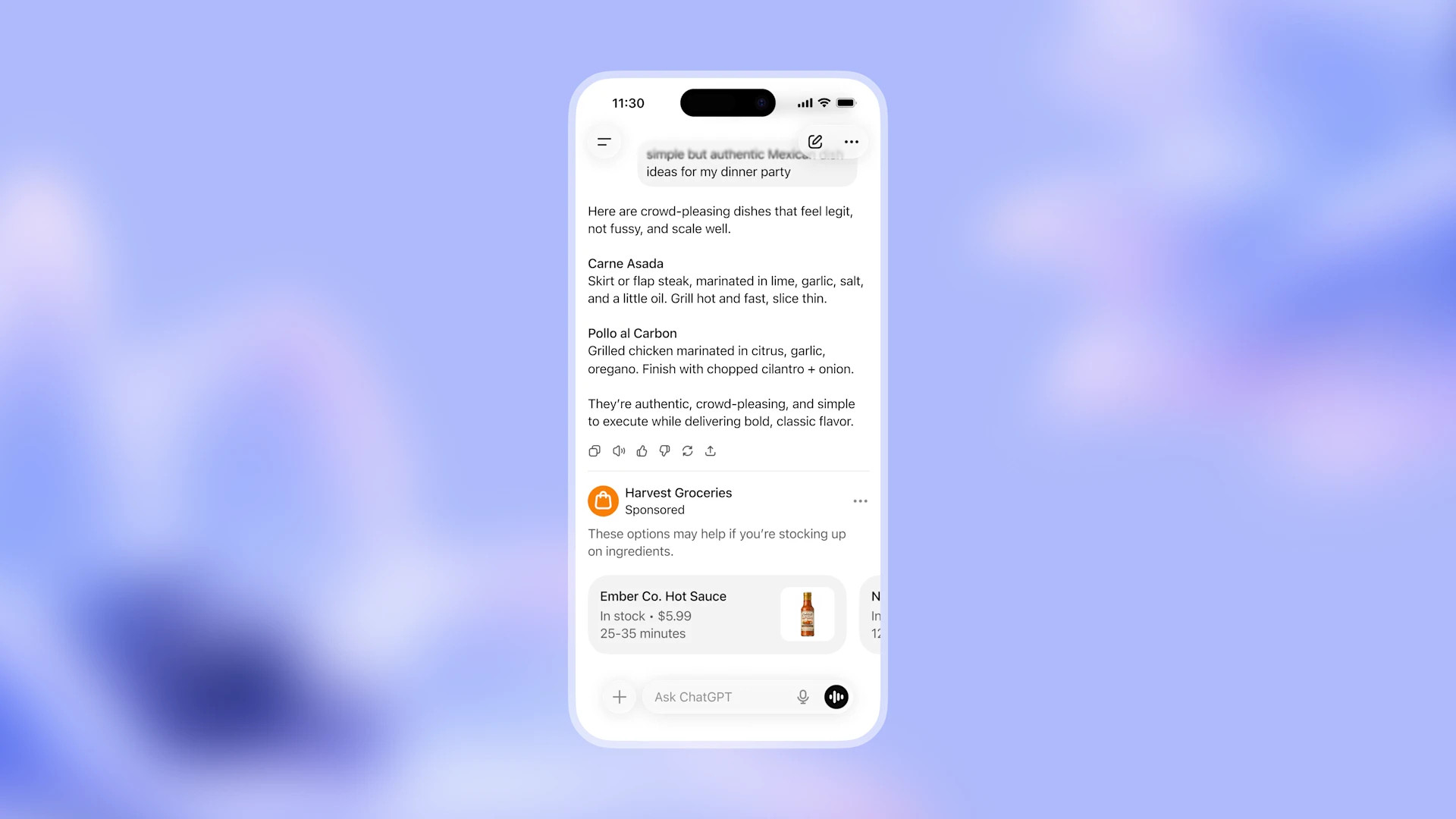
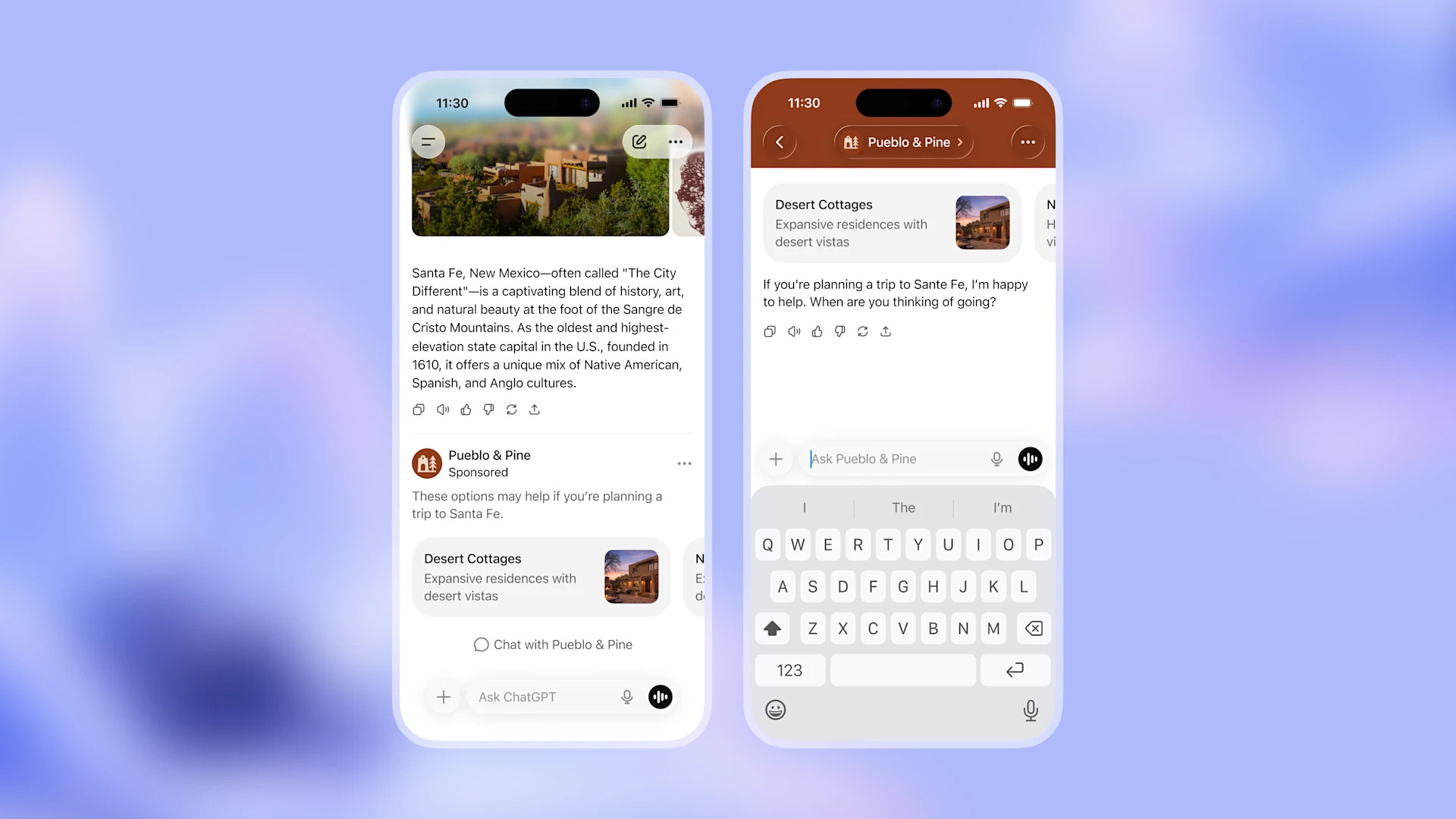
According to OpenAI’s blog post, the company plans to test ads “at the bottom of answers in ChatGPT when there’s a relevant sponsored product or service.” Ads will be labeled and separated from the answer.
In example screenshots shared by the company, the ads look like blocked off sections of the chat window with a small image and some advertising copy. Asking ChatGPT for places to visit in Mexico could result in holiday ads appearing, for instance.
An example mock-up of an advertisement in ChatGPT provided by OpenAI. Credit: OpenAI
“Our enterprise and subscription businesses are already strong,” Fidji Simo, OpenAI’s CEO of applications, wrote in the blog post. “We believe in having a diverse revenue model where ads can play a part in making intelligence more accessible to everyone.”
OpenAI’s announcement follows the company’s April 2025 introduction of shopping features to ChatGPT Search. At that time, OpenAI’s Adam Fry told Wired that product recommendations were “not ads” and “not sponsored,” but it felt like a potential step in that direction at the time.
OpenAI is not the only AI company exploring advertising revenue. Googlebegan testing AdSense ads in chatbot experiences through partnerships with AI startups in late 2024.
Financial pressures and a changing tune
OpenAI’s advertising experiment reflects the enormous financial pressures facing the company. OpenAI does not expect to be profitable until 2030 and has committed to spend about $1.4 trillion on massive data centers and chips for AI.
According to financial documents obtained by The Wall Street Journal in November, OpenAI expects to burn through roughly $9 billion this year while generating $13 billion in revenue. Only about 5 percent of ChatGPT’s 800 million weekly users pay for subscriptions, so it’s not enough to cover all of OpenAI’s operating costs.
Not everyone is convinced ads will solve OpenAI’s financial problems. “I am extremely bearish on this ads product,” tech critic Ed Zitron wrote on Bluesky. “Even if this becomes a good business line, OpenAI’s services cost too much for it to matter!”
OpenAI’s embrace of ads appears to come reluctantly, since it runs counter to a “personal bias” against advertising that Altman has shared in earlier public statements. For example, during a fireside chat at Harvard University in 2024, Altman said he found the combination of ads and AI “uniquely unsettling,” implying that he would not like it if the chatbot itself changed its responses due to advertising pressure. He added: “When I think of like GPT writing me a response, if I had to go figure out exactly how much was who paying here to influence what I’m being shown, I don’t think I would like that.”
An example mock-up of an advertisement in ChatGPT provided by OpenAI. Credit: OpenAI
Along those lines, OpenAI’s approach appears to be a compromise between needing ad revenue and not wanting sponsored content to appear directly within ChatGPT’s written responses. By placing banner ads at the bottom of answers separated from the conversation history, OpenAI appears to be addressing Altman’s concern: The AI assistant’s actual output, the company says, will remain uninfluenced by advertisers.
Indeed, Simo wrote in a blog post that OpenAI’s ads will not influence ChatGPT’s conversational responses and that the company will not share conversations with advertisers and will not show ads on sensitive topics such as mental health and politics to users it determines to be under 18.
“As we introduce ads, it’s crucial we preserve what makes ChatGPT valuable in the first place,” Simo wrote. “That means you need to trust that ChatGPT’s responses are driven by what’s objectively useful, never by advertising.”
As a Partner and Co-Founder of Predictiv and PredictivAsia, Jon specializes in management performance and organizational effectiveness for both domestic and international clients. He is an editor and author whose works include Invisible Advantage: How Intangilbles are Driving Business Performance. Learn more...





0 comments:
Post a Comment