Slaughter Of Russian Armor At Siversk, Pokrovsk Reveal Kremlin Desperation
For most of 2025, Russian armored assaults have been rare, not because of some clever new strategy, but because Russia just doesn't have a lot of armor left, having lost 20,000 tanks, APCs, IFVs and whatever other Soviet era mechanized vehicles capable of running they could salvage from long term storage.
But recently, at Siversk and Pokrovsk, among other crucial sectors of the front, the Russians have suddenly thrown massed armor assaults at Ukrainian defenses. This suggests that the Kremlin is desperate to make some sort of demonstrable gain either before it really runs out of the ability to launch offensives - or before Donald Trump actually decides to act on his frustration with Putin. Whatever the motivation, the reintroduction of armor does not appear to be part of an effective solution for the Russians, as in both cases, the armored columns were destroyed. As usual. JL
Euromaidan Press reports:
A surprising Russian armored assault ended in disaster for the Russians as they tried, and failed, to break through Ukrainian defenses outside Siversk. It’s unclear how much the belated deployment of increasingly precious armored vehicles is helping the Russian war effort. The doomed Russian armored assault, as Russia’s vehicle losses exceed 20,000, involved 6 tanks, 9 armored personnel carriers, an armored recovery vehicle, 12 Lada compact cars, 2 ATVs and a staggering 41 motorcycles. The 155th Mechanized Brigade thwarted another assault on the Pokrovsk direction. "The entire enemy column was destroyed.”
A surprising Russian armored assault ended in disaster for the Russians as they tried, and failed, to break through Ukrainian defenses outside Siversk in eastern Ukraine’s Donetsk Oblast.
But that doesn’t mean the Russians aren’t creeping toward front-line settlements including Siversk. Trading a few vehicles and a lot of bodies for every meter, Russian regiments are moving toward the city—and “may begin an assault … in the near future,” according to the Ukrainian Center for Defense Strategies.
The doomed Russian armored assault outside Siversk, a relative rarity as Russia’s vehicle losses exceed 20,000 and the Kremlin holds back most of its surviving tanks and fighting vehicles for future use, involved six tanks, nine armored personnel carriers, an armored recovery vehicle, 12 Lada compact cars, two all-terrain vehicles and a staggering 41 motorcycles from the 3rd Combined Arms Army.
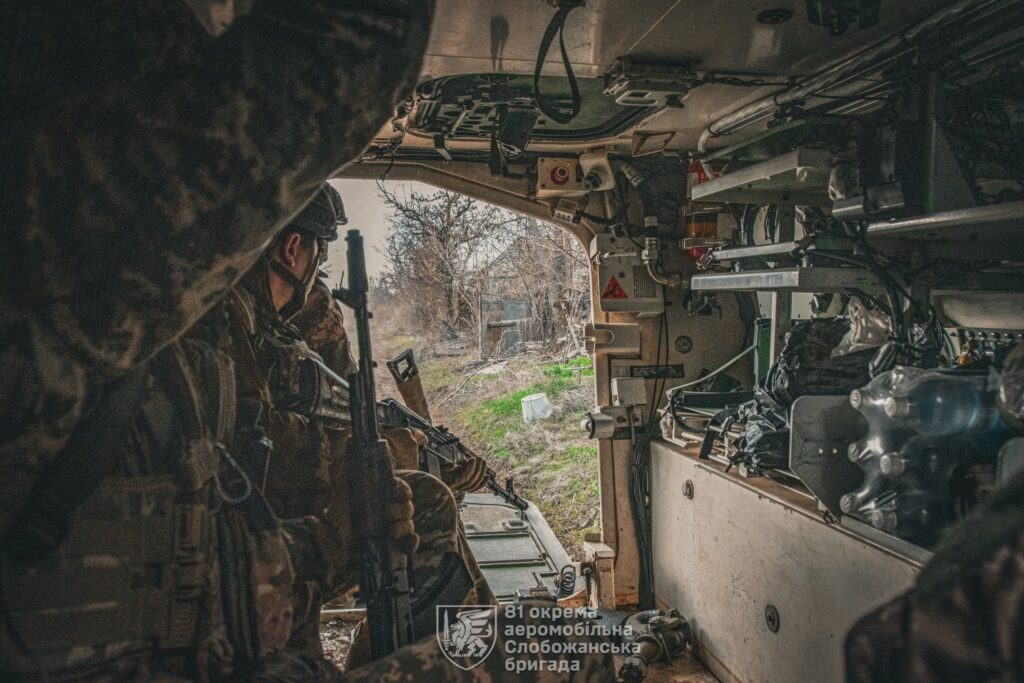
Ukrainian soldiers. Photo: 81st Brigade via Facebook
The Ukrainian 54th Mechanized Brigade and 81st Air Mobile Brigade struck back with the first-person-view drones, bomber drones and—presumably—artillery. “Most of the equipment was destroyed or damaged,” Special Kherson Cat noted after they and other Ukrainian observers scrutinized drone videos of the assault.
“Russian infantry losses are estimated at around a company killed and wounded,” Special Kherson Cat reported. That’s potentially more than 100 casualties.
The horrific losses belie very gradual Russian gains around Siversk, however. “Tactical gains by the enemy northeast of Siversk indicate that Russian troops have reached a line several kilometers from Siversk,” CDS wrote.
Bike tactics
It’s unclear how much the belated deployment of increasingly precious armored vehicles is helping the Russian war effort. As Russia’s wider war on Ukraine grinds into its 42nd month, the Russians tend to attack with infantry riding on motorcycles—or even marching on foot.
The growing proportion of the 46-ton, three-person T-72Bs in the Russian inventory is the latest sign that Russian regiments are “de-mechanizing.” That is, evolving—or devolving—into infantry-first formations.
It’s a costly approach. But it can work. Russian infantry have exploited Ukrainian brigades’ desperate manpower shortage—Kyiv’s army is short 100,000 trained infantry—and recently marched through gaps in Ukrainian lines northeast of Pokrovsk, further closing a pincer around that city 90 km southwest of Siversk.
Russian tank with anti-drone protection.
Russian commanders tried to hasten Pokrovsk’s fall by pulling their dwindling reserves of tanks out of the vehicles’ protective hideouts and rolling them into action on the city’s southern flank, where small Russian sabotage groups have lately enjoyed some limited success infiltrating Ukrainian lines.
The problem, for the Russians, is where the tanks went. They traveled along a notorious “road of death” for Russian vehicles threading from the Russian stronghold of Selydove through the village of Shevchenko, a few miles south of Pokrovsk.
The 155th Mechanized Brigade’s drones spotted the Russian tanks and infantry fighting vehicles—a dozen or so?—coming on Saturday. “Coordinated actions of artillery and unmanned systems forces of the 155th Mechanized Brigade thwarted another assault on the Pokrovsk direction,” the brigade reported. “The entire enemy column was destroyed.”
“Tanks have become a second priority in war,” a Ukrainian tanker named Bohdan told David Kirichenko, an analyst for the Center for European Policy Analysis in Washington, D.C. “It’s now a war of artillery, drones and infantry.”
Ukraine may have the edge in drones, but Russia has a lot more troops and artillery. So the wholesale destruction of rare Russian armored columns might not mean much in the end. Russia can lose more of its dwindling stocks of tanks … and still advance.
CDS announced it expects more aggressive Russian action around Siversk in the coming weeks. “The 3rd Combined Arms Army will try to break through to the northern bank of the Siverskyi Donets River between Yampil and Hryhorivka, and from the southeast—toward Siversk.”
As a Partner and Co-Founder of Predictiv and PredictivAsia, Jon specializes in management performance and organizational effectiveness for both domestic and international clients. He is an editor and author whose works include Invisible Advantage: How Intangilbles are Driving Business Performance. Learn more...





0 comments:
Post a Comment