


Facebook claims that it investigates all claims of fraud and attempts to eliminate them. And they probably do - within certain strictures and boundaries framed by financial, legal and reputational limits.
But disturbing reports continue to emerge about what we might fairly call abuse or, in some cases, strategic indifference to behavior generally considered questionable.
However, this isn't really about ethics, though that enters the conversation. It is, rather, about measuring performance. Because the big question, as Twitter learned to its dismay, is whether anyone is really going to be able to figure out how to make a decent living in the long term from the shapeshifting edges of ecommerce. The places where notions of buy and sell are more of a bank shot than a direct transaction. And this matters to advertisers, marketers, investors and customers as we collectively attempt to get our heads around what is a real opportunity and what is a nice idea that will never deliver on its promise. JL
Lenny Teytelman comments in PubChase, hat tip to Mish Shedlock:
No one wants to admit that they buy ‘likes’ on Facebook. And certainly no one wants to admit to buying possibly fake ‘likes’. Most importantly, once tricked and sitting on a pile of these senseless ‘likes’, you at least want to get something for your money. So you stick this number on your landing page in the hope of convincing everyone that you have a strong community and that your product is taking off
You are drinking a Coke at lunch. Do you feel compelled to go to Facebook and “like” the Coca Cola facebook page? You use Matlab to process your microscopy data. Do you express your gratitude for not having to count RNA spots by hand by “liking” Matlab? And if your physician prescribes a pill made by AstraZeneca, do you “like” the pharmaceutical? Well, someone does.
In June of 2013, we released our essay platform for scientists to tell the stories behind their research. A month before that, we tried to build up a following on Facebook, so that we would be able to make the author-contributed content more visible. We had about 100 “likes” from our science friends and decided to pay for promotion to accumulate more. This exercise (and the resulting “likes”) is still the most puzzling event in the two-year existence of our startup. For $50, we ended purchasing 900 empty likes that we still can’t get rid of to this day.
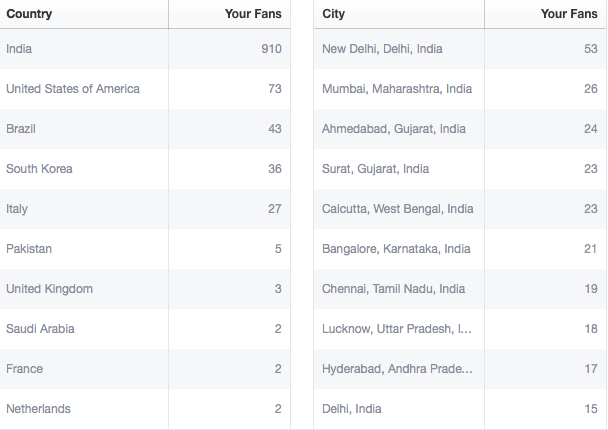
We are not talking about going to an outside agency to accumulate fake likes – something that Facebook prohibits. We are talking about Facebook giving companies the ability to pump cash into the generation of useless but impressive-sounding “likes” with a click of a button via the “promote your page” campaigns. A click that Facebook promises will allow you to “connect with more of the people who matter to you.” We planned to spend $400-500 to grow our “likes” by one or two hundred. It took us a day to realize that we were paying Facebook not for interested followers but for a meaningless number. For $50 in the very first day, we instantly felt the love from almost a thousand Facebook accounts in India. None of them seemed to be scientists, and we are far from certain that they are real people. Here are the countries and cities that “like” PubChase.
Of course, there are countless scientists in India, but the statistics from GoogleAnalytics on the use of our apps for scientists, be they on iOS or Android, clearly indicate that India is not our main user base1.
As we tried to understand why New Delhi citizens were so enamored with PubChase we bumped into the post titled, “Are 40% Of Life Science Company Facebook Page ‘Likes’ From Fake Users?” In our case, it seems to be about 90%.
PubChase iOS PubChase Android Lab Counter iOS Lab
Counter AndroidBench Tools iOS Bench Tools Android U.S. U.S. U.S. U.S. U.S. U.S. UK UK Brazil Japan Germany China China China UK Belgium Turkey Australia Brazil Italy Mexico Brazil UK Netherlands Germany Germany Australia Ireland S. Korea Poland Poland India Italy Spain Netherlands Turkey Canada Spain Japan China Thailand Germany Italy Guatemala France Canada Ukraine Greece Mexico Canada Canada Argentina Italy Austria Turkey Vietnam Thailand Mexico China Italy
We stopped our campaign right away, but it was too late. Facebook has no interface to remove these fake likes. You have to manually delete each follower and can only do so for a few dozen most recent ones. There is no way to clear the likes beyond the most recent. So, we got stuck with our following, and that means that it is senseless for us to promote any content on Facebook at this point.
This is far from an isolated incident, as is clear from the above post. A quick look at companies similar to ours, software for scientists, suggests that many fall into this trap2.
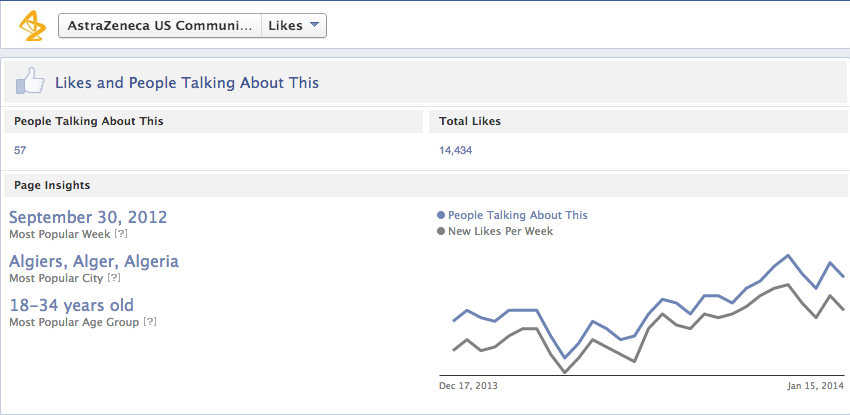
Naturally, this is not exclusive to software companies. The most popular city for Novartis and Pfizer is Cairo and Sanofi has the most loyal fans in Karachi, Pakistan. If we had to give a prize for the funniest example of this, it would have to be the “AstraZeneca US Community Relations” page on Facebook. It clearly says “This page is intented for US residents only” but its most popular city is Algiers.
- Figshare – Tehran, Iran
- Matlab – Tehran, Iran
- Mendeley – Bogota, Colombia
- Papersapp – Jakarta, Indonesia
- Readcube – New Delhi, India
- ResearchGate – Mexico City, Mexico
- Sciencescape – Karachi, Pakistan
Responding to a BBC investigation of fake likes in 2012, Facebook claimed:
“We’ve not seen evidence of a significant problem,” said a spokesman.There are a few simple reasons why the companies don’t raise it at as an issue.
“Neither has it been raised by the many advertisers who are enjoying positive results from using Facebook.
All of these companies have access to Facebook’s analytics which allow them to see the identities of people who have liked their pages, yet this has not been flagged as an issue.
A very small percentage of users do open accounts using pseudonyms but this is against our rules and we use automated systems as well as user reports to help us detect them.”
It should not be surprising that we only felt confident enough to write about this travesty once we organically acquired a real user base for our products.
We have no idea whether these meaningless “likes” are the bane of Facebook’s anti-bot/spamming efforts or whether Facebook quietly enjoys the revenues from the purchases of these. Regardless, it is certainly misleading for Facebook to promote this as a way to connect to the people that matter to the advertiser/company.



0 comments:
Post a Comment