As Russia's Summer Offensive Stalls, It Pulls Last Old Tanks Out of Storage
The math is inexorable: Russia has lost almost all its usable tanks in Ukraine. It has about 300 rusty T-72s left in storage and is hauling them out at a rate of 20 per month to lead its increasingly de-mechanized attacks in Ukraine. But the problem is that the T-72s optics are so antiquated that these museum pieces are essentially fighting blind. Which means there is little left to recover once they meet their inevitable end versus Ukrainian drones and artillery.
So it may have a year's worth of old Russian tanks for Ukrainian drone crews to use for target practice before there is almost literally nothing left for the Kremlin to send into battle. Which is part of the explanation for the failure of its summer offensive and the urgency with which the Kremlin is forcing attacks now, before its forces become even less threatening. JL
David Axe reports in Trench Art:
As recently as a year ago, there were several hundred rusty T-72Bs in various states of repair at storage yards. The Russians are fetching them at a rate of 20 a month. The growing proportion of the 46-ton, three-person T-72Bs in the Russian inventory is the latest sign that Russian regiments are “de-mechanizing:” evolving into infantry formations that ride into battle on motorcycles or other unarmored vehicles. Or walk. There are few Russian armored vehicles to exploit advances. (And) the T-72B’sbiggest problem is its antiquated optics, which renders the crew blind under battlefield conditions. Increasingly de-mechanized, Russian forces can’t advance fast or at low risk to its exposed infantry.
The growing proportion of the 46-ton, three-person T-72Bs in the Russian inventory is the latest sign that Russian regiments are “de-mechanizing.” That is, evolving—or devolving—into infantry-first formations that mostly ride into battle on motorcycles or other unarmored vehicles. Or simply walk.
The ongoing de-mechanization of the Russian military doesn’t mean Russia is losing its 42-month wider war on Ukraine. It does mean the Russian military will struggle to exploit its battlefield victories against manpower-starved Ukrainian brigades. Russian infantry may find gaps in Ukrainian defenses. But there are precious few Russian armored vehicles on hand to rush through the gaps—and drive deep behind Ukrainian lines.
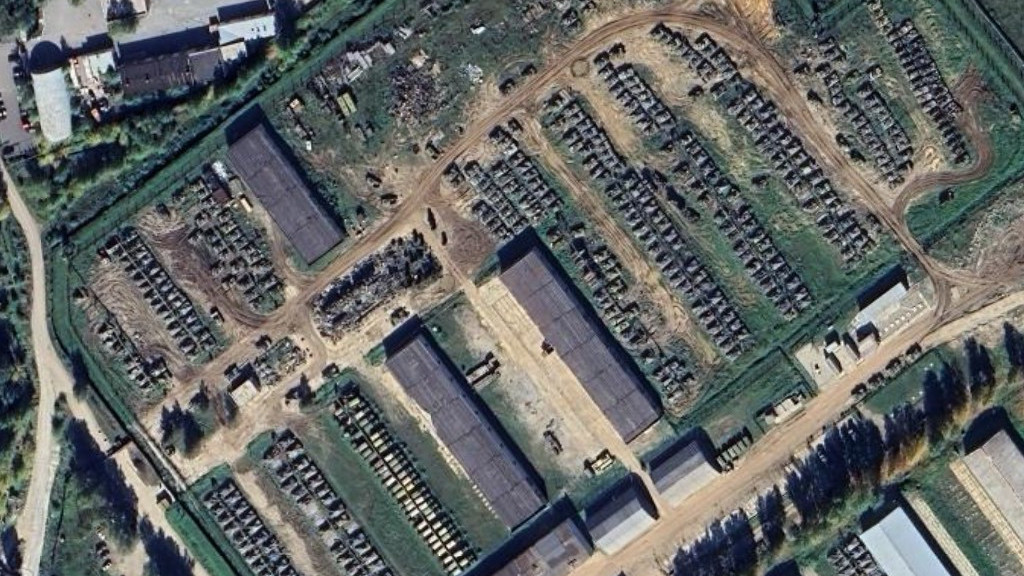
Open-source intelligence analyst Jompy, who scrutinizes satellite imagery to survey Russia’s once-vast vehicle storage yards, was first to notice workers fetching more rusty T-72Bs from the 1311th Central Tank Storage and Repair Base, 850 miles east of Moscow.
As recently as a year ago, there were several hundred T-72Bs in various states of repair at the various store yards. Now the Russians are fetching them at a rate of around 20 a month, according to Jompy. “Once the few hundreds [of] T-72B hulls are gone,” the Russians will be “in real trouble with regard to their modern MBT fleet,” Jompy wrote, using the acronym for “main battle tank.”
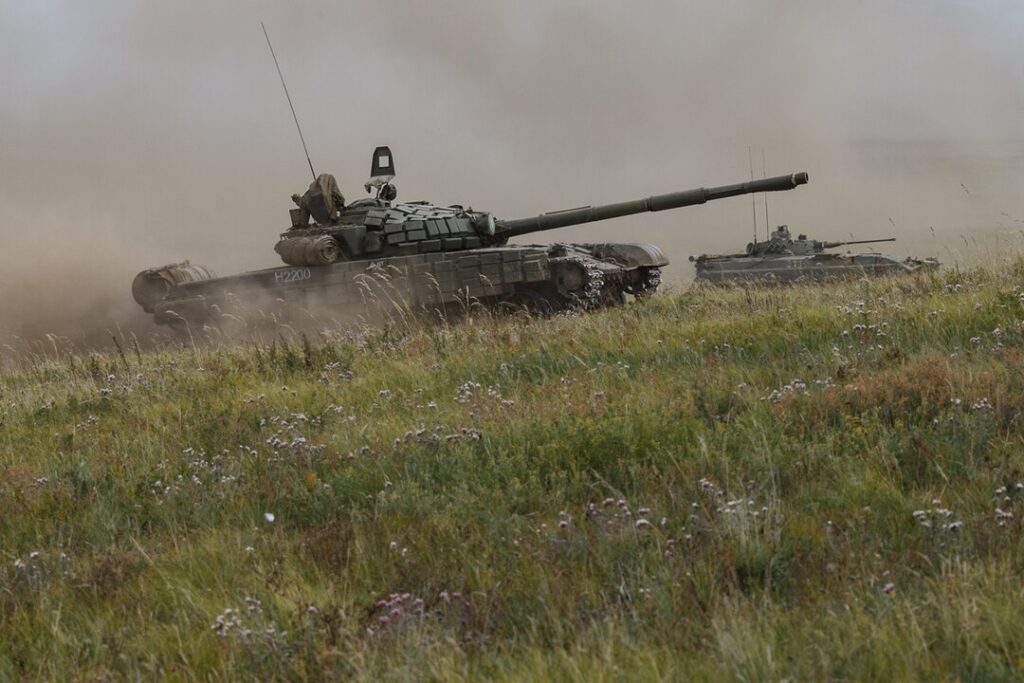
T-72B. Via Wikimedia Commons.
The T-72 has the same flaws all Soviet-style tanks have: most notably, ammunition stowage under the turret that’s prone to catastrophically exploding when hit. But compared to newer Russian tank models, the T-72B’s biggest problem might be its utterly antiquated optics, which can render the crew essentially blind under battlefield conditions.
There are worse tanks in the Russian arsenal, including 1960s-vintage T-62s and T-55s from the 1950s. But the Russians have already recovered most of the older tanks that were in reasonably good condition after decades of open storage—and then upgraded them and sent them to Ukraine, where many of them suffered the same fate that thousands of Russian tanks have suffered. Blown up by mines, artillery, missiles and drones.
1311th Central Tank Storage and Repair Base. Google Maps capture
Begging for upgrade
An old T-72B hull can be upgraded with new optics and layers of add-on anti-drone armor, albeit with great effort. The bigger problem for the Kremlin is supply. The several hundred T-72Bs that were extant a couple of years ago, and which are currently depleting at a rate of 20 per month, represented one of the last sizable tank reserves in Russia.
Once the reserves are finally gone—something that might happen this year—the Russian armed forces will only have as many tanks as Russian tank-makers can build new.
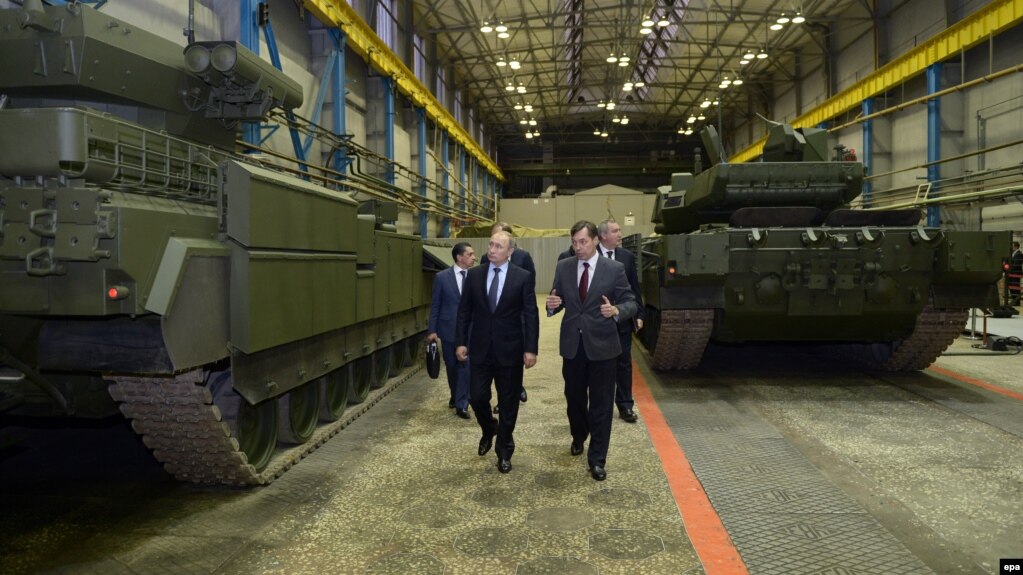
The good news for the Kremlin is that, despite successive rounds of sanctions on Russia’s arms industry, the Uralvagonzavod factory just north of the 1311th Central Tank Storage and Repair Base has managed to expand production of the latest T-90M tank.
Russia’s President Vladimir Putin at the Uralvagonzavod, 2015. Photo: RFE/RL
That’s the conclusion of a recent study from the pro-Ukraine Conflict Intelligence Team. “According to our estimates, Uralvagonzavod produced 60 to 70 T-90M tanks in 2022. In 2023, amid efforts to mobilize the defense industry, output may have increased to 140 to 180 tanks, and by 2024, it may have surpassed 200 units annually, possibly approaching a production rate of 250 to 300 tanks per year.”
Three hundred tanks a year isn’t a lot of tanks, however—not for an army that’s struggling to break through along the 1,100-km front in Ukraine while also trying to preserve some mechanized forces for possible future conflicts.
More good news for the Kremlin: Ukraine’s manpower shortage is so dire—its brigades urgently need 100,000 trained infantry—that the manpower-rich Russian military can continue to advance in Ukraine without deploying a lot of tanks.
But increasingly de-mechanized, it can’t advance fast—or at low risk to its exposed infantry.
As a Partner and Co-Founder of Predictiv and PredictivAsia, Jon specializes in management performance and organizational effectiveness for both domestic and international clients. He is an editor and author whose works include Invisible Advantage: How Intangilbles are Driving Business Performance. Learn more...




1 comments:
CAD mechanical design is essential for creating accurate, efficient, and functional mechanical systems. It streamlines the design process, reduces errors, and ensures products are ready for real-world manufacturing. A reliable CAD design is the first step toward successful engineering outcomes.
Post a Comment