Kremlin Losses So Great In Failed Pokrovsk Attacks, They're Running Out Of Troops
Russia's attempt at reintroducing armored attacks to try to take Pokrovsk is failing as badly as the previous efforts. Casualties are so high that the Kremlin is literally running out of troops.
And while the Russians keep on coming, they have nothing more to show for it than they did during the previous two years of failed attempts. JL
Euromaidan Press reports:
Is Russia losing 30,000 troops a month? Or is it 50,000? Russian 155th Naval Infantry tried to captured the village of Shakhove, northeast of Pokrovsk with 22 armored vehicles on Thursday—and failed, dramatically. "Two units of armored vehicles were detected by reconnaissance and destroyed by artillery and [first-person-view] drones of the Unmanned Systems Forces before they even tried to hide in the forest."The Azov corps hit 13 vehicles, destroying nine of them and sending the rest scurrying back to their dugouts. “They even didn’t reach the front line.”
Is Russia losing 30,000 troops a month as its wider war on Ukraine grinds into its 44th month?
Or is it losing more than that—50,000 a month ... or even more?
As the Russians shove more and more regiments and brigades into the narrow salient northeast of the fortress city of Pokrovsk, their casualties are increasing.
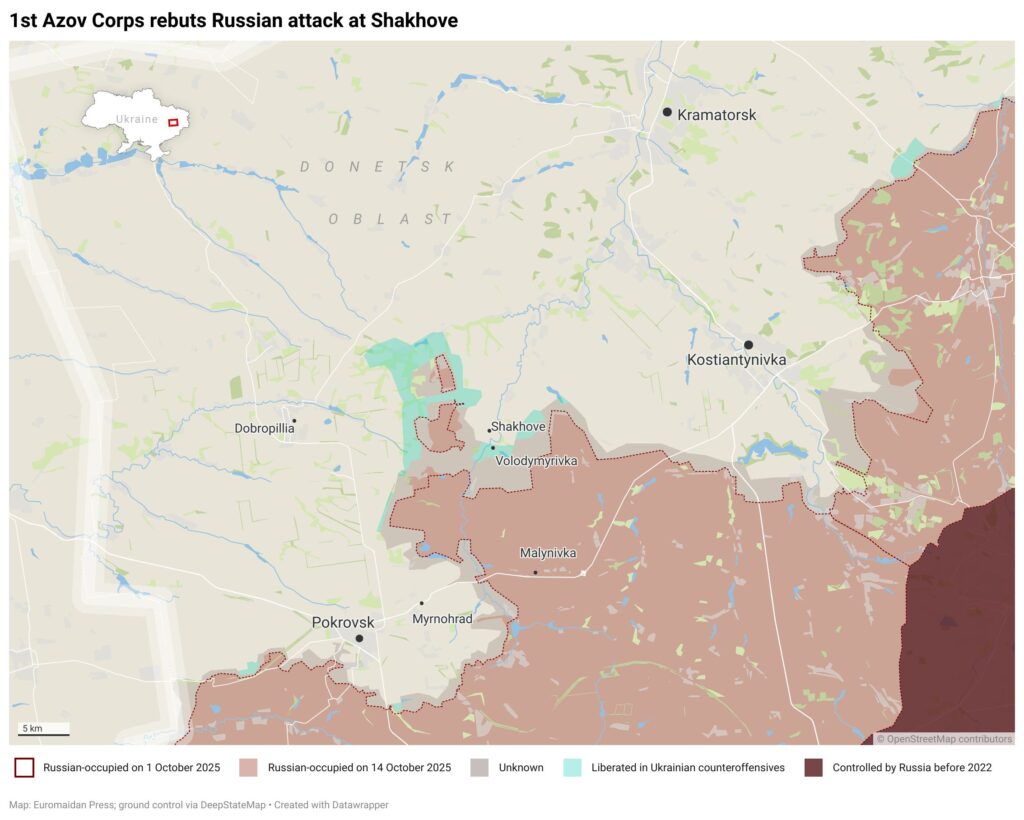
Different sources disagree over exactly how much Russian casualties are increasing. They don't disagree that more Russians are dying, getting maimed, or going missing, many of them in and around the chaotic, 40-square-kilometer salient. Russian marines tried to captured the village of Shakhove, northeast of Pokrovsk on Thursday—and failed, dramatically.
But the attack, involving 22 armored vehicles from the 155th Naval Infantry Brigade, hinted at new tactics that, with better timing and a little luck, could help the Russians break through around Pokrovsk as their wider war on Ukraine grinds into its 44th month.
The Russians made several surprising moves as they prepared two separate columns with T-80BVM tanks and BTR-82A wheeled infantry fighting vehicles laden with infantry.
In the days leading up to the Thursday morning assault, the Russian marines set up observation posts around their base in the village of Malynivka, 9 km south of Shakhove.
The goal, according to the Ukrainian 1st Azov Corps, was to detect and shoot down Ukraine's night-flying heavy bomber drones, preventing them from dropping mines on the likeliest assault routes between Malynivka and Shakhove.
At the same time, the 155th Naval Infantry Brigade—one of five marine brigades and regiments the Kremlin rushed to Donetsk Oblast this summer to bolster the Center Grouping of Forces' faltering effort to capture Pokrovsk and clear a path toward the twin cities of Kramatorsk and Sloviansk—tried to hide its T-80s and BTR-82s.
Both types are still in production at factories in Russia. But production of new vehicles isn't keeping up with vehicle losses. Every tank and fighting vehicle is precious. Especially as the winter mud deepens and strictly footborne assaults become impractical all along the 1,100-km front line.
Normally, a Russian assault column would assemble in a base such as Malynivka and roll out the morning of a planned attack, ideally under the cover of fog or an overcast sky. But that predictable deployment pattern risks drawing heavy Ukrainian fire.
To mitigate the risk, the 155th Naval Infantry Brigade sent some of its vehicles out into the tree lines around Malynivka on Wednesday, 15 October, the day before the assault.
"The maneuver was unsuccessful," the 1st Avoz Corps reported. "Two units of armored vehicles were detected by reconnaissance and destroyed by artillery and [first-person-view] drones of the Unmanned Systems Forces before they even tried to hide in the forest."
Meanwhile, enough of Ukraine's heavy bomber drones got past the Russian observation posts to drop their mines along the roads between Malynivka and Shakhove.
All the creative measures amounted to nothing when the run rose on Thursday, and the 22 vehicles rolled out.
"Thanks to the advanced engineering equipment of the positions, effective mining and coordinated actions of the units of the defense forces of Ukraine—primarily artillery crews of the brigades of the armed forces and the national guard of Ukraine, as well as the crews of the Unmanned Systems Forces—the enemy attack was thwarted," the 1st Azov Corps boasted.
A map of the situation around Pokrovsk
The corps hit 13 vehicles, destroying nine of them and sending the rest scurrying back to their dugouts. “They even didn’t reach the front line,” Ukrainian drone operator Kriegsforscher observed.
The weather was a critical factor. Low clouds can prevent the safe operation of drones. But the sky was clear enough on Wednesday and Thursday for Ukraine to fly lots of bomber drones (to drop mines) and surveillance drones (to surveil Malynivka and the surrounding tree lines).
Leaked documents reveal baseline Russian losses
A leaked Russian document provides a baseline for Russian losses between 1 January and 1 September this year. According to the document, Russian forces suffered 281,550 casualties in those 245 days:
86,744 killed in action
33,996 missing in action
158,529 wounded in action
2,311 captured
That's 35,000 casualties a month through the early weeks of Russia's renewed push toward Pokrovsk. Of those 35,000 casualties, several thousand were probably temporary as the more lightly wounded recuperated and returned to service.
Given that Russia recruited nearly 32,000 fresh troops a month over the same eight months, there's a good chance the Kremlin enjoyed a small troop surplus throughout much of 2025.
But Russian commanders' determination to capture Pokrovsk, one of the last urban strongpoints between the Russians and the free twin cities of Kramatorsk and Sloviansk, has erased that surplus. Now the Russians are almost certainly losing more troops than they're recruiting every month.
It's unclear how deep the deficit is, however.
Russian dead near Pokrovsk.
September losses climb higher than Ukrainian estimates
Another leaked document, detailing Russian casualties for 4 September, lists 995 total casualties, around half of them from the Center Grouping of Forces fighting around Pokrovsk. Incredibly, this is a slightly higher count than the official Ukrainian count of Russian losses for the same day.
The Ukrainian general staff, which could be forgiven for projecting rosier figures, tallied just 810 Russian casualties on 4 September.
Pokrovsk offensive drives losses 18-20% higher
The casualty rate among Russian field armies has probably increased since then. "On the Pokrovsk direction, Russian troops activated attacks across the entire direction, suffering 18-to-20% greater losses over the last week," the Ukrainian Center for Defense StrategiesreportedWednesday.
If CDS is correct, the Russians are losing around 1,200 troops a day. If the typical ratios of killed to wounded to missing hold, 1,200 total casualties could mean 400 confirmed KIA a day. (Analysts widely assume most missing Russian soldiers are also dead somewhere along the 1,100-km front line.)
But at least one analyst has good reason to believe Russian losses are currently much greater.
Visual confirmation suggests actual deaths far exceed official counts
Analyst Andrew Perpetua visually confirmed 825 Russian KIA in five days starting on 9 October. That's 165 dead Russians every day, on average.
But Perpetua stressed that his count is probably low, as there are surely many Russian combat deaths that don't leave behind photographic or video evidence. Perpetua himself estimated he observes between 15% and 30% of Russian losses.
Being conservative, that could mean that Russia's battlefield deaths are approaching 500 a day. Applying the usual ratios, that could mean 1,000 wounded and 250 missing. Again, most of the missing are probably dead.
Russia's recruitment can't keep pace with mounting casualties
That's ... a lot of dead, maimed, and missing Russians. Potentially 50,000 or more total casualties a month.
The problem for the Kremlin is that there's no evidence it has boosted recruitment to match the deepening losses. If the Russian military is still adding 32,000 fresh troops a month, it's likely running a manpower deficit of around 20,000 troops a month that it can't replace.
As a Partner and Co-Founder of Predictiv and PredictivAsia, Jon specializes in management performance and organizational effectiveness for both domestic and international clients. He is an editor and author whose works include Invisible Advantage: How Intangilbles are Driving Business Performance. Learn more...




0 comments:
Post a Comment