How Rafale Fighter Jets Benefit Ukraine Against Russia
That the Kremlin made threatening statements to France about the Rafale deal as soon as it was announced suggests the scale of the potential benefit to Ukraine.
The Rafale is newer than the F-16 and combined with the Swedish Gripen fighters already promised (which are designed to take off and land on back country roads and runways necessary to fight Russia) provide Ukraine with a transitional next generation air force. Russia's air force is widely perceived to have underperformed in this war, so the Rafale and Gripen enhanced capabilities are an additional boost for Ukraine. But the additional benefit is the determination they show from NATO countries to fight Russia, sending a signal that they have no intention of bending to Putin's threats and thus raising military and economic threat and cost to his regime. JL
Thomas Newdick reports in The Drive Warzone:
Ukraine has signed a letter of intent to buy up to 100 Dassault RafaleF4 multirole fighters from Franceover the next 10 years. Yesterday’s agreement comes less than a month after Sweden and Ukraineunveiled a plan to export as many as 150 Gripen E fighters to Kyiv. The Rafale and Gripen would be the most advanced combat aircraft in Ukraine's arsenal. Ukraine’scommitmentto buy Rafales and Gripens, alongside other defense equipment can placate its supporting countries by showing interest in huge arms buys. It signals Kyiv’s ambitious re-equipment plans and the deepening defense relationship between Ukraine, France (and other NATO countries).
In its latest efforts to modernize its air force, Ukraine has signed a letter of intent to buy up to 100 Dassault Rafale F4 multirole fighters from France over the next 10 years. Today’s agreement comes less than a month after Sweden and Ukraine unveiled a plan to export as many as 150 Gripen E fighters to Kyiv. While the Rafale and Gripen E would be the most advanced combat aircraft in Ukraine’s inventory, there remain glaring questions about whether the acquisition of one of these aircraft types, let alone two, is actually feasible, especially in such numbers.
Ukrainian President Volodymyr Zelensky and French President Emmanuel Macron signed the document for the potential Rafale deal during the Ukrainian leader’s latest visit to Paris, his ninth since Russia’s full-scale invasion began in February 2022.
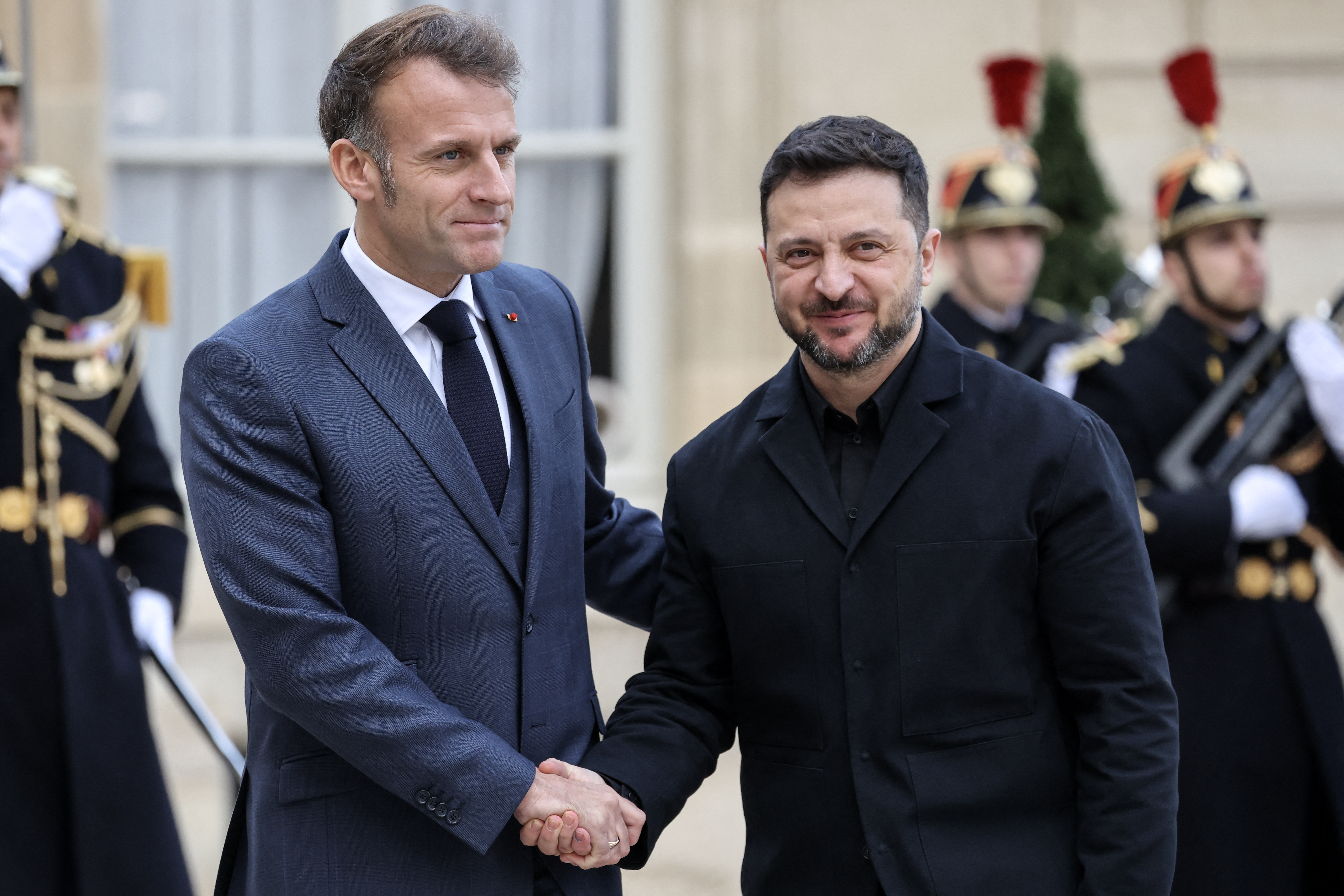
President Emmanuel Macron (left) welcomes President Volodymyr Zelensky before their meeting at the Elysee Palace in Paris on November 17, 2025. Photo by Ludovic MARIN / AFP LUDOVIC MARIN
“It will be the greatest air defense, one of the greatest in the world,” Zelensky told reporters after he signed the letter of intent with Macron in front of a Rafale at the French airbase of Villacoublay, outside Paris.
Ahead of the agreement, Zelensky wrote on X on Sunday that he looked forward to a “historic deal with France in Paris to strengthen our combat aviation and air defense.”
Speaking to French television, Macron said: “We’re planning Rafales, 100 Rafales — that’s huge. That’s what’s needed for the regeneration of the Ukrainian military.” The timeline for delivering the jets would extend to 2035. So far, there is no indication that Ukraine would take part in the Rafale production workshare, but the two nations did also agreeto work togetheron developing and building interceptor drones.
In response to the news, Dassault’s shares soared and were up 7.4 percent this morning.
At this stage, the document outlines Ukraine’s political commitment to buy Rafales, alongside other French-made defense equipment, and it is not a purchase deal. In that sense, there is nothing for Ukraine to lose here, and it can placate its supporting countries by showing interest in huge arms buys without any liability.
However, it does signal the potential of Kyiv’s ambitious re-equipment plans and the deepening defense relationship between Ukraine and France.
Prior to Zelensky’s latest visit to France, French Air Force Gen. Fabien Mandon, the chief of the French defense staff, told French senators that Ukraine urgently needs additional air defense equipment. He highlighted that Russia is, on average, targeting the country with around 1,700 drones every week, in addition to much smaller numbers of missiles.
Mandon claimed that European-made SAMP/T surface-to-air missile systems that France has provided are proving more effective than U.S.-made Patriot batteries when it comes to targeting Russian missiles. Earlier this year, we reported on how a surge in the Russian use of ballistic missiles with enhanced maneuvering capabilities had reduced the effectiveness of Ukrainian Patriots, according to the U.S. Defense Intelligence Agency (DIA).
“We helped Ukraine by deploying missile and drone interception systems called the SAMP/T system,” Mandon said. “The Russians adapted the flight profiles of their most advanced missiles because they realized they were being intercepted by Ukrainian defenses. Today, the Patriot system is struggling to intercept them, but the SAMP/T is intercepting them.”
With winter around the corner, Ukraine is bracing itself for another Russian campaign directed against its energy infrastructure, as well as other targets, in an effort to weaken its resolve and sap its fighting ability.
France is already among the most prominent suppliers of defense assistance to Ukraine. As well as the aforementioned SAMP/T, air defense equipment provided includes former French Air ForceMirage 2000-5Ffighters.
It’s unclear exactly how many Mirages have now been pledged to Ukraine by France. At first, France offered six, but last month, Macron said he would offer more. At least one has so far been lost in Ukrainian service.
the arrival of Western-suppliedF-16sand Mirages, Ukraine continues to rely heavily on its Soviet-era fighters. The entirety of its combat fleet — Mirages and F-16s included — is in the latter stages of its service life and needs to be replaced before too long. With that in mind, Kyiv is planning to bolster its air force with more modern equipment.
The Rafale would be a significant addition to the Ukrainian Air Force, especially as the letter of intent outlines new-build jets rather than secondhand examples.
The F4 is the current production version of the Rafale, and some of its capabilities we have outlined in the past:
“The F4 standard […] is optimized for networked combat, with new satellite and intra-flight datalinks, as well as a communication server and software-defined radio. The F4 also features upgrades to the radar, electro-optical system, and helmet-mounted display. New weapons are also being integrated, including the forthcoming Mica NG air-to-air missile and the 2,200-pound version of the AASM modular air-to-ground weapon.”
The AASM, also known as the Hammer, isa rocket-assisted bombalready employed by Ukraine, on adapted Soviet-era jets. The Rafale notably also carries theSCALP-EGconventional cruise missile, another weapon also previously delivered by France to Ukraine.
A video from the French Directorate General of Armaments showing the test campaign for the Rafale F4:
In the meantime, Dassault is developing the F5 standard, with plans to field this with the French Air Force in 2030. The F5 is seen as a way of bridging the gap between the Rafale and the sixth-generation Next Generation Fighter (NGF), which is planned to be developed under the pan-European Future Combat Air System (FCAS) air combat program.
The big question about Ukraine’s potential Rafale deal is how to pay for the jets. On top of buying them, actually operating and supporting a force of 200 or more newer 4.5-generation fighters (Rafale and Gripen) for decades would be very expensive.
For comparison, back in 2021, the United Arab Emirates signed a deal for 80 Rafales, with a total value of $16 billion, not including weapons for the jets.
The office of the French president said that the plan is to finance the deal via European Union programs and frozen Russian assets. However, the EU has not yet agreed on how to use these assets and, even then, it’s unclear how far these would fund such a deal. At the same time, France is experiencing unusual political and budgetary instability, making it harder to firm up a long-term Rafale plan for Ukraine.
As well as financing the fighters and their weapons, a new training program for pilots and maintainers would have to be put in motion, alongside infrastructure and sustainment efforts.
The same goes for the Swedish-made Gripen E, for which Ukraine signed a letter of intent last month, covering “likely between 100 and 150 fighter jets.”
Swedish officials have said it would take around three years for new-build Gripen Es to arrive in Ukraine. With an urgent need for fighters, Zelensky has said he would like to see Gripens delivered by 2026. That would almost certainly involve providing secondhand Gripen C/Ds. So far, secondhand Rafales have not been proposed for Kyiv, although that could change.
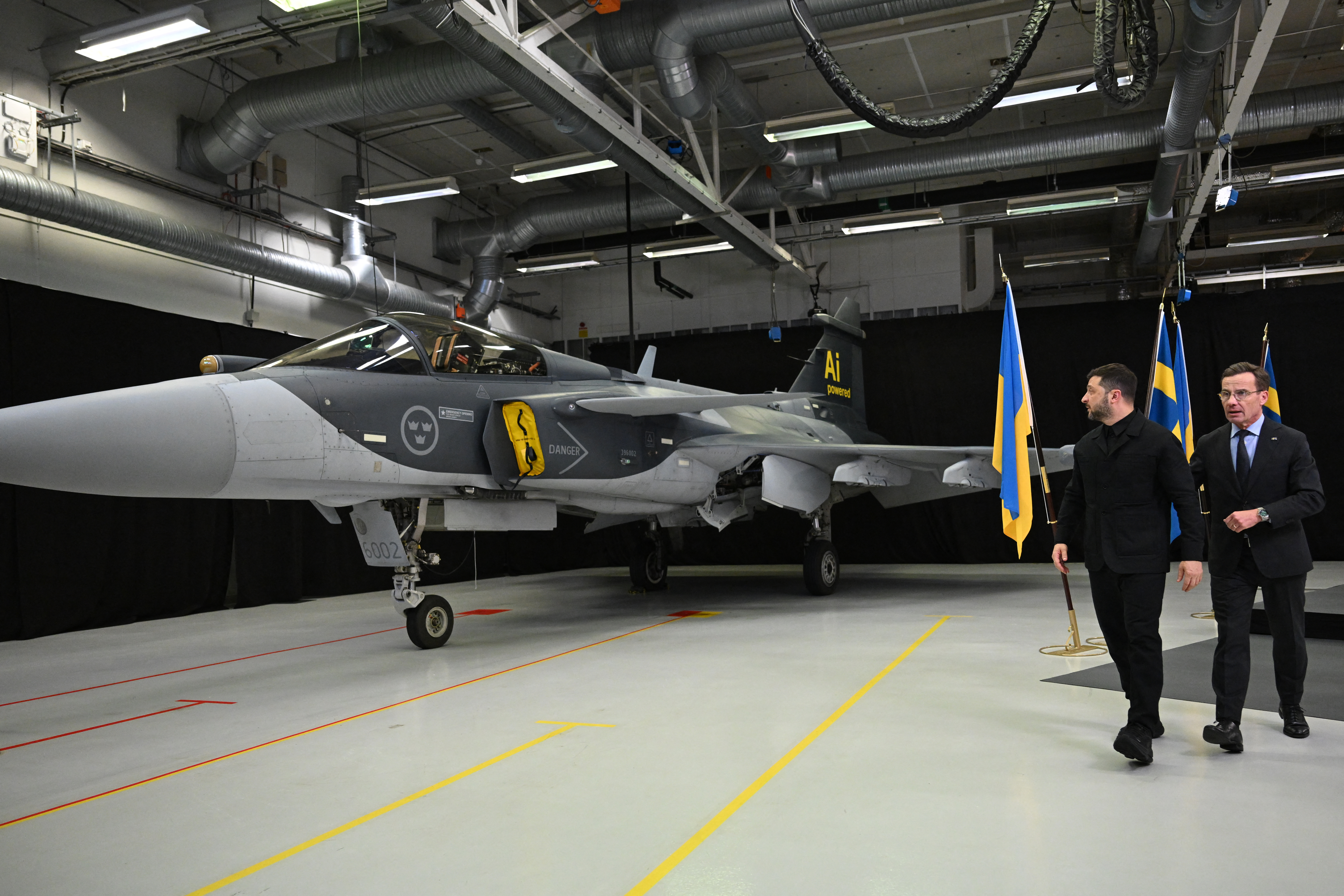
Swedish Prime Minister Ulf Kristersson (right) and Ukrainian President Volodymyr Zelensky walk past a Gripen fighter after they delivered a joint press conference in Linköping, Sweden, on October 22, 2025. Photo by Jonathan Nackstrand / AFP JONATHAN NACKSTRAND
As well as future air defenses, Zelensky and Macron today discussed the emerging plans for a coalition of allies to send troops and assets to Ukraine, or along its western borders, once a peace deal is agreed with Russia. The two leaders visited the headquarters of this so-called “coalition of the willing,” which is based in France.
France and the United Kingdom have so far led the push for this initiative, which they say would consist of around 30 countries.
Like the initiative aimed at modernizing the Ukrainian Air Force, the coalition of the willing is part of broader plans to secure the long-term security of the country. However, there are some very big hurdles to negotiate before either of these efforts can be firmed up.
Having foreign troops on Ukrainian soil under this kind of arrangement depends first on successfully negotiating a ceasefire, something that Russian President Vladimir Putin has consistently rejected.
Beyond the issue of how to pay for the new fighters, there are also questions about how rapidly Rafales might become available for export, with Dassault currently heavily engaged in fulfilling existing domestic and foreign production contracts.
With the Trump administration keen for Europe to buy weapons and give them to Ukraine, sales of this kind involving the Rafale or Gripen might be welcomed, and Europe would likely prioritize its own aircraft in these circumstances. On the other hand, both European fighters would likely face stiff competition from the U.S.-made F-16, in more advanced versions, and the Ukrainian Air Force is already building up significant combat experience with earlier-model Vipers and has a training program underway.
At the moment, the prospect of new Rafales, Gripens, or Fighter Falcons for Ukraine remain headline grabbing developments, but the diplomatic and logistical pathways, and especially the treasure, needed to actually realize a large fleet of 4.5 generation fighters are all questions to be answered at a later date.
As a Partner and Co-Founder of Predictiv and PredictivAsia, Jon specializes in management performance and organizational effectiveness for both domestic and international clients. He is an editor and author whose works include Invisible Advantage: How Intangilbles are Driving Business Performance. Learn more...






1 comments:
Social media marketing in digital marketing, serving as a bridge between brands and their audiences.
Post a Comment