Tomahawks Useful For Ukraine, But Building Its Own Drones, Missiles Is Better
If Ukraine ever actually receives US Tomahawk missiles, they will be useful. But Kyiv is not likely to receive anywhere near enough even if the increasingly unreliable US government finally delivers.
Far more strategically, militarily and economically advantageous will be European investment in Ukraine's own, impressive drone and missile capabilities. Doing so provides Ukraine - and Europe- with more control and greater impact in the long term. JL
Fabian Hoffmann reports in CEPA:
Ukraine’s armed forces value the Tomahawk for its ability to strike whole military production plants. (But) it would likely have only a very limited number of Tomahawk-launch platforms which would severely constrain the launch rate. Moreover,Ukraine has, over the past two years, developed an impressive missile industry of its own and become significantly less dependent on Western partners. Nonetheless, it continues to face difficulties in scaling up heavy missile production. That demonstrates the need for industrial investments.
There is no question that the Tomahawk cruise missile is a serious item of weaponry. With a range of up to 1,600km (1,000 miles), low-altitude maneuvering, and pinpoint accuracy, it’s a formidable weapon. In the hands of Ukrainian forces, it would no doubt inflict damage on Russian forces and infrastructure, which may be why Vladimir Putin takes time out to issue threats about the consequences of the missile’s supply.
The White House first floated possible Tomahawk deliveries in October but later pulled back. Volodymyr Zelenskyy’s recent visit to the United States failed to secure a commitment, and Trump said on November 2 that a deal was off the table, at least for now.
The news will disappoint Ukraine’s government, which saw a deal as a major signal of US backing and a boost to its long-range strike campaign inside Russia. But it may be good news for Ukraine in the medium term.
How badly does Ukraine need the missiles, and what benefits would they actually provide? Ukraine has, over the past two years, developed an impressive missile industry of its own and become significantly less dependent on Western partners. Nonetheless, it continues to face difficulties in scaling up heavy missile production. That demonstrates the need for industrial investments.
Ukraine’s armed forces will no doubt value the Tomahawk for its ability to strike whole military production plants. There are targets aplenty.
Russia’s arms industry has so far been relatively unscathed by Ukrainian strikes. This particularly applies to factories producing the growing number of drones and missiles that are used in the near-nightly mass attacks against Ukrainian cities and infrastructure.
Two prime targets would be the Geran-2/Geran-3 long-range drone plant in Alabuga and the 9M723 short-range ballistic missile plant in Votkinsk. Both lie roughly 1,400km to 1,500km from likely launch points; i.e., within Tomahawk’s nominal range but at the outer edge of its flight envelope. This would limit its ability to maneuver around air defenses, though it would still provide for potential attack routes.
But there is a problem — the number of missiles required to do sufficient damage to the Alabuga plant is significantly larger than the roughly mid-double-digit figure previously floated for potential Tomahawk deliveries. The plant doubled in size between 2023 and 2025, and now comprises about 160,000 square meters (1.7m sq ft) of production area. Each Tomahawk warhead has a lethal radius of roughly 13 meters, within which it can do catastrophic damage.
Assuming the goal is to comprehensively destroy 50% of the plant to render it inoperable for an extended period, this requires a minimum of 150 Tomahawk missiles, presuming no missiles fail to reach their targets (either because of internal error or enemy countermeasures). This is clearly unrealistic.
That calculation also assumes Ukrainian targeting planners know exactly which parts of a plant to strike, which may not necessarily be the case. In World War II, a major portion of Allied intelligence on bombing campaigns focused on locating critical machinery inside German factories and distinguishing those from non-essential areas such as break rooms.
The question today is whether Ukrainian targeting planners have comparable, detailed knowledge of the precise location of Russian computer numerical control (CNC) machines critical to advanced arms manufacturing. There is also a question whether a decentralized and open-spaced plant like that in Abaluga — as seen on video imagery from inside the factory — offers these critical targets in the first place.
The Votkinsk ballistic missile plant, which is more reliant on advanced machinery, is likely more vulnerable.
Ukraine would have another problem. It would likely have only a very limited number of Tomahawk-launch platforms, called Typhon, which would severely constrain the launch rate. That makes it unlikely that it could fire large Tomahawk salvos simultaneously.
This is not to suggest that this type of counter-industry targeting is inherently unfeasible. It is not, and Russia’s partially effective missile strikes on Ukrainian arms manufacturing facilities throughout the war demonstrate this. Still, such operations are more demanding than commentators generally suggest, and arguably require more heavy missiles than Ukraine has access to in the short term.
Tomahawk does still offer the advantage of a tripartite combination of long range (1,500km-plus), a relatively high payload, and high accuracy — a combination of capabilities Ukraine currently lacks in a single missile system. In principle, it would therefore expand the range of targets Ukraine could engage with its missile arsenal.
Compared to Ukraine’s existing conventional long-range strike weapons, Tomahawk would also represent a “heavy” missile capability, combining a relatively large payload with long range and high accuracy.
The closest equivalent in Ukraine’s arsenal would be the Flamingo cruise missile, reportedly featuring a 3,000km range and a 1,150kg (2,500lb) warhead. However, the status of the program remains highly uncertain, and initial performance appears to have been slightly underwhelming.
There is an alternative to attacking drone and missile assembly plants. A more effective approach might focus on disrupting the supply chains that support Russia’s drone and missile production — targeting critical inputs such as electronics, explosives, propellants, and composites.
Ukraine is already pursuing this strategy, most recently with its Storm Shadow cruise missile strike on the Bryansk Chemical Plant. The key issue is whether Tomahawk is necessary for these missions or whether Ukraine’s indigenous systems — or UK-French systems like Storm Shadow — can perform them as well, if not more efficiently.
There are other alternatives too; Zelensky has also raised the idea of seeking US weapons that require less training than the Tomahawk. While it is unclear what missiles he had in mind, he may have been referring to mini-cruise missiles and other affordable long-range strike capabilities such as Anduril’s Barracuda and Zone 5 Technologies’ Rusty Dagger, which are comparatively less complex and costly, though also less capable.
The situation is not binary, and Ukraine could undoubtedly make effective use of 50 or so Tomahawks. However, there is also the issue of finance.
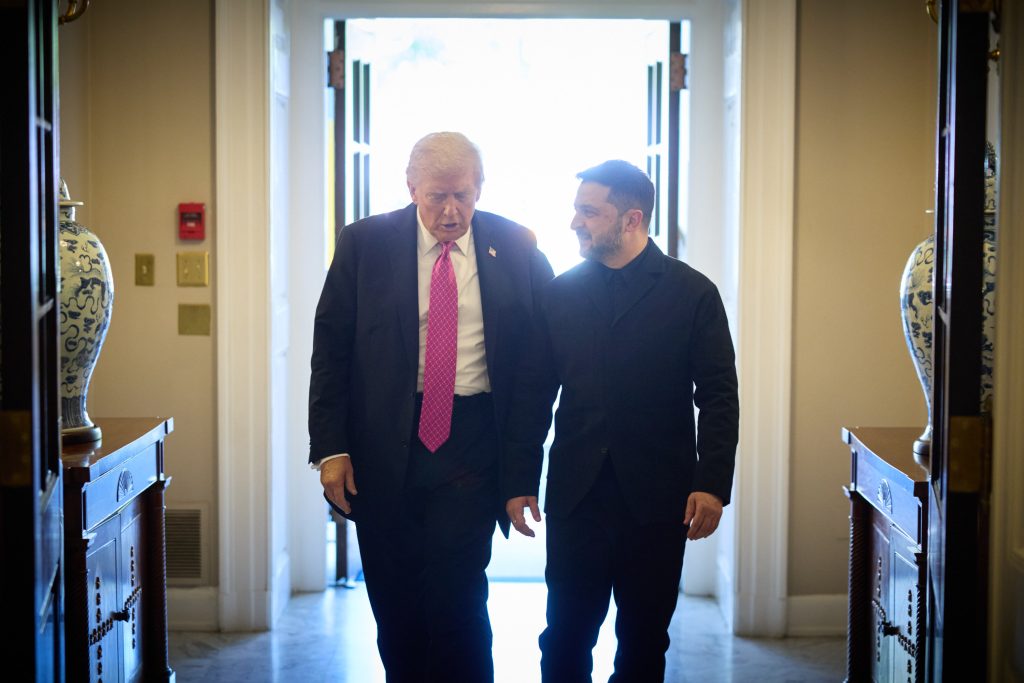
Photo: Ukrainian President Volodymyr Zelenskyy visits US President Donald Trump. Credit: President of Ukraine Website https://www.president.gov.ua/photos/robochij-vizit-prezidenta-ukrayini-do-ssha-7457
Since the United States has now effectively ended military equipment donations to Ukraine, the funding would have to come from European governments. And they might be better advised to channel the estimated $125m–$200m they would cost (assuming a per-unit cost of $2.5m–$4m) directly into Ukraine’s missile industry.
Given that expanding Ukraine’s domestic missile production remains a major strategic priority, this may represent the more beneficial option. In any case, the supply of Tomahawks to Ukraine will not decide the war.
What matters far more is that European governments continue to invest substantial funds directly into Ukraine’s missile sector.
Small businesses, startups, or individuals can create an online presence without going over budget with a cheap website design. A good low-cost website design still offers necessary features like clear layouts, responsive performance, and simple navigation, even though its main goal is to keep costs down. Businesses can create a polished website that successfully conveys their brand by utilizing open-source platforms, pre-made templates, and affordable tools.
The Warning Tape Singapore by Singhal Industries Private Limited for Singapore markets is impressive in strength and visibility. The tape’s high-quality material ensures resistance to tearing and fading, making it ideal for both indoor and outdoor safety marking. I found it particularly useful for industrial sites where clear hazard communication is essential. Its bright coloration and crisp printing stand out even in low-light conditions. The tape also withstands humidity and frequent handling, which is important in Singapore’s climate. Overall, it is a dependable and durable solution for professional safety requirements.
As a Partner and Co-Founder of Predictiv and PredictivAsia, Jon specializes in management performance and organizational effectiveness for both domestic and international clients. He is an editor and author whose works include Invisible Advantage: How Intangilbles are Driving Business Performance. Learn more...




2 comments:
Small businesses, startups, or individuals can create an online presence without going over budget with a cheap website design. A good low-cost website design still offers necessary features like clear layouts, responsive performance, and simple navigation, even though its main goal is to keep costs down. Businesses can create a polished website that successfully conveys their brand by utilizing open-source platforms, pre-made templates, and affordable tools.
The Warning Tape Singapore by Singhal Industries Private Limited for Singapore markets is impressive in strength and visibility. The tape’s high-quality material ensures resistance to tearing and fading, making it ideal for both indoor and outdoor safety marking. I found it particularly useful for industrial sites where clear hazard communication is essential. Its bright coloration and crisp printing stand out even in low-light conditions. The tape also withstands humidity and frequent handling, which is important in Singapore’s climate. Overall, it is a dependable and durable solution for professional safety requirements.
Post a Comment