Ukrainian F 16s With Laser "Sniper" Pods Raise Shoot Down Rate To 97%
Ukraine has quietly armed its F-16s with laser-guided sniper pods that significantly increase accuracy and lethality in shooting down Russian Shahed drones and cruise missiles.
The success is so dramatic that as of last week, 97% of Russian missiles fired at Ukrainian cities were shot down. JL
David Axe reports in Trench Art:
Ukrainian forces shot down 34 out of 35 cruise missiles Russian forces launched at Ukrainian cities on the night of 22-23 December. The cruise missiles were "mainly" shot down by the air force's ex NATO F-16 fighters. The 97% intercept rate marks a dramatic improvement—and points to new hardware transforming what Ukraine's jets can do, and at what cost. Ukraine has received 50 out of 90 of the F-16s that a Belgian-Danish-Dutch-Norwegian consortium pledged. The $2-million Sniper pod is a passive sensor - it doesn't emit radiation—and thus doesn't betray the F-16's location. A pilot can switch off his radar, go emissions "silent" and still detect and shoot down a cruise missile or Shahed drone on radar, or on the pod's cameras, that "designates" the target for laser-guided weapons.
Ukrainian forces shot down 34 out of 35 cruise missiles Russian forces launched at Ukrainian cities on the night of 22-23 December. Col. Yurii Ihnat, head of communications for the Ukrainian air force, toldUkrainian Pravda the cruise missiles were "mainly" shot down by the air force's ex-European F-16 fighters.
The 97% intercept rate marks a dramatic improvement—and points to new hardware that's quietly transforming what Ukraine's jets can do, and at what cost.
Ukraine has received around 50 out of 90 or so of the supersonic F-16s that a Belgian-Danish-Dutch-Norwegian consortium pledged back in 2023. Four of the nimble, 1980s-vintage—but heavily upgraded—jets have crashed or been shot down since the type flew its first combat sortie over Ukraine in August 2024.
The survivors stay very busy jamming Russian radars, lobbing satellite-guided bombs at Russian troops, and patrolling for Russian cruise missiles and Shahed drones. Recent additions to the F-16s' sensor suites are making them much more effective.
What Sniper pods bring to the fight
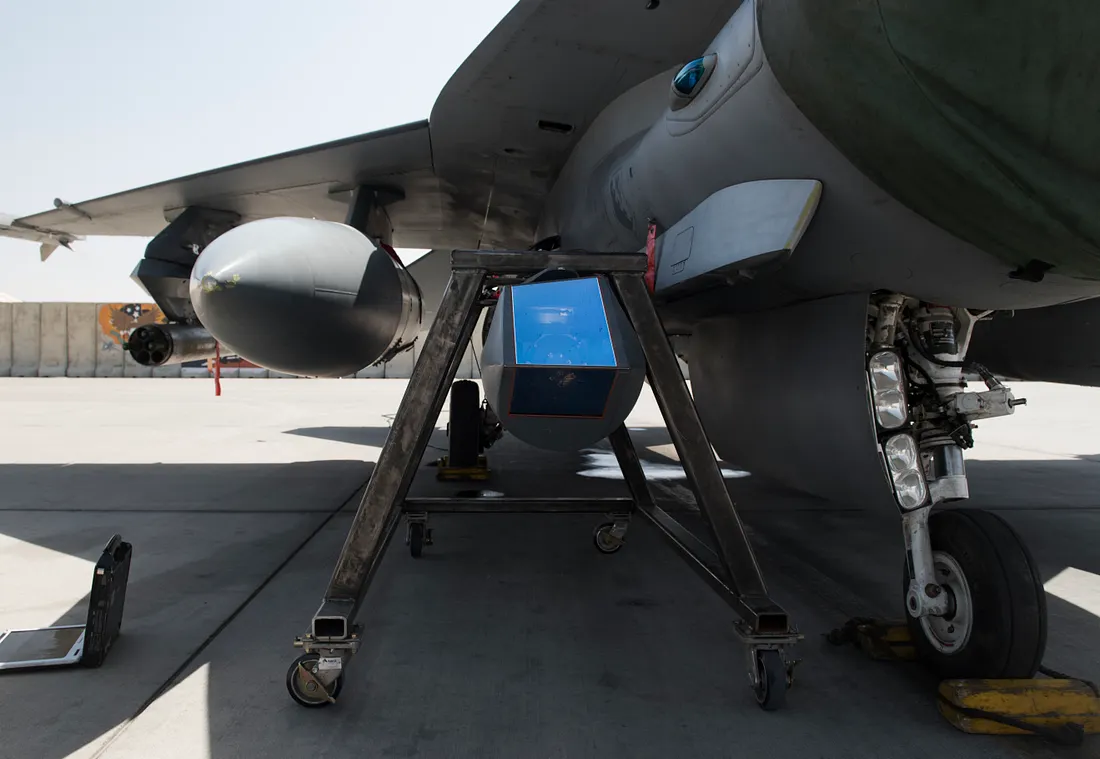
The Sniper XP Pod on an F-16. DoD Public Domain
In early December, the first images appeared online depicting Ukrainian F-16s with Sniper targeting pods under their inlets. Additional imagery confirms the jets are flying with the pods, which include daylight and infrared cameras as well as a laser designator.
While the F-16's nose-mounted APG-66(V)2A radar is still its primary sensor, the $2-million Sniper pod is an important addition. It's a passive sensor, meaning it doesn't emit radiation—and thus doesn't betray the F-16's location. A pilot can switch off his radar, go emissions "silent" and still detect and shoot at Russian targets.
Laser F-16s
The Sniper pod's laser might be its most important feature—and may explain why, all of the sudden, Ukraine's F-16s are shooting down so many Russian cruise missiles. A pilot can detect a cruise missile or Shahed drone on radar, or on the pod's cameras, and then "sparkle" it with the laser.
That "designates" the target for laser-guided weapons. It's no accident that the very first photo of a Ukrainian F-16 carrying a Sniper pod also depicted the same F-16 carrying a pair of seven-round launchers for AGR-20 Advanced Precision Kill Weapon Systems.
An F-16 with APKWS rockets. Photo: The War Zone.
The APKWS is a laser-guided rocket weighing 15 kg and ranging as far as 11 km. It is ideal for shooting down numerous targets, such as cruise missiles and Shaheds, in just a few passes. It's also cheap compared to bigger air-to-air missiles that, for anti-Shahed missions in particular, are frankly overkill.
A Shahed costs just $50,000. The F-16's infrared-guided air-to-air missile, the AIM-9, costs around $500,000 per round. A single APKWS rocket is priced to move at just $35,000, making it one of the few anti-Shahed munitions in the Ukrainian inventory that's cheaper than its intended target.
The cost math: rockets vs. missiles
Weapon system
Unit cost
Per sortie capacity
Cost efficiency
APKWS laser-guided rocket
~$35,000
14 rockets (2 pods)
Cost-effective
AIM-9 Sidewinder missile
~$400,000
6 missiles
Overkill
Shahed drone (target)
~$50,000
—
—
Hitting what GPS bombs can't
With Sniper pods, the F-16s also unlock another new capability. Last year, the United Kingdom pledged to Ukraine an unspecified number of 1,100-kg Paveway IV guided bombs. The $60,000 Paveway IV is unique in that it's primarily laser-guided, but also has back-up GPS and inertial guidance.
Where primarily GPS-guided bombs, such as Ukraine's American-made Joint Direct Attack Munitions, home in on pre-set coordinates, the Paveway IV follows a laser's sparkle. A skilled pilot can keep his Sniper pod's laser zeroed in on a moving target.
In short, JDAMs are best at striking stationary targets. Paveway IVs can hit moving ones such as mobile air defenses, vehicle convoys, and even ships at sea. The British bombs are the only precision air-to-ground munitions in the Ukrainian inventory with this moving-target capability. There are JDAMs with add-on laser seekers, but there's no evidence Ukraine has any of these bombs.
We haven't yet seen Ukrainian F-16s carrying Paveway IVs, but now that the fighters have Sniper pods with lasers, the pairing may break cover soon.
As a Partner and Co-Founder of Predictiv and PredictivAsia, Jon specializes in management performance and organizational effectiveness for both domestic and international clients. He is an editor and author whose works include Invisible Advantage: How Intangilbles are Driving Business Performance. Learn more...




0 comments:
Post a Comment