Russian Loss Of Front Starlink 'Catastrophic," Causing Friendly Fire, Attack Halt
SpaceX CEO Elon Musk restricted access to 'gray zone' Starlink terminal access, which was the only kind Russian troops were allowed to use - but which had become crucial to their operations.
The result, for Russian forces on the front line and in rear areas has been described as 'catastrophic, as units have lost the ability to communicate with each other, leading to friendly fire incidents and cancelled offensive operations. There is no known substitute available to Russia in the short term. And the Ukrainians are grateful that commercial considerations from licensed users forces SpaceX to enforce its own rules, which hurt the Russians. JL
Howard Altman and Tyler Rogovay report in The War Zone:
Russia isfrantically tryingto plug massive communications gaps afterSpaceXCEO Elon Musk restricted the Starlink satellite communications system in and around Ukraineto only registered users. Starlink gives users high bandwidth, secure communications anywhere. Replacing that capability, especially in the short term, is impossible. The situation is close to critical. Assault operations have been suspended, and unit command and control system is experiencing serious interruptions. It is virtually paralyzed. “Without stable comms on the front line, chaos begins, including incidents of friendly fire. Lack of coordination is already leading to heavy losses. It is a catastrophic situation.”
Russia is frantically trying to plug massive communications gaps after SpaceX CEO Elon Musk restricted the Starlink satellite communications system in and around Ukraine to only registered users. Both sides have relied very heavily on Starlink terminals for battlefield communications, and, more recently, Russians have been installing unregistered Starlink terminals on drones to provide beyond line-of-sight connectivity and resistance to jamming. This is a very troubling development for Ukraine, which is now experiencing attacks by drones suspected of using Starlink.
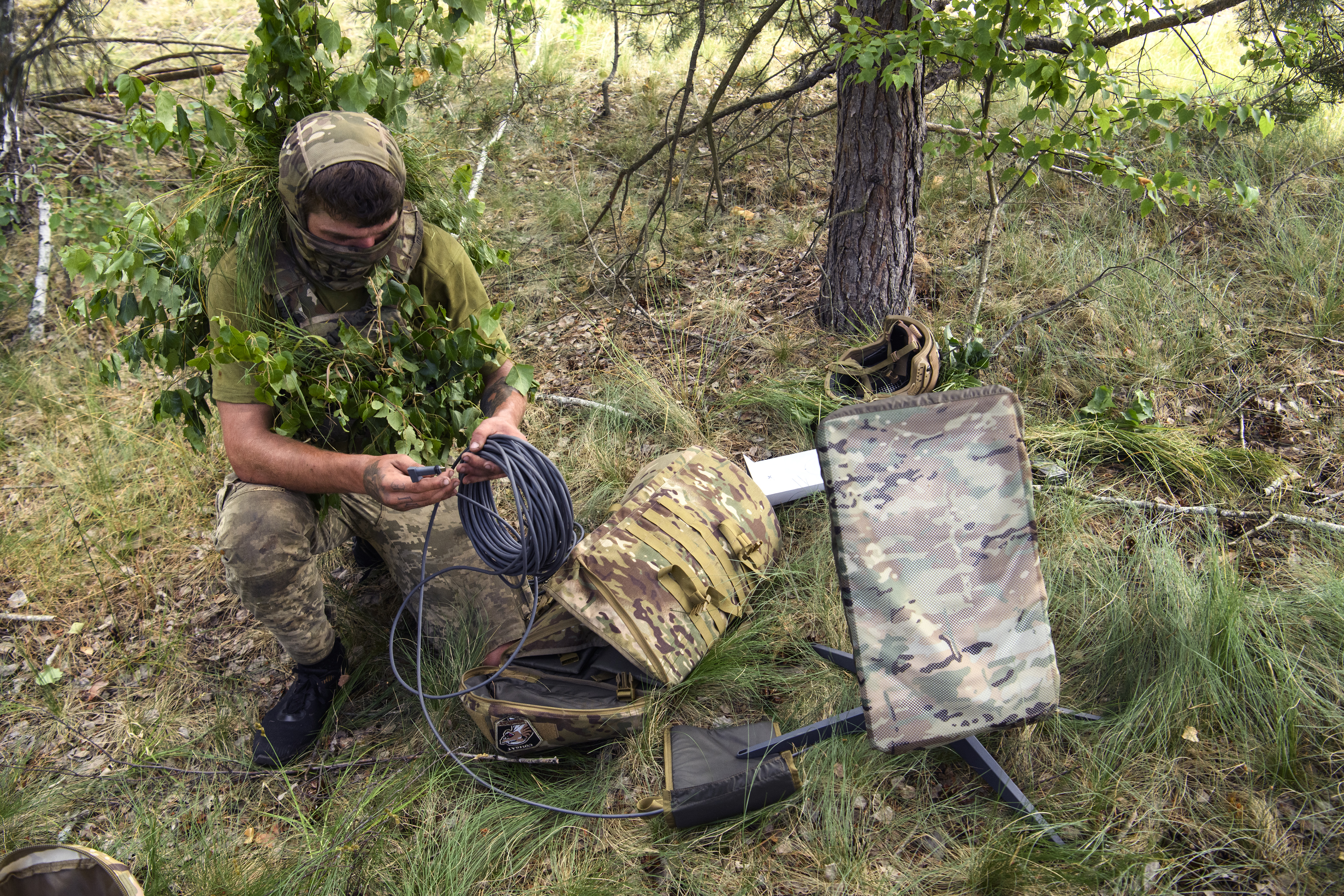
The introduction of Starlink to the battlefield in Ukraine has revolutionized how war is waged, giving users high bandwidth, relatively secure communications basically anywhere, all in a small, off-the-shelf package. This has impacted everything from high-level command and control, to basic communications and data exchange between troops across the entire battlespace. It has also enabled long-range drone warfare in new and surprising ways.
A Ukrainian soldier of the 61st Separate Mechanized Brigade uses the Starlink system during military exercises in the Chernihiv region, Ukraine, June 2023 (Photo by Maxym Marusenko/NurPhoto via Getty Images) NurPhoto
Replacing that capability, especially in the short term, is impossible. SpaceX’s massive constellation of mesh-networked satellites that makes up the Starlink system is groundbreaking and required a huge investment and constant space access over years to achieve. A case in point as to just how important Starlink has become on the battlefield in Ukraine is that SpaceX and Musk have faced criticism over how access to Starlink has been altered, even for Ukraine, throughout the war.
SpaceX’s enacting a “white list” of authorized Starlink terminals, which will allow Ukrainian forces to access the satellite constellation, followed what is essentially the company’s installation of speed-based ‘kill switches’ on the terminals to prevent their use on drones. The system cuts connectivity when movement “above approximately 75-90 km/h (47-56 mph),” is detected, DroneXL noted. “That threshold sits just below the cruising speed of the fixed-wing strike drones Russia has been mounting them on.” Still, there are ways around this, but the move will impact Russia’s ability to efficiently employ Starlink-equipped drones over long distances.
The white listing was apparently very effective, and almost immediately began impairing Moscow’s war effort, according to both sides.
“As a result” of the SpaceX action, “instead of a planned strike against the enemy, where their (meaning ours) communications are instantly cut off while theirs remains operational, we have a hellish mess,” Andrey Medvedev, Deputy Chairman of the Moscow City Duma and Deputy Director General for Radio Broadcasting of theVGTRKtelevision and radio company,stated on Telegram.
“Our forces are urgently trying to set up an analogue,” complained noted Russian milblogger Alexander Sladkov. “I recall a conversation with the military, who said that, in this case, a universal and extremely cheap solution is to have our own broadband communication, specifically in the combat zone… So a problem has arisen, and it’s probably being solved, but it certainly creates significant difficulties.”
“The fascist beloved by millions, Elon Musk, serves the interests of the Armed Forces of Ukraine,” the Russian Two Majors Telegram channel posited. “This may explain the massive failure of terminals that began yesterday evening on the front. In this way, the ‘genius’ adored by liberals once again assisted the Armed Forces of Ukraine in killing our soldiers.”
Russians blame Elon Musk’s decision to cut off unauthorized Starlink access for helping Ukraine kill its soldiers. (Photo by Harun Ozalp/Anadolu via Getty Images) Anadolu
“The fact is that in the absence of alternatives, the Russian Armed Forces use ‘grey Starlinks’ to organize communication on the front,” Two Majors added. “The danger is that this was an easy way compared to creating something of their own in space, dragging out eternally, tearing fiber optic cables, setting up ‘[WiFi] bridges’, or even working massively with digital stations to organize the transmission of small data packets. Now, either do it the old-fashioned way, or urgently come up with something of their own.”
“There are no alternatives [to Starlink] right now – at least not at the level of today,”the Russian Colonelcassad Telegram channel explained. It added that Russia is looking for workarounds, but nothing appears to be imminent.
The Russian Gazprom Space Systems satellite array is not a viable alternative at the moment, Rozin rightfully noted.
“There is Gazprom’s dish, it works, but, to put it mildly, it lags behind in connection speed and needs development or refinement. Of course, it is technically possible to provide high-speed internet in the fields by other methods, which many are currently working on.”
Russia is also exploring ways to bypass Musk’s white-listing or to rely on Chinese satellites, Colonelcassad added, but these alternatives “will take some time” to come to fruition.
Meanwhile, some Russian troops have gone public with pleas for equipment to help bridge the communications gaps caused by the Starlink restrictions.
The situation has become so concerning that Russian propagandist Vladimir Solovyov suggested attacking factories producing Starlink terminals or the satellites themselves. While this isn’t uncommon bluster from Solovyov, it underlines how big of an issue this is for Russian forces now left without a similar means of communications, which they have become reliant on.
The complaints aired by Russian milbloggers follow rave reviews Ukraine has given to the Starlink white listing. This isn’t surprising as it could be argued that shutting off Russia’s access to Starlink could be among the biggest sudden possible blows to its ability to fight with any cohesion.
Ukraine’s Stratcom Center claimed that, according to reports from the field, “assault operations have been suspended, and the unit command and control system is experiencing serious interruptions. The reason is the Starlink shutdown for Russian troops following the introduction of mandatory pre-registration.”
“According to reports from the front, the situation is close to critical,” the center added. “Over the two years of active Starlink deployment, almost all operational command and control—communication between units, fire coordination, and UAV data transmission—has been tied to the American satellite infrastructure. There has been no practical alternative comparable in stability and speed.”
Serhii “Flesh” Bezkrestnov, an adviser to the Ukrainian Defense Ministry, was even more effusive.
“The opponent on the fronts doesn’t even have a problem, the opponent has a disaster,” Bezkrestnov said in a post on Facebook. “All management of the troops has gone down. Assault actions have been stopped in many areas.”
“Without stable communication on the front line, chaos begins,” Atesh claimed. “Lack of coordination is already leading to heavy losses – and not just from the enemy.”
“On the Zaporizhia direction, due to a complete breakdown of communications, a typical case of ‘friendly fire’ occurred,” Atesh added. “Units, having no information about each other, opened fire on their own forces. As a result, an assault group of 12 people was completely destroyed by their own forces. The Russian army’s dependence on civilian technologies has worked against it. As soon as communication is lost, command collapses, and troops start exterminating themselves.”
While aimed at the Russians, Musk’s Starlink restrictions are also affecting Ukrainians who have yet to register their terminals.
“…at some places, Ukrainian military Starlinks, which have not been registered yet, have also been disconnected,” a Ukrainian soldier told Politico. “But the registration process is ongoing.”
“We continue to verify Starlink terminals,” Fedorov stated on Telegram. “The first batch of terminals that made it onto the ‘white list’ is already operational.”
These “white lists” are currently updated once a day, Fedorov added.
“If you submitted your terminal for registration but it’s not working yet, it’s worth waiting,” he pointed out. “This is a very large-scale process that takes time. In parallel, we are already working to ensure that data is submitted for verification in real time.”
of issues getting terminals properly recognized, this can only be seen as a large victory for Ukrainian forces facing another winter of tough fighting.
best website design combines visual appeal with functionality to create a smooth and engaging user experience. It features a clean layout, fast loading speed, mobile responsiveness, and clear navigation that helps visitors find information quickly.
As a Partner and Co-Founder of Predictiv and PredictivAsia, Jon specializes in management performance and organizational effectiveness for both domestic and international clients. He is an editor and author whose works include Invisible Advantage: How Intangilbles are Driving Business Performance. Learn more...





1 comments:
best website design combines visual appeal with functionality to create a smooth and engaging user experience. It features a clean layout, fast loading speed, mobile responsiveness, and clear navigation that helps visitors find information quickly.
Post a Comment