Russian Strikes Fall As Artillery Never Recovered From Arsenal Explosion A Year Ago
The explosion and fire at one of Russia's largest arsenals of artillery ammunition and components ten months ago has continued to affect the Kremlin military's ability to provide fire support to its troops.
The explosion, evidently caused by an accident rather than Ukrainian drone strikes or sabotage (that is what the Kremlin is claiming), destroyed not only a significant amount of inventory, but also the capacity to manufacture and deliver more as facilities, roads and railroad tracks were demolished. JL
David Obelcz reports in his substack, Malcontent News:
Last year an accident at the 51st Main Missile and Artillery Arsenal near Barsovo, Russia, 60 kilometers from Moscow, caused a chain reaction that destroyed almost half of the ammunition stored at the 3.5 square kilometer depot. 231.5 million pounds of ammunition were destroyed. Most of the remaining 160,000 tonnes were stored in above-ground Soviet-era sheds, protected only by earthen berms. The surviving ammunition was exposed to repeated shocks and intense heat for two days. In the following weeks, Russian artillery strikes dropped 15%. In the months that followed, the number of Russian artillery strikes in Ukraine has steadily declined.
Last year, an accident at the 51st Main Missile and Artillery Directorate (GRAU) Arsenal near Barsovo, Russia, caused a chain reaction that destroyed almost half of the ammunition stored at the 3.5 square kilometer (865 square acres) depot. In the months that followed, the number of Russian artillery strikes in Ukraine has steadily declined.
The first explosion was on the morning of April 22, 2025, and occurred in the area of the shed where railroad cars full of ammunition are unloaded, before being put on trains bound for parts of occupied Ukraine. Over the next two days, secondary explosions of artillery rounds, rockets, solid rocket fuel, and tactical ballistic missiles rocked the surround area in the Vladimir Oblast, 60 kilometers from Moscow. The Russian Ministry of Defense said the accident was caused by “a violation of safety regulations when handling explosive materials.”
Windows and doors were blown out over 6 kilometers away (3.75 miles). Unexploded ordnance fell in residential neighborhoods, parking lots, and fields. Eight surrounding villages, including Barsovo, just 1,200 meters (1 mile) from the depot, were evacuated.
The Kremlin reported there were no casualties, while Vladimir Oblast Governor Alexander Avdeev said four civilians were injured. Hundreds of homes and businesses were damaged.
Approximately 105,000 metric tonnes of ammunition (231.5 million pounds) were destroyed. Most of the remaining 160,000 tonnes were stored in above-ground Soviet-era sheds, protected only by earthen berms. The surviving ammunition was exposed to repeated shocks and intense heat for two days.
The blast also destroyed the railroad spur line in the depot and covered the arsenal in unexploded ordnance. Recovery work couldn’t start until engineers removed the unexploded munitions that littered the site and the surrounding area.
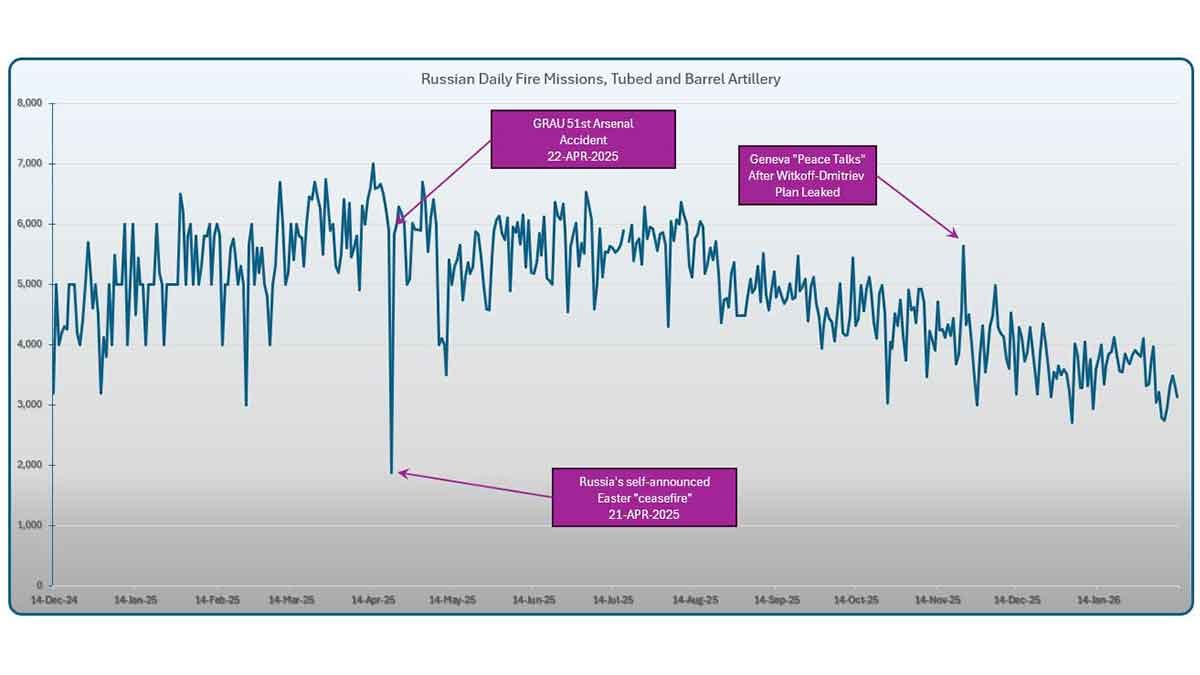
In the weeks that followed, the number of Russian artillery strikes in Ukraine, called fire missions, predictably dropped 15 percent, despite ongoing major offensives in the areas of Pokrovsk and the western edges of the Donetsk Oblast. Then something unexpected happened.
Daily Russian fire missions against Ukraine from December 14, 2024, to February 13, 2026, based on information by the General Staff of the Armed Forces of Ukraine
After holding at the reduced rate, the number of fire missions didn’t recover. Instead, they continued to drop.
As a Partner and Co-Founder of Predictiv and PredictivAsia, Jon specializes in management performance and organizational effectiveness for both domestic and international clients. He is an editor and author whose works include Invisible Advantage: How Intangilbles are Driving Business Performance. Learn more...




0 comments:
Post a Comment