Ukraine Counterattacks In 9 Sectors As Russian Starlink, Telegram Still Down
At the same time Elon Musk suspended illegal Starlink use by uncertified and - crucially - non-paying customers in the Russian military, the Kremlin suspended use of the Telegram social media platform, apparently not realizing how widely used it was by Russian troops for basic, reliable frontline communications.
The result has been chaos as Russian infantry, drone and air force coordination has all but ceased. Seeing the opportunity, Ukrainian forces have pounced and have made gains. JL
David Axe reports in Trench Art:
A powerful Ukrainian force attacked last week, taking advantage of confusion and paralysis in the Russian ranks resulting from an abrupt collapse in Russian command, air support and surveillance. The surprise decision by Elon Musk’s to brick Russia’s stolen and smuggled Starling terminals blinded and deafened Russian headquarters and grounded many Russian drones. At the same time, the Kremlin restricted military use of the Telegram social media platform to suppress dissent. Instead, it muted troops who had depended on the platform for communications. The moves hamstrung Russian forces all along the front line. Seizing the momentum, Ukrainian forces launched local counterattacks to clear out Russian infiltrators and stabilize their own defenses.
When billionaire Elon Musk blocked Russian forces' access to Starlink satellite navigation last week, it was a signal for Ukrainian forces to counterattack.
Now, several days into the Ukrainian operation in Dnipropetrovsk and neighboring Zaporizhzhia Oblast in southeastern Ukraine, it's apparent that the Ukrainians aren't actually aiming to break through Russian defenses and roll back recent Russian gains.
Instead, a powerful force of Ukrainian assault troops, supported by American-made tanks and infantry fighting vehicles, and Swedish-made armored personnel carriers, is trying to clear Russian infiltrators from the wide no-man's-land in Dnipropetrovsk and Zaporizhzhia—and establish new and stronger defensive positions in preparation for a renewed Russian offensive widely expected in the coming weeks.
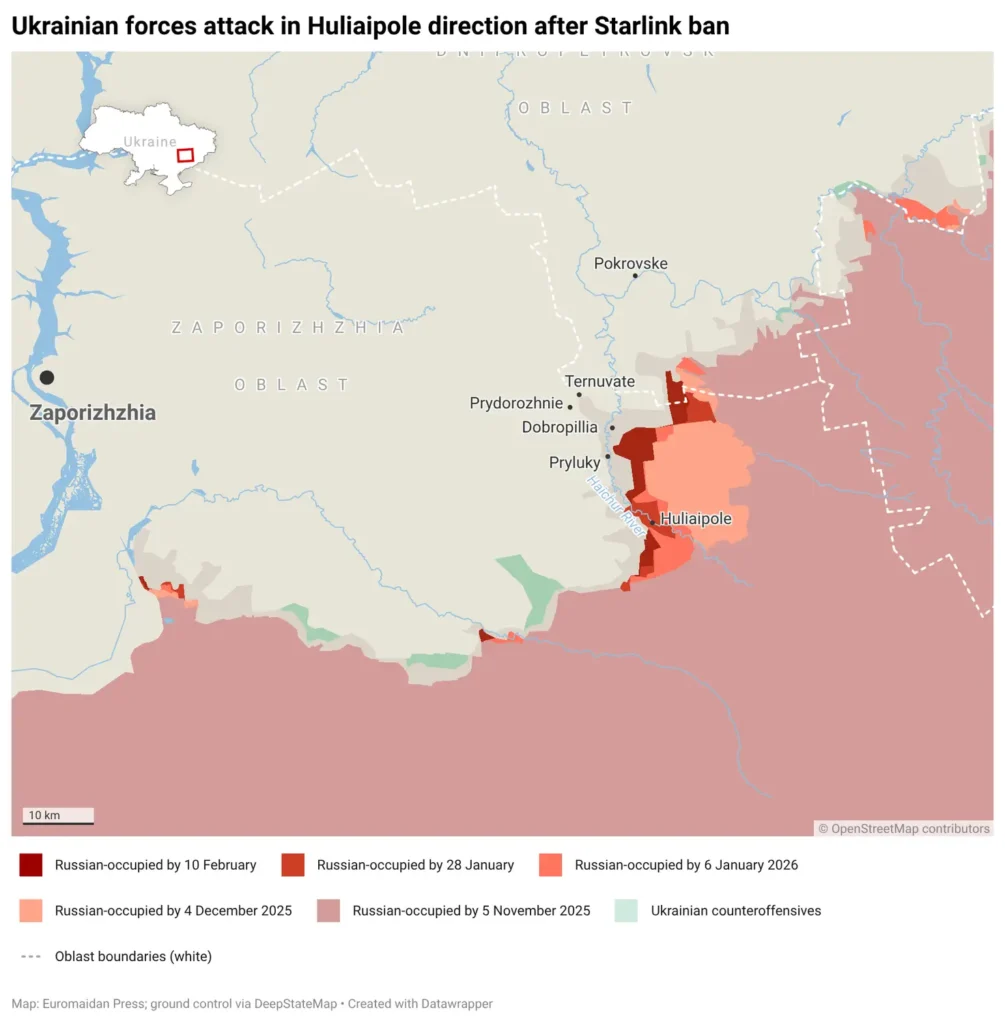
A powerful force of Ukrainian assault troopers is pushing back the first line of Russian troops around the ruins of Huliaipole, a logistical hub in Zaporizhzhia Oblast that the Russians captured in December.
The Ukrainians attacked last week, taking advantage of confusion and paralysis in the Russian ranks resulting from an abrupt collapse in Russian command, air support and surveillance.
In recent days, Ukrainian troops—possibly from the 24th or 33rd Assault Regiment—may have ejected Russian troops from the village of Pryluky, formerly a key Russian bridgehead on the left bank of the Haichur River.
The Ukrainians are winning right now because the Russians have lost access to some of their best communication systems.
The surprise decision by billionaire Elon Musk’s Starlink company to brick Russia’s stolen and smuggled satellite terminals last week blinded and deafened many Russian headquarters and grounded many Russian drones.
Around the same time, the Kremlin restricted military use of the Telegram social media platform. The move was supposed to suppress dissent. Instead, it muted troops who had depended on the platform for front-line communications.
The twin moves hamstrung Russian forces all along the 700-mile front line of Russia’s 48-month wider war on Ukraine. Seizing the momentum, Ukrainian forces launched local counterattacks mostly meant to clear out Russian infiltrators and stabilize their own defenses.
"This is not a counteroffensive, but a clearing operation," French mapper and analyst Clément Molin explained. That's not to say the current op isn't a top priority for Kyiv, however.
Russian forces led by the 127th Motor Rifle Division had been steadily advancing across Dnipropetrovsk and Zaporizhzhia before the bitter winter slowed their assaults. In a shocking upset for Ukrainian forces, the Russians even captured the town of Huliaipole—a key logistical node—when the outgunned Ukrainian territorial troops garrisoning the town retreated in late December.
Historically undermanned and lacking dense fortifications, the southeastern corner of the 1,200-km front line of Russia's 48-month wider war on Ukraine has long been the riskiest sector for the Ukrainians. The current clearing operation could finally stabilize Ukrainian defenses after months of instability.
In that sense, the current Starlink shutdown is the opportunity Ukrainian commanders have been desperate for. It's not an opportunity to go on offense. Instead, it's an opportunity for a more effective defense.
Ukrainian counterattacks in the southeast. Clément Molin map.
Stabilizing the southeast
The 127th Motor Rifle Division and the rest of the Russian Dnipro Group of Forces hold strong positions in a 30km line threading from Pokrovske in the north to Huliaipole in the south, running roughly parallel the Haichur River on the waterway's eastern bank. The no-man's-land or "gray zone," which neither side controls, straddles the Haichur.
This zone is infested with small teams of Russian infiltrators who march out on foot under the cover of winter fog—and often while wearing thermal camouflage. Doing their best to avoid Ukrainian drones, the infiltrators aim to march right past widely scattered Ukrainian positions in order to sow chaos and create lodgements for reinforcements.
To maximize their mobility, the infiltrators carry light weapons and few supplies. When food, water, and ammunition run low, they radio for resupply by aerial or ground drones. As often as not, these drones use—or used—Starlink terminals for navigation. When Musk consented to the Ukrainian defense ministry's request and throttled the Russians' stolen or smuggled Starlinks, all those infiltrators found themselves without support and resupply.
The Russian disposition in the gray zone between Pokrovske and Huliaipole was suddenly weaker than it had ever been. Seizing the opportunity, Ukrainian assault regiments and battalions—aggressive, well-equipped formations that answer directly to Ukrainian commander-in-chief Gen. Oleksandr Syrskyi—attacked along nine vectors in Dnipropetrovsk and Zaporizhzhia.
Situation in the Huliapole direction. Map: Euromaidan Press
At the cost of at least one Australian-donated M-1A1 Abrams tank and one ex-Swedish Pbv 302 armored personnel carrier, the assault troops quickly ejected Russian infiltrators from five settlements, including a few on the far side of the Haichur.
"After clearing some villages behind the Haichur River, Ukraine will probably try to establish a better defensive perimeter," Molin concluded.
"The priority is to secure Haichur River and Pokrovske approach," Molin added. "This will buy time for further fortification improvements in the area."
With Russian reinforcements still streaming into Ukraine, swelling the overall Russian force to a new high of around 715,000 troops, many observers expect the Russians to renew their two-year offensive as winter turns to spring. Thanks to the Starlink block and the current Ukrainian counterattacks, that offensive may run into much stiffer Ukrainian defenses in the southeast.
Apply for your New Zealand Student Visa with expert guidance from Zealand Immigration India. We provide complete assistance with documentation, eligibility checks, and application filing to ensure a smooth and successful visa process for your study abroad journey.
Great post! This is a very informative article on Horse Bridle Manufacturers, highlighting the importance of high-quality bridles for comfort, control, and safety while riding. The content is well-explained and easy to follow, making it valuable for anyone looking for reliable and durable horse riding equipment. At Khalique Sons International, we take pride in manufacturing premium horse bridles that combine strength, comfort, and long-lasting performance. Explore our range of products and experience superior quality today!
As a Partner and Co-Founder of Predictiv and PredictivAsia, Jon specializes in management performance and organizational effectiveness for both domestic and international clients. He is an editor and author whose works include Invisible Advantage: How Intangilbles are Driving Business Performance. Learn more...




2 comments:
Apply for your New Zealand Student Visa with expert guidance from Zealand Immigration India. We provide complete assistance with documentation, eligibility checks, and application filing to ensure a smooth and successful visa process for your study abroad journey.
Great post! This is a very informative article on Horse Bridle Manufacturers, highlighting the importance of high-quality bridles for comfort, control, and safety while riding. The content is well-explained and easy to follow, making it valuable for anyone looking for reliable and durable horse riding equipment.
At Khalique Sons International, we take pride in manufacturing premium horse bridles that combine strength, comfort, and long-lasting performance. Explore our range of products and experience superior quality today!
Post a Comment