Coordinated Attacks, Strategic Tradeoffs, Led To Ukraine's Winter Success
Ukraine's successful southern counteroffensive - which continues to gain ground - relied on several strategic tradeoffs that worked due to superior intelligence, elite troops and weaponry.
The Ukrainians launched coordinated and mutually supporting assaults on two different axes to spread the already undermanned Russians even thinner. And Kyiv also redeployed elite units - one with Australian-supplied M1 Abrams tanks - risking some loss around Pokrovsk vs advances in the south, which was deemed a net gain. Those bets have paid off. JL
RFU News reports:
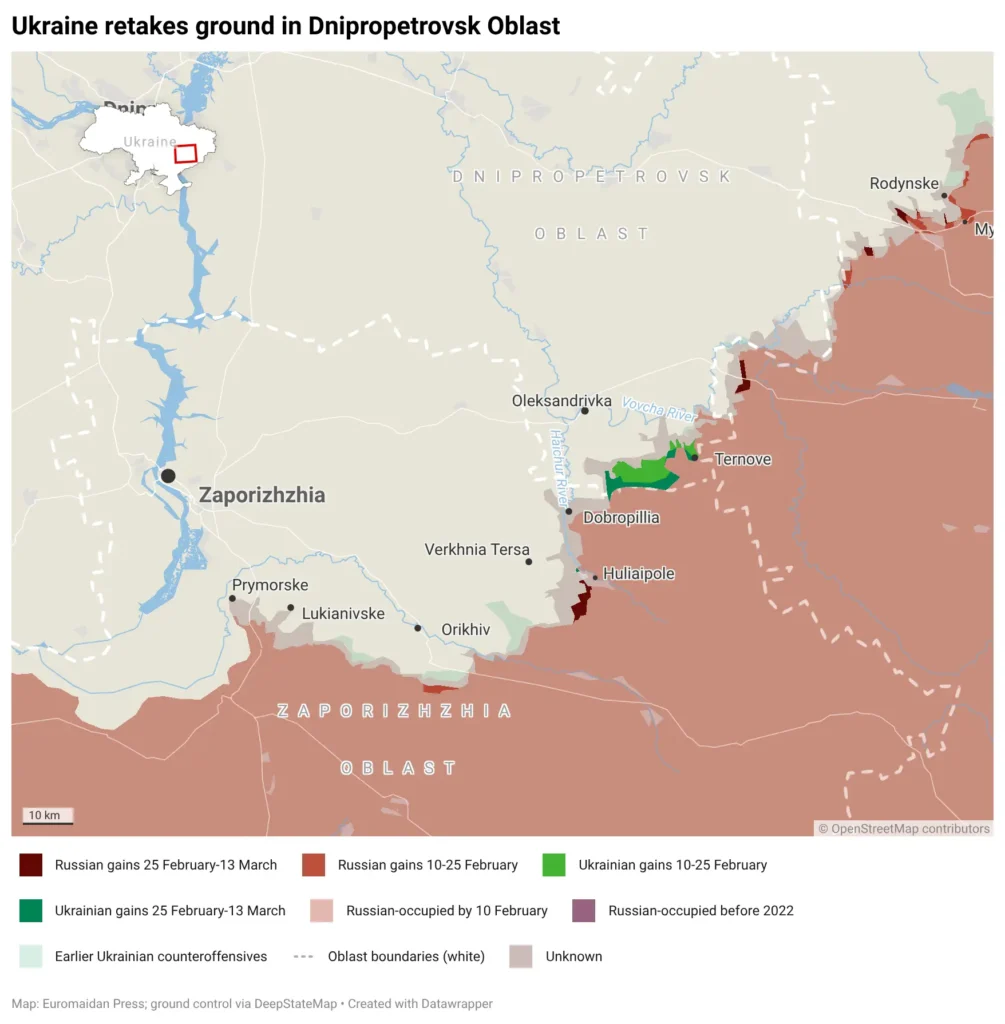
Ukraine's counteroffensive combined two mutually supporting drives—one toward Huliaipole in late 2025 and toward Oleksandrivka on 29 January 2026. Together, the two advanced 10 to 12 kms into Russian-held territory across the junction of Donetsk, Zaporizhzhia, and Dnipropetrovsk oblasts, then recapturing 285.6 square kilometers in February. The unexpected blocking of Russia's Starlink degraded Russian situational awareness and command-and-control on the Oleksandrivka axis. Russian units switched to large antennas mounted on high-rise rooftops which expose their positions and make them easier targets. The success was (due) to a deliberate tradeoff as Kyiv pulled elite units - including the 425th Assault Regiment and its Abrams tanks - south from Pokrovsk, accepting some losses in Donetsk in exchange for strategic gains in the southeast.
Ukrainian forces have recaptured more than 400 square kilometers of territory in a planned offensive on the Oleksandrivka axis—nearly clearing Dnipropetrovsk Oblast of Russian forces and marking the first time since the 2024 Kursk operation that Ukraine liberated more land in a month than Russia seized, Maj. Gen. Oleksandr Komarenko, head of the General Staff's Main Operational Directorate, told RBC-Ukraine on 10 March.
The operation collapsed Russia's stated plan to create a buffer zone in Dnipropetrovsk Oblast and forced Moscow to delay planned offensives, plug gaps in its defenses, and redeploy troops from other fronts, Commander-in-Chief Oleksandr Syrskyi stated on 9 March. Russia holds nearly a three-to-one troop advantage, but Ukraine's active operations are forcing it to react rather than advance.
February was also Russia's worst month for the pace of territorial advance since at least July 2024—a reversal that went largely unnoticed as international attention shifted to the crisis in the Middle East.
Map: Euromaidan Press
How the counteroffensive worked
The offensive combined two mutually supporting drives—one toward Huliaipole launched in late 2025 and the Oleksandrivka counterattack launched on 29 January 2026—carried out by Airborne Assault Forces with support from mechanized brigades.
Together, the two drives advanced 10 to 12 kilometers deep into Russian-held territory across the junction of Donetsk, Zaporizhzhia, and Dnipropetrovsk oblasts. The Airborne Assault Forces grouping alone recaptured 285.6 square kilometers in February.
ISW assessed the operation could disrupt Russia's planned spring-summer 2026 offensive campaign.
An unexpected factor accelerated the gains. SpaceX's blocking of Russia's Starlink satellite connection in Ukraine in early February degraded Russian situational awareness and command-and-control on the Oleksandrivka axis, according to Ukraine's Airborne Assault Forces. Russian units, having lost Starlink, switched to large antennas mounted on high-rise rooftops—which expose their positions and make them easier targets for Ukrainian strikes.
The counteroffensive was made possible by a deliberate tradeoff. As EP reported in February, Kyiv pulled elite assault units—including the 425th Assault Regiment and its Australian-donated Abrams tanks—south from the Pokrovsk axis to reinforce the Huliaipole sector, accepting incremental losses in Donetsk in exchange for strategic gains in the southeast.
As of 10 March, only three small settlements in Dnipropetrovsk Oblast remain to be cleared. Komarenko confirmed the goal Russia had been pursuing: "Their leadership constantly says they need the entire Donbas and a buffer zone. Their goal was to create a buffer zone in Dnipropetrovsk Oblast—that was their plan." That plan has now largely failed.
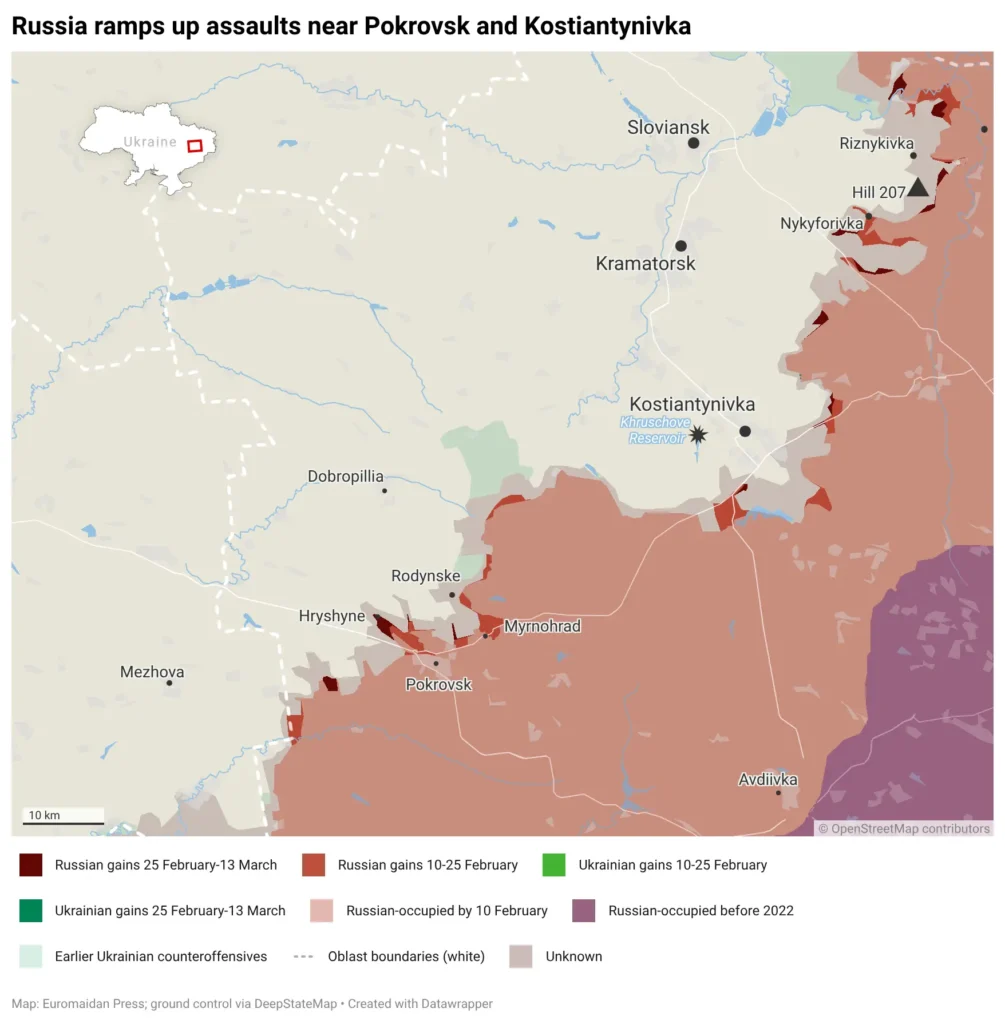
The most intense fighting continues around Hryshyne, Rodynske, and the Svitlye area, where Russian assault groups are trying to infiltrate deep into Ukrainian defenses. More than a third of all Russian attacks on the front are concentrated here, marking Pokrovsk as Moscow's top priority axis.
After seizing Pokrovsk following a two-year battle, Russian forces are now massing reserves for a fresh push. But the terrain works against the attackers, turning the area into a kill zone where assault groups absorb heavy losses.
The advance toward Mezhova and Dobropillia has stalled accordingly—though Russian forces captured Hryshyne, opening a potential path to Dobropillia.
Map: Euromaidan Press
Kostiantynivka: phosphorus, flooding, and civilian hunting
On 25 February, Russian forces destroyed the bridge and dam near Osykovo with a three-tonne guided aerial bomb, flooding the Oleksiyevo-Druzhkivka-Novoselivka road—one of two key supply routes into Kostiantynivka.
Since then, Russian forces have continued striking dams northwest of the city, forcing Ukrainian units to withdraw from flooded positions into permanent buildings in Kostiantynivka—where they become easier targets. The dam strike was part of a broader strangulation strategy that EP documented in early February, after Russian forces failed to take the city by direct assault.
The situation has worsened. Border guard pilots filmed Russian forces shelling the city with phosphorus munitions—a prohibited weapon. FPV drones are now hunting the roughly 2,000 civilians who remain. The 28th Mechanized Brigade released footage of a civilian killed by a Russian FPV drone while trying to leave the city on a bicycle—the operator could clearly see the target was not military.
On the ground, units of the 100th Mechanized Brigade destroyed and drove out most Russian assault groups from Kostiantynivka's southwestern outskirts, partially stabilizing that sector.
In January, EP reported that after being repulsed from the east and south, Russian forces opened a new infiltration axis from the west toward a gap in Ukrainian lines—threatening the city's main supply route.
The pattern continues. Russian infiltration groups are penetrating the city in a manner similar to the force accumulation that preceded the fall of Pokrovsk's residential areas. Attack intensity dropped compared to February, according to the 93rd Mechanized Brigade, but the infiltration demands sustained attention to prevent the loss of a critical urban defense hub. EP reported on 6 March that the 100th Brigade drove out the infiltrators—but the slow strangulation continues.
Kramatorsk and Sloviansk: building up, but limited gains
Russian troops continue to build offensive capabilities toward the fortified cities of northern Donetsk Oblast. Assault operations were recorded near Mankivka, Pryvillia, and Lipivka, west of Nykyforivka. On the southern flank, Russian forces made minor advances near Makove. None brought meaningful tactical advantage.
The Armed Forces of Ukraine are strengthening Kramatorsk, Sloviansk, and Dobropillia with additional defensive lines in the rear—preparing for a fight the Russians have not yet managed to bring to them.
Kharkiv: Russia's second buffer zone attempt
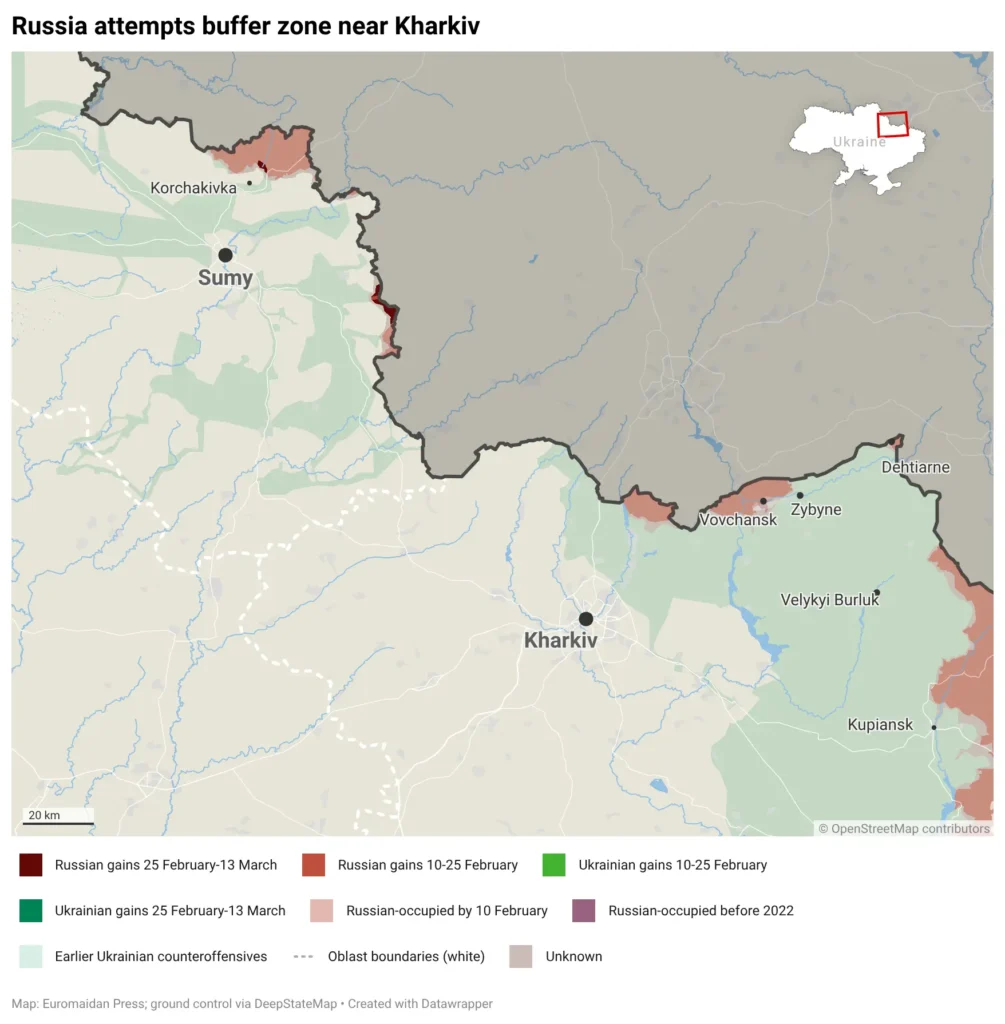
In Kharkiv Oblast, Russian forces appear to be building a buffer zone along the border—the same concept Komarenko confirmed Russia was pursuing in Dnipropetrovsk.
EP documented the pattern in February: probe, flank, lose troops, repeat—with small bridgeheads established but no deeper breakthrough achieved for months.
After occupying the ruins of Vovchansk, Russian troops attempted to expand their zone of control: they stormed the village of Zybine east of Vovchansk without success, and after taking the abandoned village of Dehtiarne, pushed toward Kruhle along the Vovchansk-Zemlyanki road. Similar activity near Velykyi Burluk suggests Russian assault units are trying to move toward each other from separate axes to stitch together the zone Putin first declared in 2024.
Unlike in Dnipropetrovsk, this buffer zone effort has not yet been dislodged. Zelenskyy responded on 3 March by calling for a buffer zone on Russian territory instead—arguing that only pushing artillery out of range can protect Kharkiv.
Map: Euromaidan Press
Rotation and reinforcement
The High Command approved a plan to rotate units that have spent more than six months continuously on the front line. Personnel are being directly replenished and equipment added to brigades deployed in critical areas. For units like those defending Kostiantynivka and Pokrovsk, fresh troops and gear could mean the difference between holding and gradual erosion
As a Partner and Co-Founder of Predictiv and PredictivAsia, Jon specializes in management performance and organizational effectiveness for both domestic and international clients. He is an editor and author whose works include Invisible Advantage: How Intangilbles are Driving Business Performance. Learn more...




0 comments:
Post a Comment