Myth Vs Reality: Scaling Up Ukraine's Drone War Required Structure, Training
It is fascinating how Ukraine's success in drone warfare is so similar to business adaptation. Instead of the 'plug and play' myth, effective implementation requires serious training and organizational changes to optimize impact on desired outcomes.
Ukraine has evolved from an early 'cowboy' phase driven by passionate volunteers to an increasingly institutionalized system in which purposeful recruitment, training and organization have replaced ad hoc approaches. The result can now be seen, four years into the war, as Ukraine, with far fewer soldiers, has fought Russia to a standstill and has now seized the offensive momentum, largely through the increasingly effective and lethal application of its operationally focused drone forces. JL
Oleksandra Molloy reports in The Australian Army Research Center:
The learning curve for drone piloting in combat is (challenging). Battlefield awareness is essential. Uncrewed systems remain highly dependent on people. Flying a drone is not simple. Each system is different; each mission is complex. Without proper training, drones are wasted. Investing in platforms means investing in people. Technical proficiency must be integrated with tactical awareness, coordination, survivability, and mission execution under fire. Humans are required for tasking, targeting, mission control, technical support, communications, logistics, power supply, and intelligence. Drone units must be institutionalised within the order of battle, integrated into established fire and manoeuvre systems. Deployment requires organisational structures: dedicated UAV platoons, companies, and battalions with defined command and standardised procedures.
Uncrewed systems across domains (UxS), or drones, have become central in the Russia-Ukraine War. Their widespread use challenges established assumptions about airpower, force protection, and technological advantage in modern warfare. The Russia-Ukraine war is characterised by continuous change driven by rapid battlefield innovation, accelerated adaptation cycles, and persistent contestation across the air and electromagnetic domains.[1] Static conceptual frameworks rapidly lose explanatory power, yet operational myths continue not only to emerge and endure—but to evolve at speed. The transition from myth to operational reality, or vice versa, occurs not over decades, but within weeks, underscoring the compressed timescale of military innovation in high-intensity conflict.[2]
Ukraine has invalidated two dominant pre-war myths: that drones would deliver decisive effects through technological superiority, and that they would be rapidly neutralised by air defences and electronic warfare (EW). Instead, drone warfare has emerged as a domain characterised by mass, attrition, and continuous adaptation, with UAS integrated across the full targeting cycle (find, fix, track, target, engage, assess) within distributed kill webs. The Armed Forces of Ukraine (AFU) have often demonstrated that what seems to be a ‘myth’ can become ‘an operational reality’. However, the further from the operational reality in Ukraine, the more myths persist.
What follows is the first of a two part series on the myths versus operational realities of UxS use in the Russia-Ukraine War. Each part will explore six of these myths.
Why do myths persist?
Myths about UxS and counter-UAS (C-UAS) continue to shape professional military organisations and public discourse. This tendency is not due to a failure of evidence but is instead a consequence of how organisations learn (i.e., militaries observe, interpret, and institutionalise experience from the conflicts, or fail to do so), how individual experience shapes the formation of beliefs, and how cognitive bias affect decision-making.
Learning in war is uneven and localised. Context matters. Units operating in relatively permissive sectors may experience small UAS as highly effective and survivable, reinforcing beliefs in technological dominance. Conversely, formations operating under conditions of dense EW and layered defences may find the same systems fragile and easily neutralised. Both conclusions are empirically valid within their local context. Individual experience further shapes belief formation.[3] Combat is filtered through what soldiers and commanders personally observe rather than through aggregated operational data. Success with a particular system at a certain location is readily generalised into assumed truth, while contradictory experiences produce competing narratives.[4] These narratives coexist because they are rooted in authentic but partial experience rather than comprehensive operational analysis.
Next, organisational learning is also constrained by institutional lag. Militaries identify lessons slowly, while conflicts evolve rapidly. In Ukraine, tactical adaptation cycles measured in weeks contrast sharply with Western militaries’ experience of multi-year timelines for doctrine, capability development, and procurement. As a result, pre-war conceptual frameworks continue to structure professional thinking even when battlefield evidence increasingly contradicts them.[5] The information environment further reinforces selective learning. Ukraine has generated unprecedented volumes of tactical footage and open-source reporting of both successes and failures concerning the reality of sustained attrition and incremental adaptation. This visibility bias enables exceptional cases to be generalised into claims of systemic effectiveness, sustaining myths through anecdote rather than operational synthesis.[6] Together, these dynamics explain why myths about UxS and C-UAS endure despite extensive combat data. They are not simply misconceptions, but artefacts of fragmented experience, uneven learning, and cognitive bias.
This series of Land Power Forum posts forms part of a broader evidence-based research project (2024–2026) on lessons learnt from drone warfare in Ukraine, based on input from Ukrainian and Australian experts from their respective defence organisations and defence industries. The research highlights the need for the Australian Defence Force, its allies and partners (i.e., NATO) to institutionalise continuous processes for identifying the right lessons and implementing them through iterative adaptation cycles. This will entail identifying operational problems, designing responses, adapting organisational practices, and implementing change. Such competitive adaptation cycles are consistent with Boyd’s observe–orient–decide–act (OODA) model,[7] military adaptation theory, and NATO’s Warfighting Capstone Concept that emphasises sustained learning, experimentation, and force-level adaptation in contested environments.[8] Accordingly, this post adopts a ’myth versus operational reality’ framework to interrogate key assumptions about uncrewed warfare and counter-UAS effectiveness.
Myth 1: Drones will completely replace people on the battlefield
Operational reality. In reality – no they won’t. Even the smartest UAS depends on target-tasking and target designation, operators, technical support specialists, communications, logistics, power supply, and intelligence data. The EW environment, weather factors, and the need to make decisions regarding UAS employment, all ensure that humans remain the key element of control. Drones are displacing the role of some soldiers on the battlefield, not replacing them.[9] The myth that UAS are better than soldiers is simply incorrect. Certainly, UAS can perform a full range of effects across battlefield operating systems (BOS) spectrum. However, it remains the soldier who is ultimately responsible for taking and holding the ground. The UAS deliver the effect that enables the soldier to do so. In this equation, military capability multiplies when UAS and soldiers are sufficiently integrated to fully complement each other.
A persistent assumption in debates on uncrewed and autonomous systems is that drones will ultimately replace human combatants, removing soldiers from the battlefield and rendering human decision-making obsolete. Evidence from contemporary conflicts, particularly from Ukraine, rejects this assumption. Rather than replacing people, drones have increased the demand for human labour, judgement, and organisational capacity across the kill chain. Further, uncrewed systems do not replace soldiers in key battlefield functions such as manoeuvre, occupation, and control of terrain. They enhance sensing and striking, but they cannot hold ground, reassure populations, or exercise authority. Ukraine illustrates that drones amplify the effectiveness of infantry and artillery rather than being a substitute for them, reinforcing the continued centrality of human forces in combined arms operations.[10]
At present, uncrewed systems remain highly dependent on human operators for tasking, targeting, and mission control. Even when automated functions such as navigation or target cueing are employed, decisions about lethal action, prioritisation, and integration with manoeuvre and fires remain human-centred.[11] Doctrinally, Western militaries continue to emphasise human responsibility in command-and-control and the employment of force, reflecting both operational necessity and legal obligations.[12]
Rather than substituting the need for military men and women, operational experience in Ukraine illustrates that drones expand the human component of warfare. Drone warfare has generated new military occupational specialities – First Person View (FPV) drone pilots, EW teams, imagery analysts, and rapid-modification units – while also increasing the tempo of human decision-making within the sensor-to-shooter kill chain.[13]
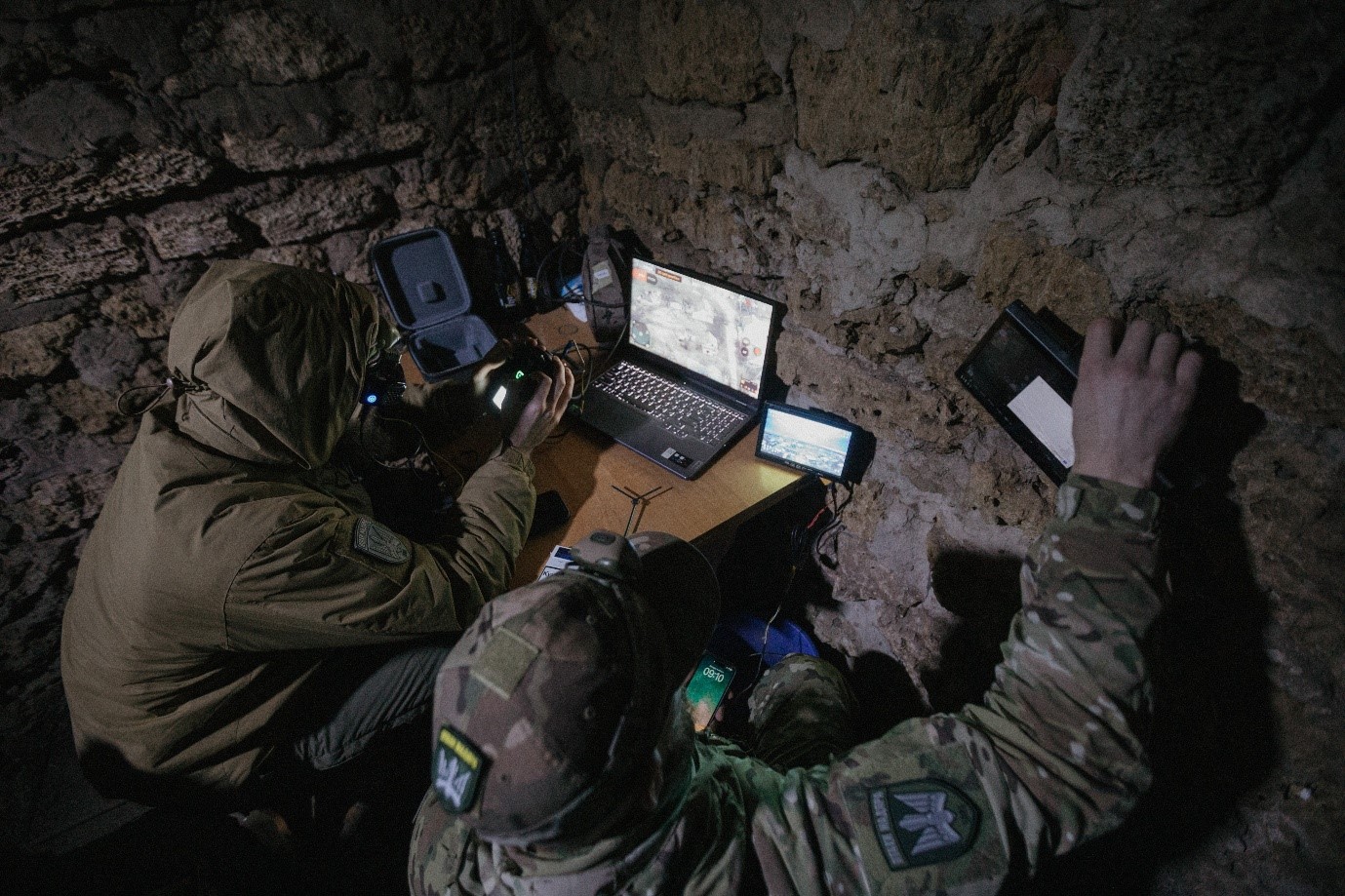
Thanks to FPV technologies, asymmetric actions against high-value weapons systems and military equipment have become highly effective: even small teams can destroy radar systems, EW stations, missile launchers, air-defence assets, communications systems, armoured vehicles, headquarters, and enemy columns. This development radically reduces reliance on massed offensives and large quantities of equipment, while also enabling strikes against port infrastructure and the destruction of ships. This capability has boosted the effectiveness of UxS for small teams. But the people in these teams have not been replaced (see Figure 1).
Figure 1. A team of Ukrainian drone operators performs a mission. (Credit: Magyar Birds. Photo reproduced with permission from the owner).
Myth 2: Learning to fly – even complex drones – is very difficult
Operational Reality. The reality is that the initial learning curve for drone piloting is comparatively easy. It does not take long to obtain basic piloting skills, but employing a drone effectively in combat conditions is a different matter. Battlefield awareness is essential to constantly track, analyse, and understand the operating environment (i.e., your own forces, adjacent units, and the adversary). It is also crucial in any effort to identify what aspects of drone technology can be adopted quickly (e.g. new methods, new adaptations). This includes whether the platform should be physically modified, the communications links changed, the employment concepts adjusted, or the procedures revised.
Interviewees noted the following when discussing the physical skills of flying UxS.
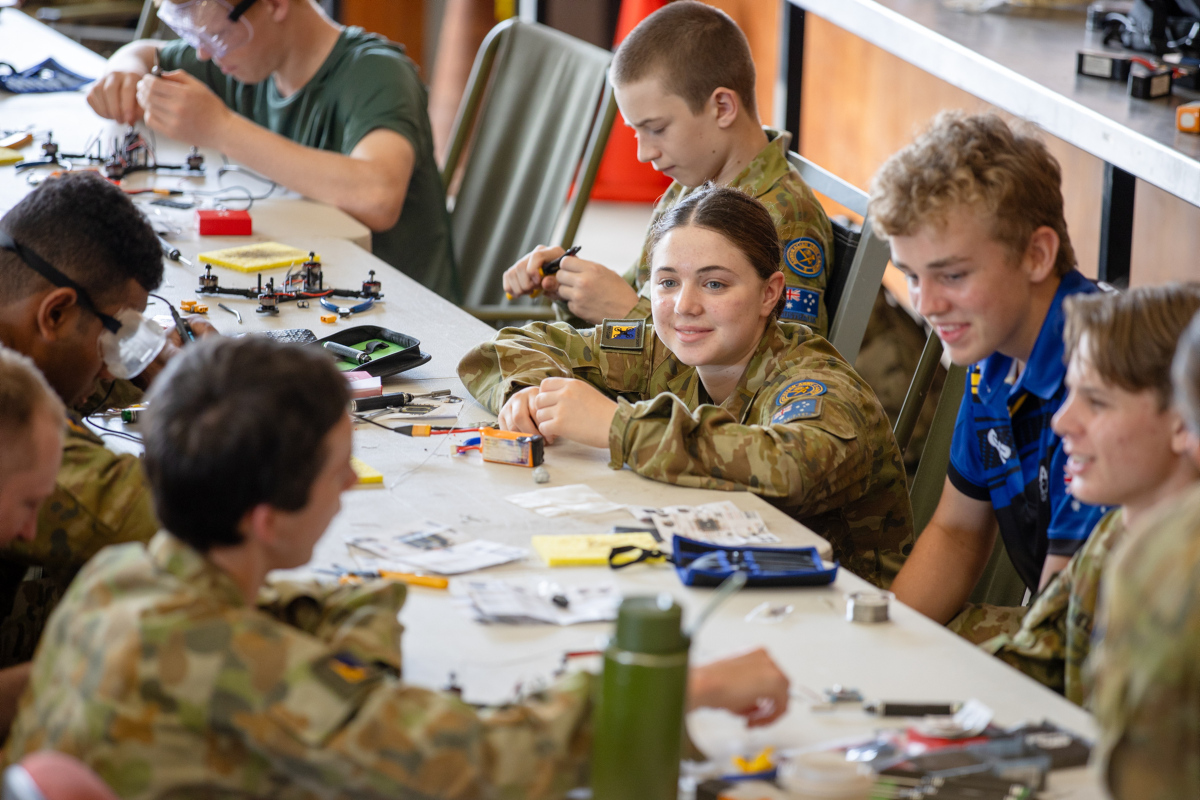
Any person under the age of 25 already has the eye-thumb cognitive ability wired into them. Anybody who’s part of the ‘PlayStation generation’ can fly a drone, and actually we see it in the drone racing. We don’t even have to teach the kids how to fly when we’re at these events. We literally just put a laptop with a simulator and a controller in front of them. At times they figure it out within 30 seconds. All we show them is the reset button. When they crash, they press it and then they learn. The way I like to contextualise that is at air shows, when I’m talking to a group of kids, and their parents in particular, I’ll point at a really sexy airplane and will say, look at that, 1 per cent of you can fly that. Look at this, pointing to a drone, 99 per cent of you can fly that. (see Figure 2; P2)
Many people do not realise this. The truth is that basic proficiency is relatively easy to acquire. The initial learning curve is fairly straightforward. It does not take long to learn fundamental control skills. What matters is the ability to process and apply information quickly –understanding systems, frequencies, countermeasures, and tactics. (P33).
Figure 2. Australian Army Cadets collaborate on constructing drones during day one of the First Person View Drone Camp at Gallipoli Barracks. Photo credit: Defence (obtained from http://images.defence.gov.au/20240116army8645194_0018.jpg)
Interestingly, flying an FPV mission on the frontline is completely different to flying a drone in a drone racing competition. Hence, training is highly important. Technology itself is overrated, because drones are not fully autonomous and are not flying on their own, identifying targets, and striking into them. Human element is still quite profound, and training aspect must not be underestimated. According to the Ukraine Defence Forces, up to 60 per cent of drone losses early in the war were due to poor pilot training.
The truth is that flying a drone is not simple. Each system is different; each mission is complex that requires thorough preparation, and without proper training, drones are wasted. The message to the ADF and partners, the message is clear: investing in platforms means nothing if not to invest in people. The drone war is not just about technology; it is also about training. Flying a drone is not the same as applying drone tactics in combat. Technical proficiency must be integrated with tactical awareness, coordination, survivability, and mission execution under fire.[14]
Myth 3: You can just bolt drones on small, roaming ‘drone groups’ or volunteer teams without changing the core military structure
Operational reality. While the technological evolution of UxS has been rapid, the real transformation is organisational. Experience from Ukraine demonstrates that drones cannot be effectively employed as an auxiliary or volunteer-led capability appended to existing force structures. Treating UxS as an ad hoc supplement to legacy formations obscures both their operational value and their true resource burden. Instead, drones must be institutionalised within the formal order of battle and integrated into established fire and manoeuvre systems.
Operationally, effective UxS employment requires purpose-built organisational structures. This includes dedicated UAV platoons, companies, and battalions with defined command relationships, trained personnel, and standardised procedures. In Ukraine, early reliance on informal volunteer drone teams produced tactical effects but lacked sustainability, coherence, and integration with artillery and manoeuvre units. In the early stages of the war, Russian use of conventional strike aircraft gave way to uncrewed long-range strike, which combined drones and missiles. The Ukrainians effectively responded with layered defences to mitigate Russian overmatch. Over time, both Ukrainian and Russian forces evolved to formalise drone units within brigades and higher headquarters, embedding them within targeting cells and fire support coordination processes.[15]
Integration into the fire system is critical. Drones function most effectively as components of the sensor-to-shooter kill chain, linking reconnaissance, target acquisition, fire direction, and battle damage assessment. Achieving this requires that doctrine is aligned with fire support coordination measures, targeting authorities, and command-and-control architectures rather than parallel or informal employment.[16] In the Russia-Ukraine War, units that retained traditional fire systems while merely adding small drone teams struggled to exploit the full operational potential of UxS, particularly under conditions of EW and high attrition.
The sustainment overhead of using drones further undermines the notion that they are a low-cost, low-overhead capability. High sortie rates, short platform lifespans, and intensive electronic contestation impose substantial logistical demands. Batteries, motors, airframes, sensors, frequencies, and software all require continuous replacement and modification. Tens of Mavic-type drones are lost per day in one brigade, which is tens of thousands of dollars daily – that demands proper staffing, procurement, write-off procedures, training, etc. Ukraine has shown that mass drone employment entails industrial-scale sustainment pipelines comparable in complexity—if not in unit cost—to conventional munitions supply. Volunteer teams operating outside formal logistics systems cannot support this scale or tempo of operations over time.
Human capital is equally decisive. Effective drone operations depend on trained pilots, maintainers, intelligence analysts, EW specialists, and command staff. In Ukraine, it takes an average of three months, where each type of a UAS (i.e., FPV, fibre-optic model, interceptor, or a reconnaissance platform) requires a distinct set of skills. The role of trained engineers should not be overlooked either. As observed by one of the participants:
Pilots can’t master a single platform because they constantly fly different airframes. It’s the engineer who ensures each new machine won’t fail…We test frequencies against jamming, calibrate video channels for peak antenna power. You won’t learn this without obsessive hands-on engineering. Hence, militaries should start training their crews as quickly as possible. (P29)
Governments can obtain thousands of uncrewed systems, but without trained personnel to operate them, the equipment becomes useless. Acknowledging the range and importance of professional skills required in drone warfare comes with a further acknowledgement that these roles must be professionalised through military training systems, rather than improvised using the expertise of civilian hobbyists. Moreover, as UxS has become embedded in fire control and manoeuvre planning, commanders must have opportunities for professional development so that they can employ the capability doctrinally rather than opportunistically.[17]
Finally, organisational integration is essential for learning and adaptation. Formal units enable the systematic collection of lessons, standardisation of tactics, and dissemination of innovation across the force. Informal drone groups, by contrast, tend to generate highly localised knowledge that is difficult to scale or institutionalise. Ukraine’s experience illustrates that battlefield innovation becomes operationally decisive only when translated into enduring organisational practice rather than remaining the preserve of isolated teams.[18]
Given these considerations, drones must be built into the official order of battle and fire system – with dedicated UAV platoons/companies/battalions, manpower, logistics, budgets and procedures – or both their value and their cost will be completely misunderstood. For example, in Ukraine a detached unit that ‘just worked here and there’—counting a few launches and losses —may conclude that ‘drones aren’t that special’ and that ‘classic systems would have been enough’. Such teams would be outside the unit’s fire system and command structure, so it may be fair for them to conclude the drone effects are both limited and messy.
If drones sit “out of system” in ad hoc groups, commanders don’t see their real role in the fire plan, and outsiders (like the representative from the Armed Forces of the Slovak Republic)[19] has drawn totally wrong conclusions about their effectiveness, although some aspects were valid, based on individual experience, they do not reflect the broader system’s perspective. If you don’t structurally integrate drones into your force design and C2, you haven’t actually learned the drone lessons from Ukraine at all. (P4)
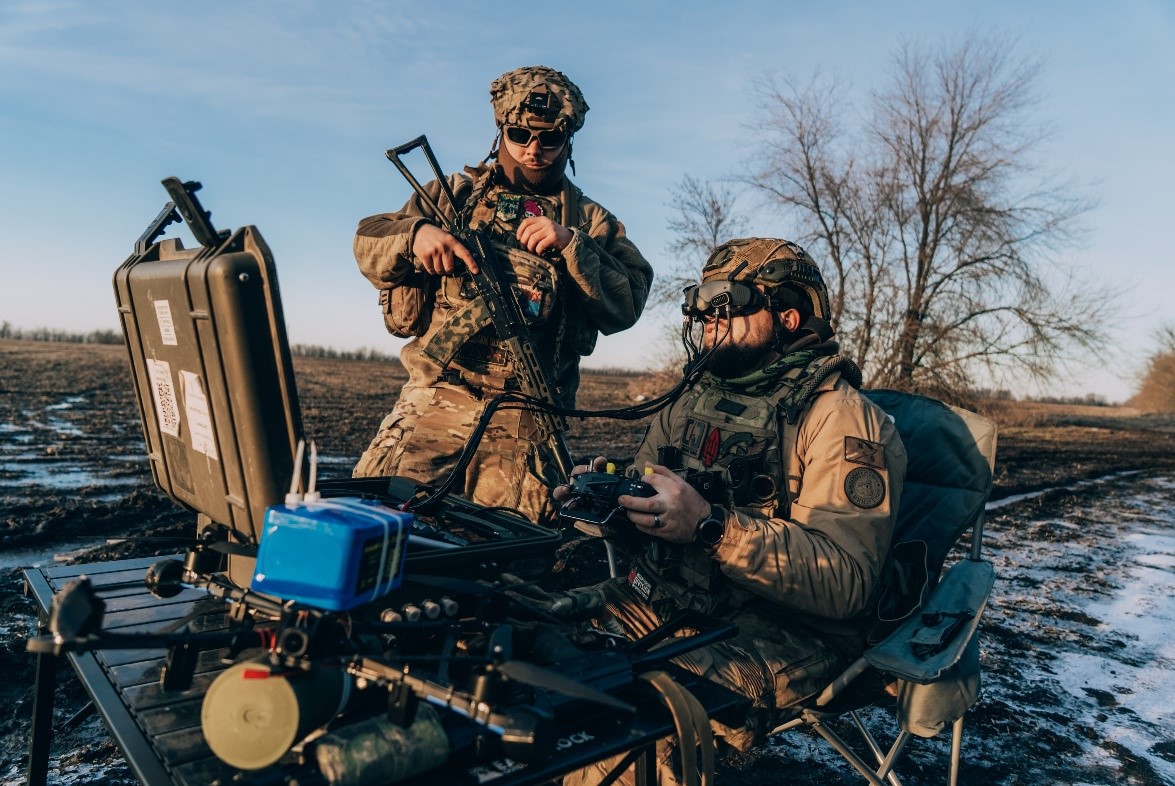
In the context of the war in Ukraine, major organisational changes have occurred in response to the introduction of drones into the battlespace. Now battalions have UAV platoons, and brigades have full battalions of uncrewed systems. From there having previously been no such role as a ‘drone operator’, the Unmanned Systems Forces (USF) of Ukraine was created. Established on 11 June 2024, the USF is the world’s first dedicated military branch that employs UxS to carry out a variety of tasks (see Figure 3). By using a cutting-edge multi-level approach, the USF can carry out combat operations on the battlefield and operate at strategic depths, eliminating the enemy hundreds of kilometres away from the front lines. The USF experience demonstrates that technological superiority, a comprehensive approach, and innovation are the keys to successfully executing missions in this war.[20] With the same name, the ‘Unmanned Systems Forces, Russia’ mirrors the organisation created in Ukraine. Established on 11 November 2025, it is a dedicated branch of the Russian armed forces focused on drone warfare. It was created to centralise the development, deployment, training and operational command of Russia’s UxS systems, acknowledging the increasing role these systems play in contemporary conflict.[21]
Figure 3. Photo Drone operators’ training. Credit: Unmanned Systems Forces. Obtained with permission from owner.
In Ukraine, the role of drone experts is set to expand further. Whereas Ukraine’s USF currently makes up to 2.2 per cent of the AFU (approx. 20,000 personnel), it is planned to increase to five per cent (approx. 45,000) to cover the entire frontline at tactical, operational and strategic levels.[22] Despite making up only 2.2 per cent of the total strength of the AFU, reports published in July 2025 indicated that USF units were responsible for eliminating every third Russian soldier on Ukrainian soil (31.8 per cent) and for verifying 36.3 per cent of enemy targets.[23]
In operational reality, the decisive shift in drone warfare is not evidenced only in the proliferation of platforms. It is also reflected in efforts to restructure military forces to accommodate them. Drones must be treated as integral elements of the combined arms system — resourced, commanded, and sustained as such — rather than as bolt-on technologies. Failure to institutionalise UxS risks misjudging both their contribution to combat power and the scale of investment required to sustain them in high-intensity conflict.
Myth 4: EW ‘dome bubble’/ C-UAS stops all drones everywhere
Operational reality. The assumption that EW or counter-UAS (C-UAS) systems can create a protective ‘bubble’ that stops all drones is not supported by battlefield evidence.
Electronic Warfare (EW) produces localised, temporary, and system-specific effects, rather than comprehensive denial. The contest between drones and countermeasures is dynamic, adaptive, and characterised by continuous counter-adaptation, rather than decisive suppression. The use of fibre-optic guided FPV drones is one of the key developments that undermines the ‘EW dome’ concept. These systems transmit control and video via a physical cable rather than radio frequency links, rendering them largely unaffected by conventional jamming of Global Navigation Satellite System (GNSS) or radio-frequency command channels. Ukrainian and Russian forces have employed such drones precisely to bypass EW-heavy sectors, demonstrating that electromagnetic dominance does not equate to drone denial. While fibre-optic systems introduce trade-offs in range, speed, and mobility, their battlefield utility directly challenges assumptions that EW can neutralise all small UAS.
Long-range autonomous or pre-programmed drones further complicate the C-UAS problem. Systems using inertial navigation, terrain-matching, or optical guidance reduce reliance on external signals and are therefore difficult to disrupt through jamming alone. Their small radar cross-sections, low acoustic signatures, and terrain-masking flight profiles make detection and interception challenging even in circumstances of layered air defence. In practice, such systems shift the contest from signal denial to physical interception and deception, increasing the burden on defenders.
Importantly, many of these technical approaches predate the war in Ukraine. Fibre-optic guidance, autonomous waypoint navigation, and low-observable small UAS concepts were developed in civilian and military research well before 2022. What changed was not the invention of the technology, but its operationalisation under battlefield conditions. The war accelerated adoption of solutions that were previously marginalised or ignored, exposing the limits of pre-war assumptions about EW dominance.
Operationally, EW remains essential but insufficient to achieve battlefield supremacy. It degrades and disrupts drone employment, forces adversaries to adapt, and can create temporary windows of advantage. However, the Russia-Ukraine War shows that no static EW posture can guarantee persistent drone denial. Instead, the contest resembles a continuous competition between detection, disruption, and adaptation, with advantage shifting as each side modifies frequencies, guidance methods, and tactics.
For the ADF and NATO forces, this finding has critical implications. Undue reliance on an EW ‘bubble’ risks creating a false sense of security and encourages static defensive postures. Effective C-UAS must be treated as a layered and adaptive system-of-systems, integrating EW, kinetic interception, physical barriers, camouflage and deception, and procedural controls, rather than as a singular technological solution.[24] The AFU’s experience demonstrates that there is no universal drone immunity through EW. Continuous adaptation and combined defensive measures are required.
In operational reality, therefore, EW does not ‘stop all drones everywhere’. It shapes the threat environment, but fibre-optic guidance, autonomous navigation, and rapid technical modification ensure that drone employment persists even under intense electromagnetic contestation. The decisive variable is not the presence of EW itself, but the ability to integrate EW into a broader adaptive defensive architecture while anticipating adversary workarounds.
The following excerpts from our interviews reinforces the inaccuracy of Myth 4.
Fibre-optic drones bypass EW entirely. EW doesn’t work on them at all. They are completely immune. Autonomous long-range drones are extremely hard to detect or jam. It’s practically impossible to jam a system like that. Most frontline innovation predates the war; militaries simply ignored it. The technology has existed for quite a long time. (P22)
Counter-UAS effectiveness is often overstated; it may work primarily against drones that are detectable by design, misconfigured, or operated by less capable adversaries. Counter-UAS only works where the drone wants to be seen. It unfortunately doesn’t work for anyone who is setting up a drone that knows anything about how C-UAS works. It’s very easy to get around it. (P24)
It's a myth that jam[ming] can block everything. Ukraine shows effective optical navigation system and other tactics and equipment which help drones work in this bubble. They can block only specific sort of frequency. We know about this …1000 per cent because we are also producing [complex] jamming on seven kilowatt[s of] power which are jamming mostly every frequency that you can imagine. (P30)
Myth 5: Drones are simple, plug-and-play tools – just show the target and the quadcopter will do the rest
Operational reality. Contrary to the perception that drones are simple, plug-and-play tools, operational experience from the Russia-Ukraine War demonstrates that effective UxS employment is a complex system-of-systems problem. Piloting the aircraft is only a small fraction of the effort involved. The majority of combat effectiveness derives from the integration of intelligence, communications, EW, fires, logistics, and command-and-control (C2) into a functioning kill chain.
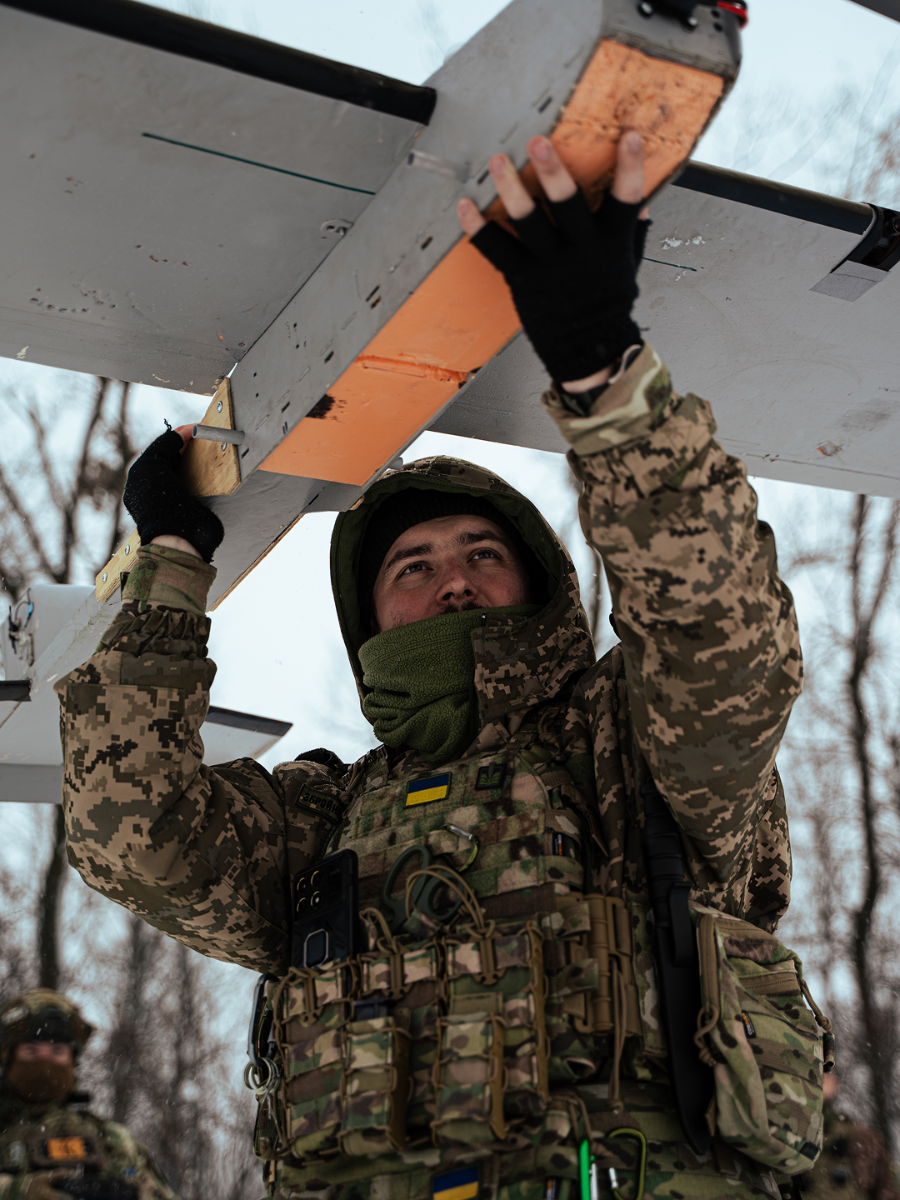
At the tactical level, drone operations depend on a layered technical architecture: reliable communications links, frequency management, navigation aids (often under Global Navigation Satellite System (GNSS) denial), power supply, software modification, and payload integration. Ukrainian and Russian forces alike have had to constantly re-engineer control systems, antennas, and guidance methods to overcome jamming and interception.[25] This technical labour, often conducted by specialist teams behind the frontline, constitutes the majority of operational effort and determines whether a sortie succeeds or fails (see Figure 4).
Organisationally, drones function as nodes within the sensor-to-shooter kill chain, rather than as independent weapons. Target detection, confirmation, fire authorisation, strike execution, and battle damage assessment require coordination between drone operators, intelligence cells, artillery or FPV strike teams, EW units, and commanders. The Ukraine military has found that when these linkages are poorly synchronised, drones generate video but little combat effect. By contrast, when they are tightly integrated, this system enables near-continuous targeting cycles and rapid fires.
The apparent ease of flying a quadcopter obscures the organisational burden required to generate combat power from it. Effective drone employment requires trained pilots, EW specialists, imagery analysts, maintenance crews, and commanders capable of integrating UxS into combined arms operations. Ukraine’s experience has demonstrated that cognitive workload, fatigue, and rapid decision-making within compressed kill chains are limiting factors as significant as platform performance.
Finally, the need for sustainment reveals the hidden complexity of drone warfare. High sortie rates and short platform lifespans generate continuous demand for batteries, motors, frames, optics, explosives, and replacement parts. This has forced Ukrainian forces to develop quasi-industrial repair and modification networks rather than rely on individual operators.[26]
Public and even some militaries think that drone warfare is basically: a gifted pilot with a joystick – a cheap gadget, instant, easy precision. People think that it’s simple – you showed it a target, press a button, and it flies there. But that’s not how it works, it’s a very complex process. It requires careful planning (terrain, radio horizon, weather, EW threat); engineering (firmware, frequencies, payload integration, batteries); multi-person teams for ground robots and more complex missions; continuous adaptation to enemy EW and tactics. To make one strike, you have to ‘fill in a whole bunch of boxes’ so everything works – link, reception, horizon, planning. Flying skills might be 20 per cent of the result. The other 80 per cent is technical work: planning, communications, radio horizon, setting up the links, the payload. You have to do a huge amount of invisible work for one strike. (P7)
Figure 4. Pre-flight preparations by a drone operator. Credit: Unmanned Systems Forces. Photo reproduced with permission of the owner.
Ultimately, drones are not simple tools that ‘just find and hit the target.’ They are components of a distributed combat system in which technical adaptation, organisational integration, and tactical coordination account for the majority of effort. The battlefield advantage lies not in the aircraft itself, but in the human and institutional capacity to sustain this system under attrition and electronic contestation. Ukraine’s battlefield experience in recent years refutes the notion that drone warfare is a matter of individual skill. Instead, it demonstrates that it is fundamentally a problem of system design and force integration.
Myth 6: Advanced military drone systems must be slow, highly bureaucratic, fully codified, and built only through traditional defence-industry cycles, otherwise they cannot be reliable or effective
Operational reality. Operational experience from Ukraine demonstrates that the effectiveness of uncrewed systems does not derive from slow, centralised, and fully codified acquisition cycles characteristic of traditional defence-industrial processes. Instead, competitive advantage has accrued to forces able to field rapidly iterated, low-cost, and adaptable drone ecosystems under conditions of intense EW and high attrition. In the Ukrainian battlespace, platforms with exquisite design but long development timelines have proven less relevant than systems that can be modified, replaced, and tactically reconfigured in weeks rather than years.
Under sustained EW pressure, survivability is transient. Frequencies are jammed, navigation is degraded, and datalinks are disrupted, forcing constant technical and tactical adaptation. Military operations in Ukraine have shown that the effectiveness of drones depends on the capacity to improvise and iterate—altering control links, flight profiles, payloads, and employment concepts in response to adversary countermeasures.[27] Commercial off-the-shelf (COTS) components have enabled this adaptation by providing modularity, rapid replacement, and affordability at scale. Rather than representing technical inferiority, such systems have underpinned a form of attritable mass that sustains operational tempo despite extreme loss rates.[28]
However, the Russia-Ukraine War also illustrates the limits of permanent improvisation. Ukraine’s ad hoc modification and volunteer-driven innovation produced early tactical effects but also generated fragmentation, interoperability problems, and training inefficiencies. Over time, both Ukrainian and Russian forces have sought to transition from a ‘zoo of solutions’ toward unified, standardised, and soldier-centric systems, integrating drones into formal organisational structures and fire control processes. The operational requirement is therefore to institutionalise rather than to abandon speed; transforming rapid battlefield innovation into coherent systems that are intuitive for operators and compatible with command-and-control and logistics frameworks.
This evolution reflects a dual imperative. On the one hand, modern warfare rewards rapid adaptation, short design loops, and decentralised problem-solving. On the other, sustained combat effectiveness requires standardisation, training pipelines, and doctrinal integration. Ukraine has demonstrated that the decisive advantage emerges when these imperatives are combined: when fast innovation is paired with unified, soldier-centric systems that reduce cognitive burden, simplify training, and allow seamless integration into the sensor-to-shooter kill chain.
Western nations may find it difficult to adapt military capabilities at the pace required on the modern battlefield. To date, the working assumption has been that uncrewed systems must follow the same slow certification, quality-control, codification and bureaucratic pathways as crewed platforms. In this worldview, drones cannot be effective unless they are fully standardised, fully tested, and produced through multi-year procurement pipelines. And that all takes time. Most of the time is spent on bureaucratic codification, preparation of documents, factory trials and joint trials. In this Western paradigm, achieving quality is a slow process and standardisation is essential before fielding a platform, a situation which makes rapid adaptation almost impossible.
In truth, speed of adaptation is the decisive advantage. But it poses challenges. These include the need to achieve standardisation once a capability is already in service, particularly when its development involved intuitive design. Without such standardisation, however, capabilities cannot be scaled or sustained.
Ukraine’s experience shows that battlefield advantage came from rapid innovation, use of commercial technology, continuous iterations, and the ability to build weapons from household components. But success now depends on a hybrid model: fast innovation plus intuitive standardisation. Democratisation of high technologies allowed modern weapons to be created from household elements. This became a salvation for Ukraine. We took an engine from a captured Russian drone, installed it in ours and sent it back — that is the reality of active war. It must be intuitive for the soldier… unified exchange protocols, unified mounts, unified systems. We need synergy that allows fast scaling while meeting certain standards. It is no longer a matter of technical parameters but of tactical characteristics – 2,000 km, 200 kg. How we achieve it is secondary. (P9)
For the ADF and its partners within NATO, the emerging need to rapidly scalable and standardised systems has direct implications for force development. If drone capabilities are constrained to traditional procurement models, they risk obsolescence before fielding. Conversely, purely improvised solutions risk fragmentation and inefficiency. Ukraine’s battlefield experiences in recent years indicates that militaries need to establish institutional mechanisms that preserve the speed of battlefield innovation while progressively consolidating it into standardised, soldier-centric systems that can be trained, sustained, and integrated at scale.
Custom signage manufacturing UAE plays a vital role in helping businesses build a strong and recognizable brand presence. From retail stores and corporate offices to shopping malls and restaurants, companies rely on customized signage to communicate their identity and attract customers.
Really informative post! Working with professional sign maker Dubai can truly elevate a brand’s visibility and overall image. High-quality signage not only attracts attention but also reflects the professionalism of a business. From creative design to precise installation, experienced sign makers ensure every detail aligns with your brand identity. Investing in expert signage services is definitely a smart step for businesses looking to stand out in Dubai’s competitive market.
Really informative post! Finding the best signage company UAE can make a huge difference in how a brand is perceived. High-quality signage, creative designs, and professional installation all play a key role in building strong visibility. It’s great to see how signage companies here combine innovation with durability to meet the region’s unique needs. Definitely an important investment for any business looking to stand out!
As a Partner and Co-Founder of Predictiv and PredictivAsia, Jon specializes in management performance and organizational effectiveness for both domestic and international clients. He is an editor and author whose works include Invisible Advantage: How Intangilbles are Driving Business Performance. Learn more...




3 comments:
Custom signage manufacturing UAE plays a vital role in helping businesses build a strong and recognizable brand presence. From retail stores and corporate offices to shopping malls and restaurants, companies rely on customized signage to communicate their identity and attract customers.
Really informative post! Working with professional sign maker Dubai can truly elevate a brand’s visibility and overall image. High-quality signage not only attracts attention but also reflects the professionalism of a business. From creative design to precise installation, experienced sign makers ensure every detail aligns with your brand identity. Investing in expert signage services is definitely a smart step for businesses looking to stand out in Dubai’s competitive market.
Really informative post! Finding the best signage company UAE can make a huge difference in how a brand is perceived. High-quality signage, creative designs, and professional installation all play a key role in building strong visibility. It’s great to see how signage companies here combine innovation with durability to meet the region’s unique needs. Definitely an important investment for any business looking to stand out!
Post a Comment