Russia Tries Armor Again To Reduce Casualties. They're Being Massacred
The winter of 2026 did not go well for Russian forces in Ukraine. Spring, if anything, is proving to be worse.
During the winter campaign, the Russians gained no appreciable ground and actually ended up seeing the Ukrainians advance. And, for the first time, Russian casualties were no longer easily replaced. So the Kremlin has decided to go back to the previously failed strategy of attacking with armor in hopes it may reduce the number of Russian killed and wounded. But if the first week's experience from multiple assaults along the entire front line, that hope is as vain as all its predecessors as Ukrainian drones, mines and artillery decimate Russian forces. JL
David Axe reports in Trench Art:
Russian tanks and other armor are back as the weather warms up along the 1,200-km front line. But the renewed mechanized offensive is off to a disastrous start for the Russians. An armored assault in eastern Ukraine on Thursday ended in a hardware "massacre." More massacres are likely. The Russians may be hitting their manpower limit. After 418,000 casualties in 2025, they bury more troops than they recruit. Hence armor again. (But) Moscow is trading one dwindling resource for another. The Russians have tried this before. Vehicle-led assaults in the first two years of the war got a lot of hardware destroyed in exchange for modest advances. Toward Lyman this week, "We knew they were planning to attack. Remote mines, emplaced along the likeliest assault lanes, wiped them out. Massacre"
Russian tanks and other vehicles are back in action as the weather warms up all along the 1,200-km front line of Russia's 49-month wider war on Ukraine. But the renewed mechanized offensive is off to a disastrous start for the Russians.
A vehicular assault in eastern Ukraine on Thursday ended in a hardware "massacre," according to one Ukrainian drone operator. More such massacres are possible, even likely, if Russia's pivot back to vehicles is a lasting one.
The Russians may be hitting their manpower limit. After 418,000 casualties in 2025 alone, they bury or retire more troops than they recruit. A yearlong pause in mechanized assaults rebuilt vehicle stocks—but the Cold War cupboard that feeds them is running bare. Moscow is trading one dwindling resource for another.
The Russians have tried this before. Vehicle-led assaults in the first two years of the war got a lot of hardware destroyed in exchange for modest advances.
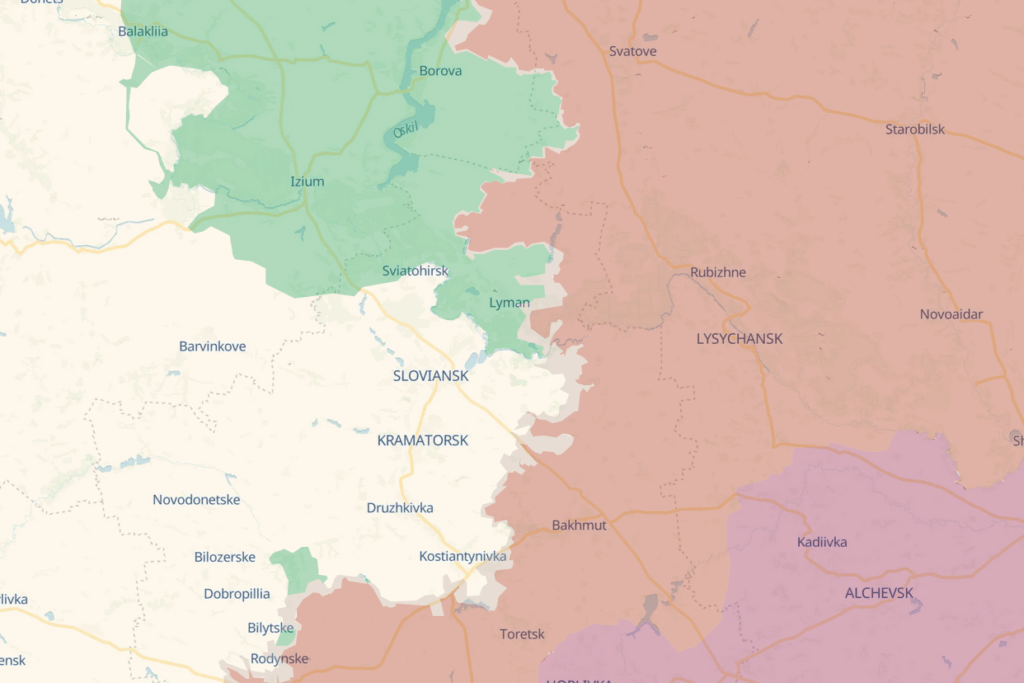
On Thursday, the Russian army's 1st, 423rd, and 488th Motor Rifle Regiments mobilized a powerful force for a fresh push toward the town of Lyman, a Ukrainian stronghold lying between Russian-occupied Donetsk Oblast and the free city of Sloviansk, roughly 20 km to the southwest.
Frontline situation around Lyman, Donetsk Oblast, 6 March 2026. Map: DeepState
For this attack, the three regiments mustered at least 54 vehicles, according to Ukrainian drone operator Kriegsforscher. The assembled assault group boasted two tanks, five BTR-70 and BTR-82 wheeled armored personnel carriers, five BMP-3 tracked infantry fighting vehicles, two BMP-2 IFVs and more than 40 all-terrain vehicles.
"We knew that they were planning to attack," Kriegsforscher noted. "Everyone was prepared." Remote mines, emplaced along the likeliest assault lanes by Ukrainian engineers and drone crews, wiped out "a decent number" of the vehicles, Kriegsforscher wrote. "Massacre."
Burning 40th Naval Infantry Brigade tank. Via Kriegsforscher.
Trading people for metal
It wasn't the first mechanized attack in Russia's fourth annual spring offensive. Farther south in the direction of Russian-occupied Pokrovsk, the Russians rolled out in 14 vehicles—and lost "a lot" of them, Kriegsforscher reported.
Observers had anticipated the attacks. "I believe by summer Russia will be forced to go back to mechanized attacks," analyst Jompy predicted in early March.
Jompy cited Russia's "ever increasing massive human casualties" as a main reason for a pivot back to vehicular assaults. In early 2025, Russia's roughly 700,000-strong army of occupation largely parked its armored vehicles and attacked with many small groups of infantry traveling on foot, motorcycle or horseback.
The idea was that infantry might present smaller, harder-to-hit targets for the thousands of Ukrainian drones that patrol the wide no-man's-land every day. It wasn't a bad idea in strict military terms: the Russians managed to capture 4,336 km2 of Ukraine in 2025 versus 3,363 km2 in 2024.
But that 30% increase in the pace of its advances cost Russia as many as 418,170 casualties, including both killed and wounded. While many wounded troops eventually return to the front, many don't. Russia still manages to recruit around 30,000 fresh troops every month, but last year it may have buried or retired more people than it recruited.
Switching back to mechanized assaults could take the pressure off a stressed resource—human beings—while increasing the pressure on a less-stressed resource: vehicles. The yearlong pause in major mechanized assaults allowed the Russians to rebuild vehicle stocks.
In total, since February 2022, Russia has written off no fewer than 24,200 vehicles and other heavy equipment that the analysts at the Oryx collective have visually identified. However, through a combination of new production and the reactivation of old vehicles from rapidly contracting Cold War stocks, Russia has made up for its equipment losses.
It's possible the Russian military now has more armored vehicles than it did on the eve of the wider war on Ukraine in February 2022. But that could change, and quickly, if Russia's spring offensive continues to travel on wheels and tracks instead of on foot.
As a Partner and Co-Founder of Predictiv and PredictivAsia, Jon specializes in management performance and organizational effectiveness for both domestic and international clients. He is an editor and author whose works include Invisible Advantage: How Intangilbles are Driving Business Performance. Learn more...




0 comments:
Post a Comment