Ukraine Has Liberated Dnipropetrovsk Oblast, Advances In Kupiansk, Zaporizhzhia
Ukrainian forces' advance in the southern theater of war continues unabated. Dnipropetrovsk has been almost completely liberated of Russian occupying units, Kupiansk is being cleared as new Ukrainian assaults take additional ground and in Zaporizhzhia, the Russian winter offensive has not only been stopped with heavy casualties, but Ukrainian troops are advancing there as well.
The effects of the Russians' offensive and defensive failures have cascaded as one affects the other. The Kremlin's plans for this year have been disrupted, if not wholly eliminated, and reflect a broader war-wide operational failing. JL
Benjamin Murdoch and Maria Tril report in Euromaidan Press:
Ukrainian forces have liberated nearly all Russian-occupied areas of Dnipropetrovsk Oblast. Ukrainian troops had pushed Russian forces back during ongoing operations on the Oleksandrivsk axis near the border of Dnipropetrovsk and Zaporizhzhia oblasts, where Russian troops had attempted to push earlier. Ukrainian troops have already recaptured more than 400 square kilometers. Additional areas have undergone follow-up sweeps to eliminate small groups of Russian infiltrators. In the Kupiansk area, Ukrainians advanced east of the city, where Russian forces were shelling a newly occupied Ukrainian position - itself an indicator of the advance - as Ukrainian forces counterattacked within Kupiansk itself. The stalled southern drive reflects a broader Russian operational failure, as Ukrainian counterattacks disrupted Russian forces. Their inability to hold newly captured ground has deprived the Russians of the starting offensive positions from which they intended to launch a summer offensive. The effects are cascading across the theater.
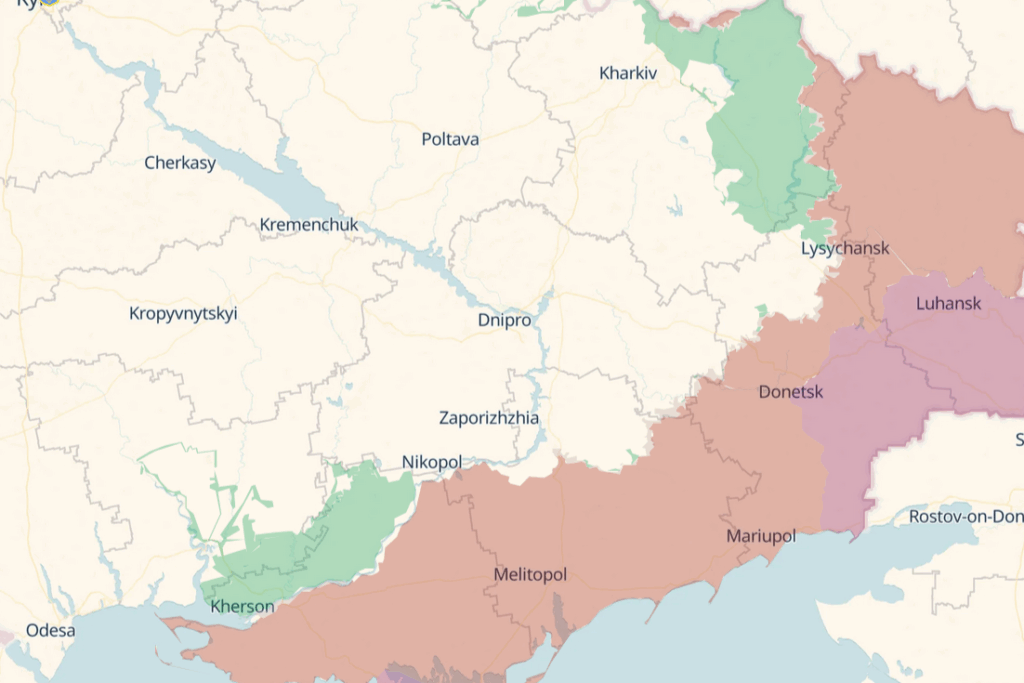
Ukrainian forces have liberated nearly all Russian-occupied areas of Dnipropetrovsk Oblast, with only three small settlements still requiring clearance, a senior Ukrainian general said in an interview with the outlet RBC-Ukraine.
While most of Dnipropetrovsk Oblast has remained outside direct ground fighting, Russian advances through neighboring Donetsk Oblast and Zaporizhzhia Oblast pushed the front line into a small part of the region’s eastern border area.
Ukraine pushes Russian forces back on the Oleksandrivsk axis
Major General Oleksandr Komarenko, head of the Main Operational Directorate of Ukraine’s General Staff, said Ukrainian troops had pushed Russian forces back during ongoing offensive operations near the border of Dnipropetrovsk and Zaporizhzhia oblasts.
“Almost the entire territory of Dnipropetrovsk Oblast has been liberated,” Komarenko said. “We still need to finish work in three small settlements and clear two more.”
Frontline situation around Dnipropetrovsk Oblast, 10 March 2026. Map: DeepState
How Ukraine recaptured 400 square kilometers
The advances come as Ukrainian forces conduct a planned offensive operation on the Oleksandrivsk axis at the junction of Dnipropetrovsk Oblast and Zaporizhzhia Oblast, an area where Russian troops had attempted to push forward earlier.
According to Komarenko, Ukrainian troops have already recaptured more than 400 square kilometers during the operation. Additional areas have undergone follow-up sweeps to eliminate small groups of Russian troops that had infiltrated behind Ukrainian lines.
The operation has involved airborne assault and assault units supported by mechanized brigades already defending the sector, the general said.
Russia's "buffer zone" plan and February's territorial balance
Komarenko added that the Russian push into Dnipropetrovsk Oblast aimed to create what Moscow describes as a “buffer zone,” part of its broader effort to expand control near the front lines in eastern and southern Ukraine.
Ukraine’s recent advances on this axis contributed to a net territorial gain in February, he said, with Ukrainian forces reclaiming more territory than Russia captured during the same period.
Despite the gains, Komarenko described the overall situation on the battlefield as “difficult but controlled.” Russian forces continue to concentrate major efforts on the Pokrovsk direction and the Oleksandrivsk sector, which he said remain among the most contested areas of the front. Ukrainian forces are pressing simultaneous counterattacks across multiple sectors — from Kupiansk in the northeast to western Zaporizhzhia in the south — generating effects that ISW assessed on March 9 are now forcing the Russian command to make operational and strategic-level decisions in response to what began as local tactical setbacks.
In the Kupiansk direction, geolocated footage published March 8 confirms a Ukrainian advance in western Podoly, east of the city, where Russian forces were observed shelling a newly occupied Ukrainian position — itself an indicator of the advance, according to ISW. A Kremlin-affiliated milblogger separately claimed Ukrainian forces counterattacked within Kupiansk itself. Russian forces continued attacking southeast of the city toward Kurylivka and near Kupiansk-Vuzlovyi on March 8 and 9, while the Ukrainian General Staff reported striking a Russian manpower concentration near Petropavlivka on March 8. Russian milbloggers have continued to criticize official messaging on the sector, with one writing that Kupiansk remains a "sore subject" but that authorities have decided to portray the situation as "neutral."
In the adjacent Borova direction, Russian forces attacked near Oleksandrivka and Korovii Yar on March 8 and 9 but did not advance.
In southern Ukraine, Ukrainian counterattacks in western Zaporizhzhia Oblast have effectively halted the Russian Dnepr Grouping of Forces, which includes the 58th Combined Arms Army. Ukrainian military observer Kostyantyn Mashovets reported March 9 that the grouping has "virtually halted" near Orikhiv and south of Zaporizhzhia City. According to Mashovets, Ukrainian forces retook Novoyakolivka and northern Lukyanivske and pushed Russian units back from northern and central Prymorske. Russian attempts to advance near Orikhiv — attacking toward Bilohirya, Mala Tokmachka, Robotyne, Danylivka, and Mali Shcherbaky — have produced no results.
The stalled southern drive reflects a broader Russian operational failure, according to ISW. The command had planned for advances in the Hulyaipole direction to complement progress near Orikhiv, setting conditions for a converging assault on Zaporizhzhia City. The commander of a Ukrainian regiment in the Hulyaipole direction stated March 8 that Russian plans to seize the city are "part of a broader plan" to advance westward across Zaporizhzhia Oblast. Ukrainian counterattacks in late January disrupted that momentum before it could be consolidated, and ISW assessed that Russian forces' failure to hold newly captured ground after infiltration-tactic advances left them exposed. "Ukrainian forces' ability to take advantage of these Russian mistakes has likely deprived Russian forces of the starting offensive positions from which they intend to launch a summer offensive," ISW wrote.
The effects are cascading across the theater. Mashovets assessed that the Dnepr GoF may need to draw forces from Kherson Oblast to stabilize western Zaporizhzhia — a move he described as difficult given prior redeployments of VDV and assault elements to Donetsk's Kostiantynivka and Druzhkivka directions. ISW assessed March 7 that the Russian command had already laterally redeployed elite VDV and naval infantry from Donetsk Oblast to the south in response to Ukrainian gains in the Oleksandrivka and Hulyaipole directions — a shift that may compromise the anticipated Spring-Summer 2026 offensive against Ukraine's Fortress Belt. A Russian milblogger claimed March 9 that elements of the 137th VDV Regiment were moved from Sumy Oblast to Kherson, then rushed back after creating what the blogger called a "critical situation" near Yunakivka; ISW said it could not independently verify the report.
ISW noted that Russian forces have already drawn on operational reserves simply to sustain ongoing combat, "likely including in the Kupiansk where Ukraine has conducted a series of successful counterattacks." The institute assessed that "the Kremlin will likely need either to abandon or to substantially adjust previous plans for its Spring-Summer 2026 offensive — either in Donetsk Oblast or in Zaporizhzhia Oblast or both," adding that "the Russian military simply does not have the capacity to overrun Ukrainian defenses that Russian President Vladimir Putin constantly claims."
On the order of battle across the northern sectors, ISW identified fiber optic FPV drone operators of the 7th Separate Reconnaissance Battalion, 47th Tank Division (1st Guards Tank Army) striking Ukrainian howitzers south of Kurylivka; FPV operators of the 68th Motorized Rifle Division (6th Combined Arms Army, Leningrad Military District) targeting Ukrainian artillery in the Kupiansk direction; elements of the 27th Separate Motorized Rifle Brigade (1st GTA) operating in the Kupiansk area; and FPV operators of the 1432nd Motorized Rifle Regiment (1st GTA) striking Ukrainian unmanned ground vehicles near Bohuslavka, north of Borova.
As a Partner and Co-Founder of Predictiv and PredictivAsia, Jon specializes in management performance and organizational effectiveness for both domestic and international clients. He is an editor and author whose works include Invisible Advantage: How Intangilbles are Driving Business Performance. Learn more...




0 comments:
Post a Comment