


In the first three months of 2026, Ukraine liberated more territory than Russia captured for the first time since 2023. If this trend continues, Russia's ability to capture the fortress belt may be completely (out of) the question. The "fortress belt" refers to four cities in Donetsk Oblast (Kostyantynivka, Druzhkivka, Slovyansk, Kramatorsk).This belt is 50 km long, It is more than four times the area of Bakhmut and seven times the area of Pokrovsk. It is optimal for defense in all topographical and geographical ways. (Plus) "Ukraine has spent the last 11 years investing time, money, and effort fortifying the fortress belt. The high casualties Russia suffered in Bakhmut or the campaign to capture Pokrovsk will pale in comparison to those it will suffer to capture the belt - if we assume Russian forces will (even try)."
While Moscow demands the surrender of Ukraine's Donbas "fortress belt" — Kostyantynivka, Druzhkivka, Slovyansk, and Kramatorsk — it is incapable of capturing Donetsk Oblast in 2026, the Institute for the Study of War (ISW) reported on April 14.
ISW experts voiced these conclusions in their special analytical report on the importance of the Donbas fortress belt for Ukraine's defense and the risks of its capture by Russians.
19% of Donetsk Oblast territory now controlled by Ukraine remains the foundation of its defense in the east and is critically important for this, analysts highlighted.
The ISW recalled that the term "fortress belt" of the Donbas refers to an agglomeration of four large cities in Donetsk Oblast (Kostyantynivka, Druzhkivka, Slovyansk, Kramatorsk) and satellite settlements stretching from north to south along the H-20 Kostyantynivka-Slovyansk highway.
This belt is 50 km long, and prior to the full-scale invasion, its combined population was over 380,000 people. "Ukraine has spent the last 11 years investing time, money, and effort into fortifying the fortress belt and creating significant defensive infrastructure in and around these cities," the Institute for the Study of War emphasized.
Donbas fortress cities on the map of population density in the Ukraine's East / Infographics: ISWSpecialists added that from a military perspective, this "fortress belt" is optimal for defense in almost all necessary topographical and geographical characteristics, from the advantages of urban areas for defenders to the features of the natural terrain.
As the experience of previous years of the full-scale invasion has shown, attempts to capture urban areas are the most exhausting and slow for the Russians.
"The high casualties Russia suffered in the battle for Bakhmut or the campaign to capture Pokrovsk will pale in comparison to those it will have to suffer to capture the fortress cities — if we assume at all that Russian forces will succeed," the ISW stated.
They recall that the urban area of the four largest unoccupied cities in the Donbas is more than four times the area of Bakhmut and more than seven times the area of Pokrovsk.
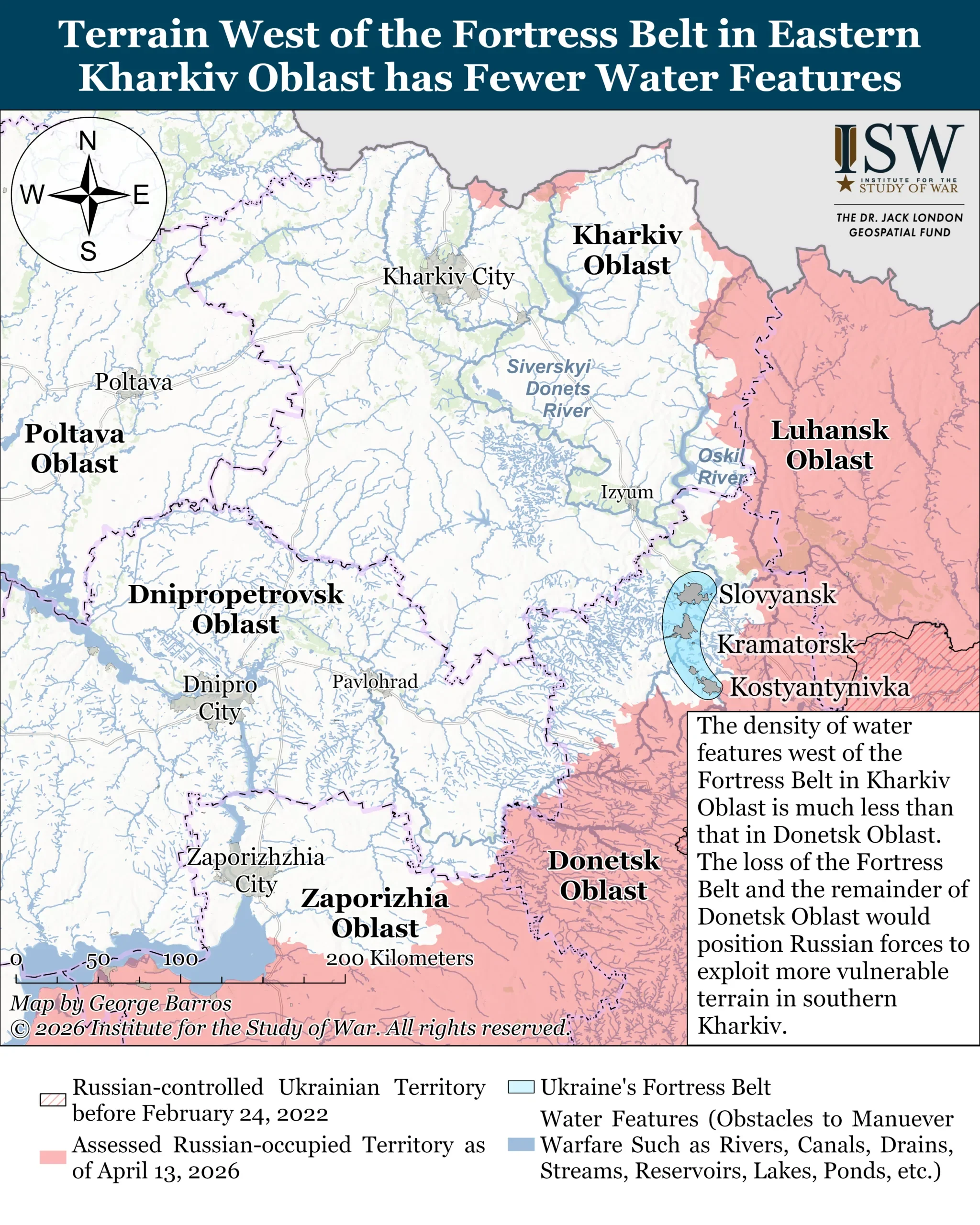
Natural water obstacles also play a significant role in this defense line, as the northern flank of the fortress belt is protected by the Siverskyi Donets and Oskil rivers. In particular, the bend of the Siverskyi Donets leaves the occupiers with only a frontal attack option from the east on the defensive fortifications of this sector.
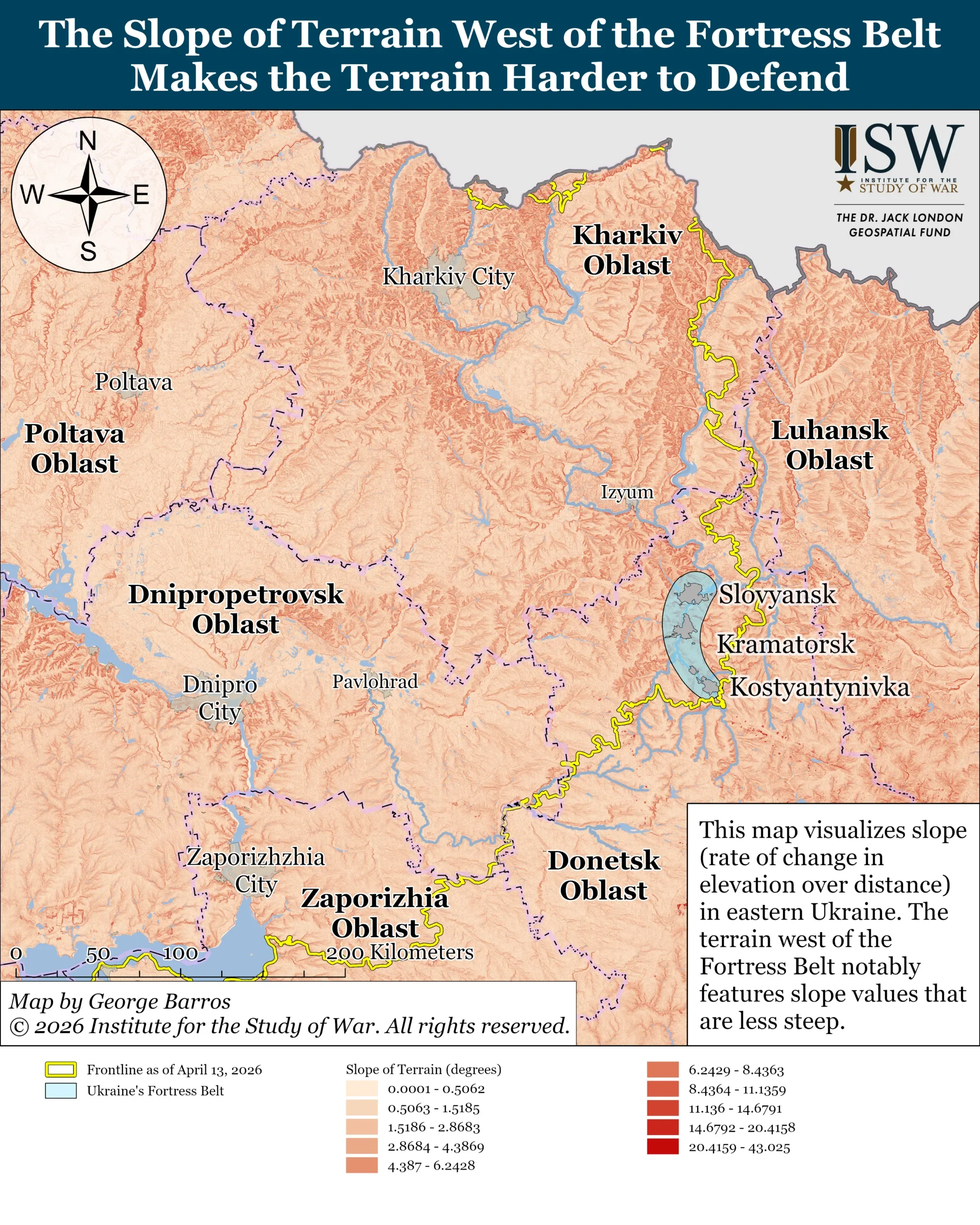
The map of Ukrainian rivers / Infographics: ISWThe terrain also favors the Ukrainian Defense Forces in these sectors of the front. The ISW recalled that the eastern part of Ukraine is generally mostly flat, but the belt of fortress cities is located in an area with steeper slopes, which provides Ukrainian defenders the ability to rely on tactical heights that facilitate defense. This is also crucial in modern drone warfare, as radio-controlled drones rely on communication equipment placed on high ground to maximize signal.
Map of terrain in Ukraine's East / Infographics: ISWUkrainian field fortifications in these sectors, built over the last 11 years, are a multi-kilometer and extensive network of combat positions, anti-vehicle trenches, rows of "dragon's teeth," barbed wire, and minefields that are convenient for defense and enhance the aforementioned natural advantages of the terrain.
In contrast, the terrain further west — the territory that would become the new front line if Ukraine lost the Donbas fortress belt — is much less suited for building a defense line. First, this loss would require Ukraine to equip new fortifications in the south of Kharkiv Oblast and the east of Dnipropetrovsk Oblast, but the physical characteristics of this terrain and the specifics of its settlement are poorly suited for defense. Here is a series of reasons voiced by ISW analysts:
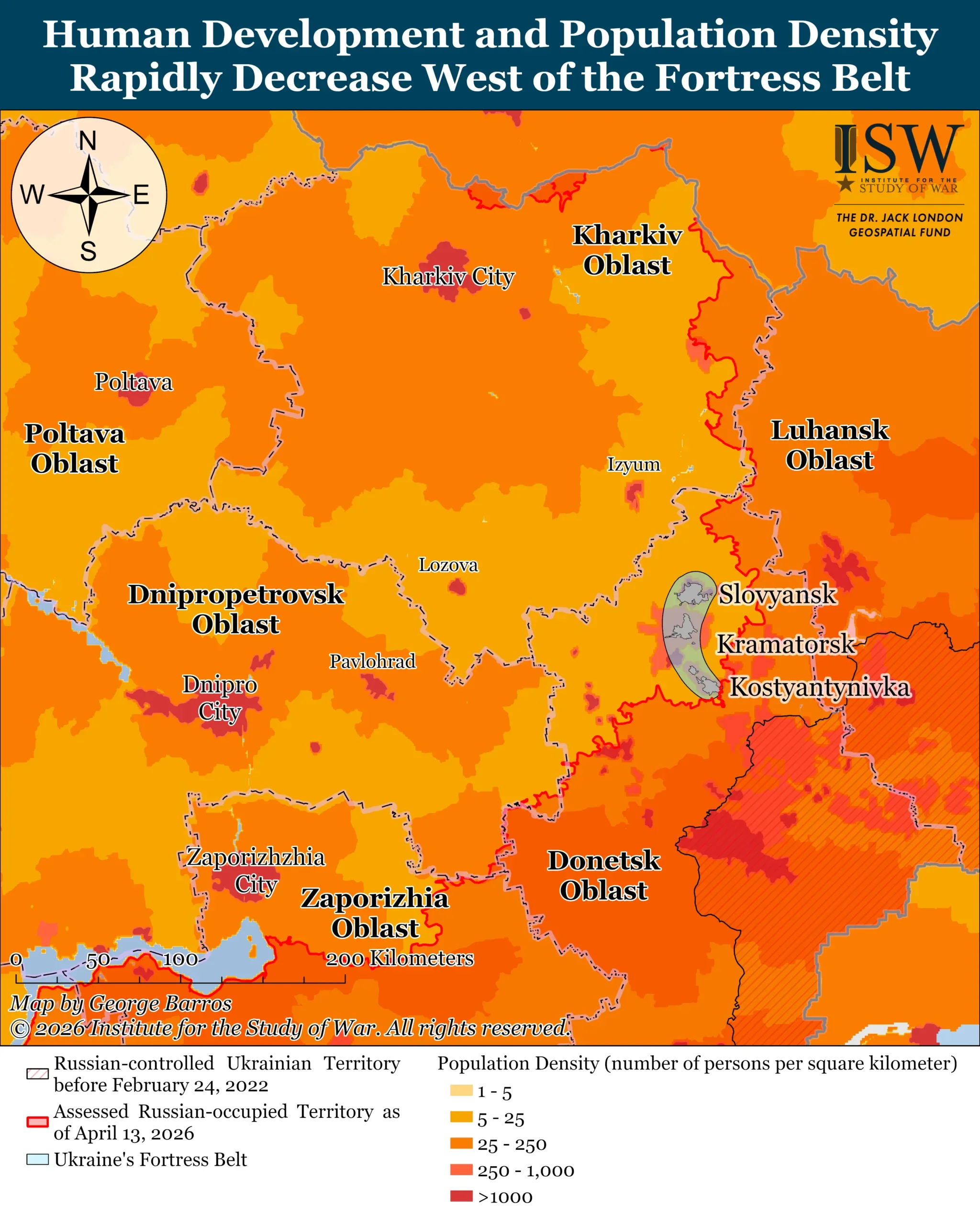
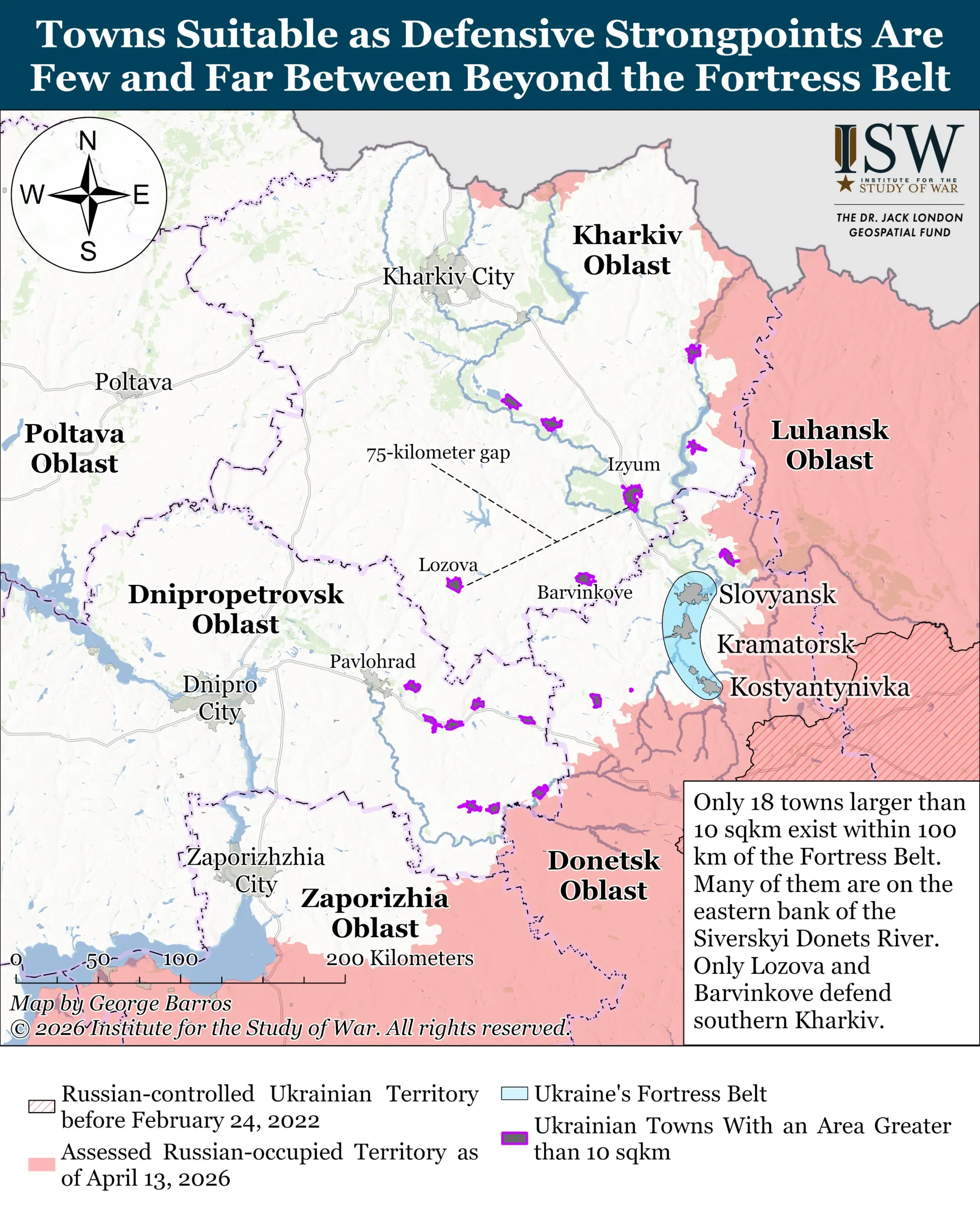
The terrain west of the fortress belt, particularly in southern Kharkiv Oblast, is sparsely populated. There are fewer settlements capable of serving as a stronghold for securing the Ukrainian defense line, and fewer roads to support Ukrainian logistics. Most settlements in this area are small agricultural hamlets and villages. Within 100 kilometers of the fortress belt, there are only 18 mid-sized cities controlled by Ukraine. The largest of these is Lozova, south of Kharkiv (pre-war population of 53,000), but it is located more than 80 km from the Donbas fortresses, and it is isolated and far from other cities with which it could form a defense line.
The population density and the location of cities in the areas to the west create a geographically vulnerable gap that Russian troops could more easily exploit if Russia controlled the Donetsk Oblast fortress belt. The "corridor" between Lozova and the forest near Izium is particularly vulnerable, ISW analysts assume.
This area also has significantly fewer water obstacles that could help the Ukrainian Defense Forces. Consequently, the Russians would gain greater freedom of movement and find themselves on the western bank of the Siverskyi Donets River and several of its tributaries, which would be optimal for the occupiers to continue their advance westward.
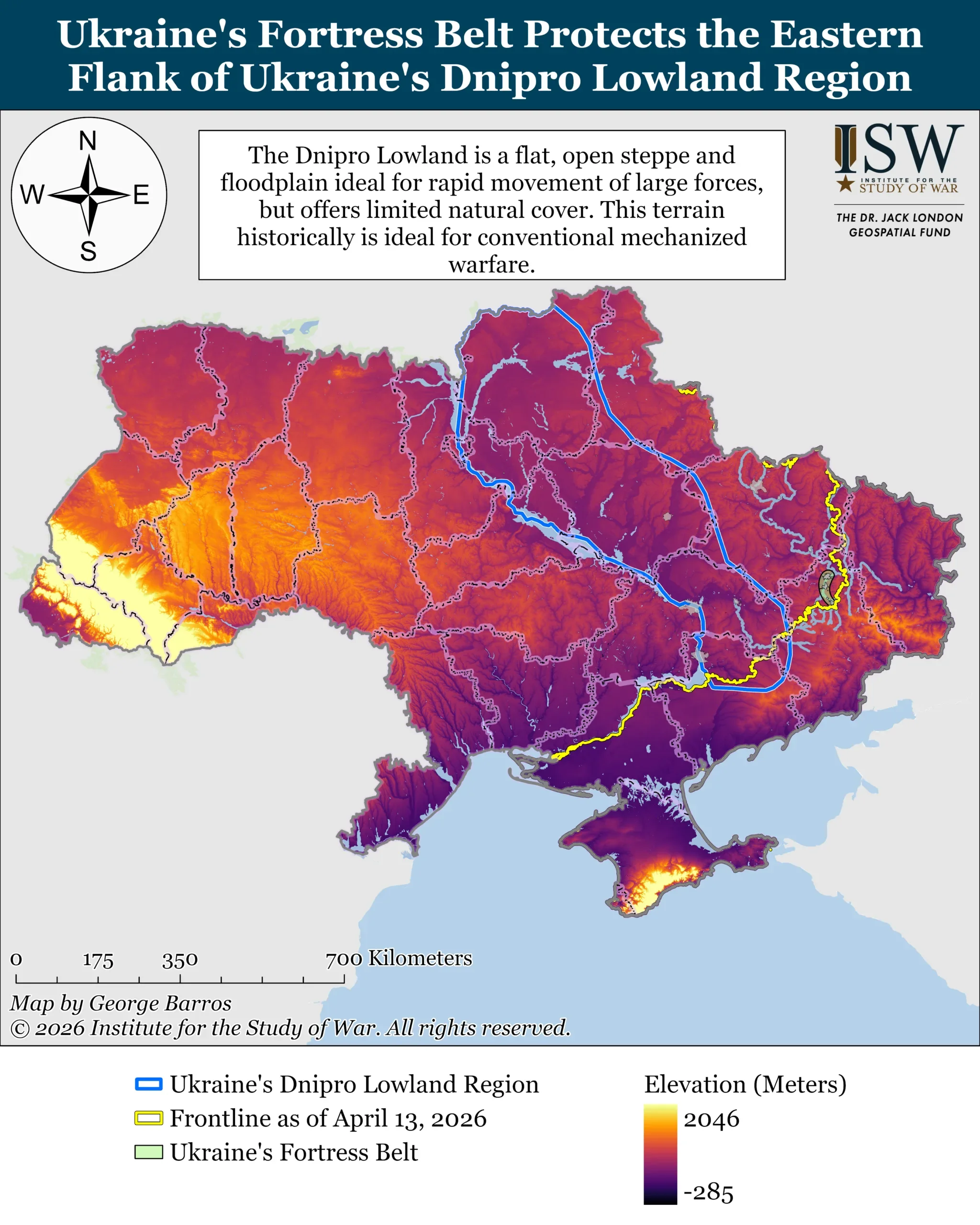
West of the fortress belt, Ukraine's territory is mostly flat and leads to the Dnipro river Lowland — a flat, open steppe and floodplains ideal for the rapid movement of large forces. If Russian troops captured the entire Donetsk Oblast, Ukraine would have to defend from this lowland, giving the Russians a height advantage.
Ukraine's territory is mostly flat to the West from Donbas fortress cities / Infographics: ISWTherefore, the Donbas fortress belt provides Ukraine with a unique combination of factors that facilitate defense, ISW analysts summarized. If Russia gained control over this sector, the occupying army would take advantageous positions to conduct further offensive operations on vulnerable terrain, which would greatly benefit the Russian army and its advantage over the defenders. It is for these reasons that the Kremlin's negotiating strategy aims to have Ukraine surrender the critically important territory of the Donbas fortress city belt without a fight, the Institute for the Study of War emphasized.
18 smaller cities that Ukraine's defense might rely on should Donbass fall to Russia / Infographics: ISWAt the same time, based on current battlefield realities, the ISW predicts that Russia is unlikely to militarily capture the fortress belt in the near future. Although the situation on the front is difficult, it is not critical for Ukraine, and its defensive lines continue to hold; their collapse is becoming increasingly unlikely, experts believe. Therefore, the best prospects for Russian forces in 2026 are continued minor creeping gains; Russia will not capture the rest of Donetsk Oblast this year, ISW analysts are convinced.
Even assuming circumstances favor Russia, this could happen only in late 2027 or early 2028 if Ukraine's international partners continue to support Ukraine. But even this forecast — assuming favorable conditions for Russia — is not final, the Institute for the Study of War stressede. They recalled that in February, Ukraine liberated more territory than Russia captured for the first time since 2023. If this trend continues and strengthens, Russia's ability to capture the Donbas fortress belt may be completely called into question.
In 2025, Russian forces captured an average of 15 sq. km per day, whereas in the first three months of 2026, they advanced an average of only 5.5 sq. km (compared to 11.06 sq. km per day in the same period a year ago).
Thus, surrendering the Donbas fortress belt without a fight would be a strategic mistake and would undermine the goal of achieving a firm and lasting peace in Ukraine, the ISW emphasized. The occupation of this sector of the front by the Russians is not an inevitable factor, as it is now unclear whether Russia's economy, defense-industrial complex, and army recruitment system can withstand several more years of the additional campaigns necessary to capture the fortress belt. Instead, for Ukraine, it must continue to serve as the cornerstone of future defense and battlefield geometry, analysts concluded.


0 comments:
Post a Comment