The drone war has become sufficiently sophisticated that there are now three aspects to it, each with its own drone types. Ukraine initially focused on the first, then the third and now the second.
In the first short range, frontline sector, the targets are troops, weapons and trenches. The next, or third, is the long range, which is now targeting economic and strategic objectives like oil refineries and defense industry manufacturing deep inside Russia, the attacks on which have played a significant role in disrupting the Russian economy. The final, and most recent, is the mid-range sector, which targets Russian supply, logistics and sector command and control. Ukrainian strikes on trucks, supply deport and local headquarters and now disrupting the spring offensive by making it harder for the Russians to amass sufficient equipment and intelligence to plan and execute attacks. JL
Euromaidan Press reports:
Ukraine is surging more explosive drones into Russia's logistical zone, weaken Russian units before they can attack. Ukraine's 12th Azov Brigade and the 20th Unmanned Systems Brigade are deploying the new SETH mid-range drone for raids in the logistical zone, which stretches from 10 km to 200 km behind the gray zone where most ground combat takes place. ""The drone war is not about the number of killed today. Ownership of depth means control of movement, logistics, [surveillance], communication and decisions in the sector, not just in the trench. We cut off the enemy's logistics, we destroy them before they reach the front line. Russia's air defense is not intact. Ukrainian drone strikes on radars, surface-to-air missile launchers and mobile guns—492 of them between June 2025 and early March—are "facilitating strikes on critical targets deep within Russian territory,"
Ukraine is surging more explosive drones into Russia's vulnerable logistical zone, aiming to weaken Russian regiments before the regiments can attack.
At least two Ukrainian units, the 12th Azov Brigade and the 20th Unmanned Systems Brigade, are deploying the new SETH mid-range drone for these raids in the logistical zone, which stretches from around 10 km to around 200 km behind the disputed gray zone where most of the direct ground combat takes place.
Recent video montages from the two Ukrainian units depict SETH strikes on Russian trucks, vans and motorcycles. "We cut off the enemy's logistics, we destroy them before they even reach the front line," the 20th Unmanned Systems Brigade stated.
The SETH is a "pusher" design with a rear-mounted propeller and 1.5-meter wingspan. It hauls a 3-kg warhead as far as 40 km under satellite navigation. The drone spots targets such as trucks or trains using an AI-assisted camera. A remote operator approves the target before the drone barrels in.
Drones tend to come down in cost as the production rate increases, however. And Ukrainian production of mid- and long-range drones is increasing a lot, to a new high of 7,000 copies in March 2026. Robert Brovdi, call sign "Magyar," the commander of Ukraine's Unmanned Systems Forces, recently announced four more USF brigades would re-equip with mid- and long-range drones.
Fast drone expansion
The fast expansion of Ukraine's mid-range strike campaign represents a profound reversal. Just a few months ago, Ryan O'Leary, an American who once led a volunteer company fighting for Ukraine, worried that Ukrainian leaders were effectively handing Russia the drone advantage in the logistical zone—by focusing too much on the shortest- and longest-range drones while neglecting the mid-range ones.
Short-range first-person-view drones, patrolling the gray zone, can inflict heavy casualties on Russian infantry. But heavy infantry losses may not mean much to the Kremlin, which continues to recruit enough fresh troops to replace combat losses.
"Ukrainian drones are still optimized for destroying infantry, not for changing sectors," O'Leary wrote in a since-deleted post. "This creates cool videos, but delivers weak strategic effect."
"The drone war is not about the number of killed today," O'Leary added. "It is about controlling the space tomorrow. Ownership of the depth means control of movement, logistics, [surveillance], communication and decisions in the sector, not just in the trench."
Ukrainian commanders clearly shared O'Leary's concern. Efforts were already underway to pivot drone units to mid-range strikes.
By this spring, these efforts were explosively evident as more FP-2s, Hornets and SETHs surged into the logistical zone—and more Russian trucks, trains, headquarters and air defenses went up in flames. A mid-March Institute for the Study of War assessment found monthly Ukrainian mid-range strikes had quadrupled since November 2025.
The mid-range strikes on logistical targets are only as effective as Russia's air defenses are ineffective. A mid-range drone might spend several minutes in the air at an altitude that could make it an easy target for an intact air defense network.
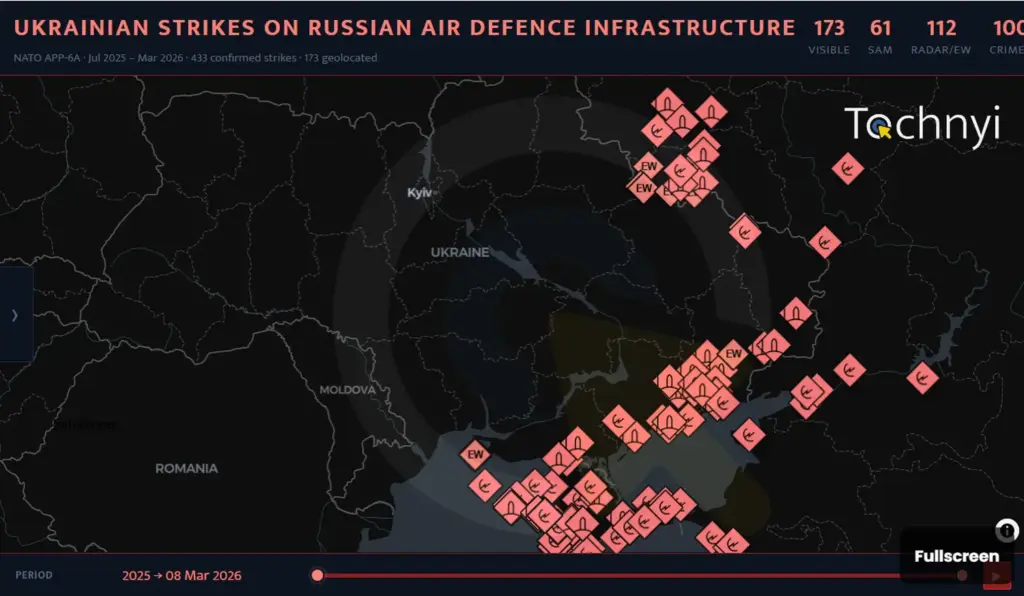
But Russia's air defense is not intact. Relentless Ukrainian drone strikes on radars, surface-to-air missile launchers and mobile guns—at least 492 of them between June 2025 and early March—are "facilitating strikes on more critical targets deep within Russian territory," Tochnyi.info explained in a recent report.
Ukraine's destruction of Russian air defense assets. Screenshot from Tochnyi.info
The Ukrainian strikes on Russian air defenses continue in parallel with the expansion of the mid-range strikes on logistical targets. Just how much damage FP-2s, Hornets and SETHs can inflict on Russian logistics may depend on how many more Russian air defenses the Ukrainians can knock out.
The impact on Russia's spring offensive, which is just starting in some sectors, may be hard to measure. But if the offensive falters without the Russians capturing much new ground, it may be thanks to the mid-range drone strikes that sapped the Russians' combat power before they could bring that combat power to bear in the gray zone.
As a Partner and Co-Founder of Predictiv and PredictivAsia, Jon specializes in management performance and organizational effectiveness for both domestic and international clients. He is an editor and author whose works include Invisible Advantage: How Intangilbles are Driving Business Performance. Learn more...




0 comments:
Post a Comment