Russia's Black Sea Fleet Down To 7 Warships: Ukraine's Hunting Them One By One
Two days ago, Ukrainian drones struck the Russian Black Sea Fleet's flagship, the Admiral Makarov, one of only seven warships remaining in what was once the Kremlin's proudest naval force.
The Makarov became the fleet's flagship when Ukraine sank its predecessor, the Moskva, four years ago this month. JL
David Axe reports in Trench Art:
After years of relentless Ukrainian strikes from the air, the surface, and below the sea, just seven warships now represent the once-powerful Russian Black Sea fleet's firepower. Ukraine's Unmanned Systems Forces just hit another, under the cover of darkness on Monday. One-way attack drones targeted the frigate Admiral Makarov while the missile-armed vessel was at its pier in Novorossiysk. It has served as the Black Sea Fleet's flagship ever since Ukrainian missiles sank the Moskvain April 2022. The strike marks the latest in an escalating Ukrainian campaign against the handful of warships Russia has left in the Black Sea. Every hit shrinks the Kalibr-launching capacity Moscow uses to bombard Ukrainian cities—and pushes the once-dominant fleet closer to combat irrelevance.
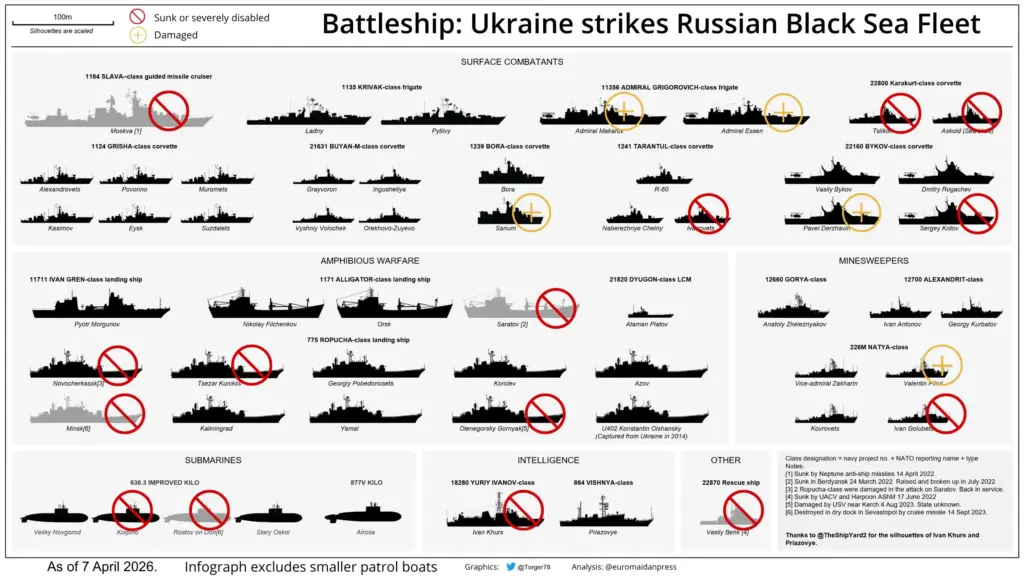
After years of relentless Ukrainian strikes from the air, the surface, and below the surface, the Russian Black Sea Fleet is a shadow of its former self. Just seven warships now represent the once-powerful fleet's offensive firepower.
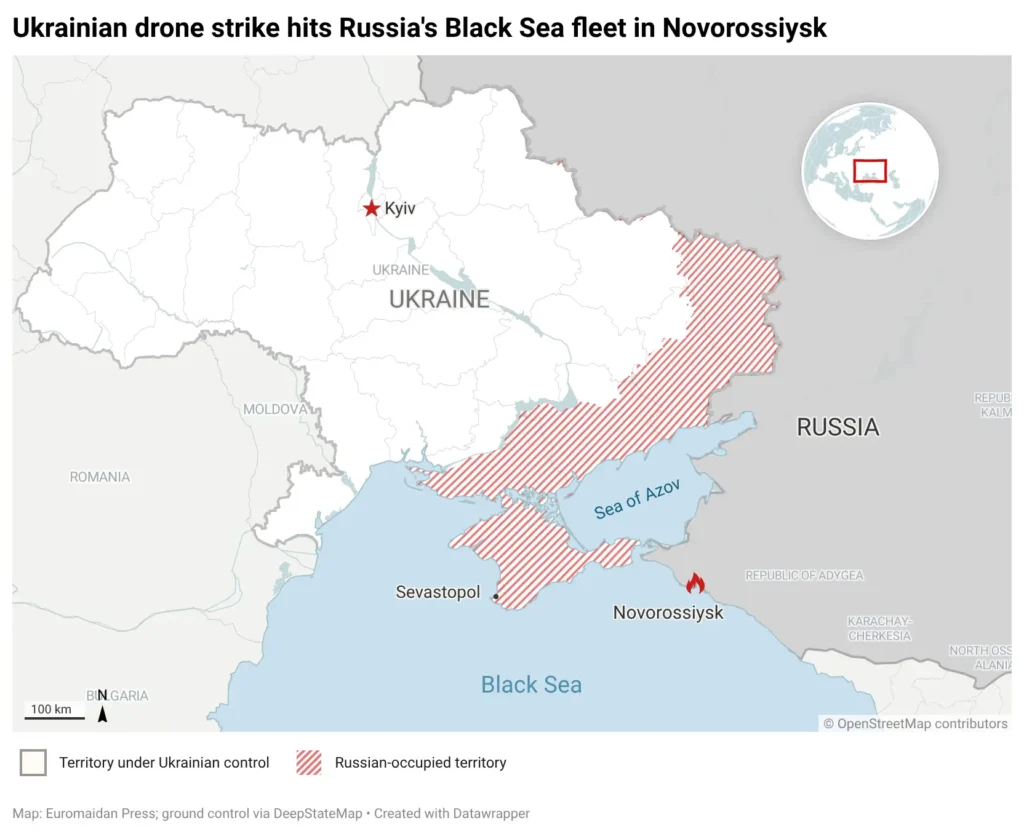
Ukraine's Unmanned Systems Forces claimed it just hit one of them. Under the cover of darkness on Monday, one-way attack drones targeted the frigate Admiral Makarov while the 125-m, missile-armed vessel was at its pier in the port of Novorossiysk in southern Russia.
The strike marks the latest in an escalating Ukrainian campaign against the handful of warships Russia has left in the Black Sea. Every successful hit shrinks the Kalibr-launching capacity Moscow uses to bombard Ukrainian cities—and pushes the once-dominant fleet closer to combat irrelevance.
The USF claimed its 1st Separate Unmanned Systems Center "struck" the ship, which is armed with surface-to-air missiles and Kalibr land-attack cruise missiles.
Russian Black Sea Fleet warships destroyed or damaged by Ukraine. Infographic by Euromaidan Press, based on Torger78 on X
Admiral Makarov, sister frigate Admiral Essen, three Buyan-class corvettes and potentially just two Improved Kilo-class submarines—all seven currently sheltering in Novorossiysk—routinely fire the 2,300-kg Kalibrs at Ukrainian cities.
Footage from the forward-facing thermal cameras aboard the 1st Separate Unmanned Systems Center's FP-1 or FP-2 drones depicts the drones barreling toward Admiral Makarov, and also depicts the frigate firing at least one surface-to-air missile in self-defense.
The footage doesn't clearly depict any impact on the frigate. The ambiguity is familiar. After a Ukrainian drone submarine infiltrated Novorossiysk exploded near a the submarine Kolpino back in December, observers spent weeks debating whether the sub had suffered any harm.
Satellite imagery from after the raid was inconclusive; the best evidence Kolpino had taken some damage was the many weeks it took the vessel to move away from its pier.
Likewise, it could be a while before there's any hard proof that Admiral Makarov was damaged or not damaged by the FP-1/2s.
The Ukrainians' potential hits on Admiral Makarov, which has served as the Black Sea Fleet's flagship ever since Ukrainian anti-ship missiles sank the cruiser Moskva back in April 2022, come after months of trying. On the night of 1-2 March, scores of Ukrainian drones swarmed the port, targeting at least eight warships including Admiral Makarov.
But that raid failed to cause any serious damage. One persistent problem for the USF and other Ukrainian drone operators is the relative weakness of its best deep strike drones.
Air-launched cruise missiles such as the British-made Storm Shadow or French SCALP-EG hit hard with 450-kg penetrating warheads that can devastate a ship. Just look at what a Storm Shadow did to the Russian submarine Rostov-on-Don back in 2024.
Storm Shadows and SCALP-EGs are in short supply in the Ukrainian inventory, however. One-way attack drones are, by contrast, fairly abundant—as Ukrainian industry can build them without a lot of external assistance.
But the drones that are capable of reaching Novorossiysk, 430 km from the front line, tend to devote most of their payload to fuel instead of explosives. And that means that even when they hit their targets, they often inflict only cosmetic damage.
Map: Euromaidan Press
The FP-1 is one of those drone designs that favors range over striking power. The propeller-drive FP-1 ranges nearly 1,400 km under satellite and inertial guidance but carries a warhead weighing as little as 60 kg. The similar FP-2 trades fuel for explosives and strikes with a much more damaging 100-kg warhead. But the standard FP-2 ranges just 200 km or so, likely placing Novorossiysk beyond its reach.
The caveat is that Fire Point, which manufactures the FP-1 and FP-2, is working on new variants of both types that have fuel tanks in their wings instead of in their fuselages. Shifting the fuel tanks makes space for bigger warheads.
The improved FP-1 will carry a 100-kg warhead, according to Denys Shtilierman, Fire Point’s co-owner. That might be sufficient explosive firepower to damage a steel-hulled warship.
Whether the drones that targeted Admiral Makarov on Monday had the bigger warheads is unclear. Ultimately, it doesn't matter. Ukraine is striking at the dwindling Black Sea Fleet more and more often with heavier and heavier drones.
If the Ukrainians missed Admiral Makarov on Monday—or hit the frigate but inflicted no lasting damage—it's a safe bet they'll just try again in the coming weeks. And keep trying until Admiral Makarov is out of action.
As a Partner and Co-Founder of Predictiv and PredictivAsia, Jon specializes in management performance and organizational effectiveness for both domestic and international clients. He is an editor and author whose works include Invisible Advantage: How Intangilbles are Driving Business Performance. Learn more...




0 comments:
Post a Comment