Ukraine Gains Momentum As Local Counterattacks Outflank Russian Operations
Ukrainian forces have gained momentum by employing an age old military tactic: 'hit 'em
where they ain't.' That colloquialism means using reconnaissance and intelligence to attack the enemy where they are weakest or have left gaps in their defensive lines.
Ukrainian counterattacks have negated Russian gains across the southeast, from Donbas to Zaporizhzhia and Kherson, by fighting holding actions against Russian assaults while outflanking those Russian movements, forcing them to either bring up reserves to defend their lodgments or withdraw. The result is that the Kremlin has been unable to achieve any of its objectives on the battlefield so far this year. JL
David Axe reports in Trench Art:
The Ukrainians have the momentum in the fight in the southeast. It's one of several axes where Ukrainian forces have the edge. Overall Russian gains have decreased to nearly zero in recent months because the Ukrainians are successfully counterattacking, resulting in a zeroing out of Russian advances. The Ukrainians have turned the tables on the Russians (because) Ukraine has the advantage in the air over the gray zone and over the logistical zone stretching 200 km behind the gray zone (meaning) Ukraine can find times and places to counterattack, even though Russian forces outnumber Ukrainian troops in most sectors.To achieve its strategic aims in Ukraine, Russia must advance. By contrast, Ukraine's own main aim is to survive as an independent state. By those standards, Ukraine has the edge.
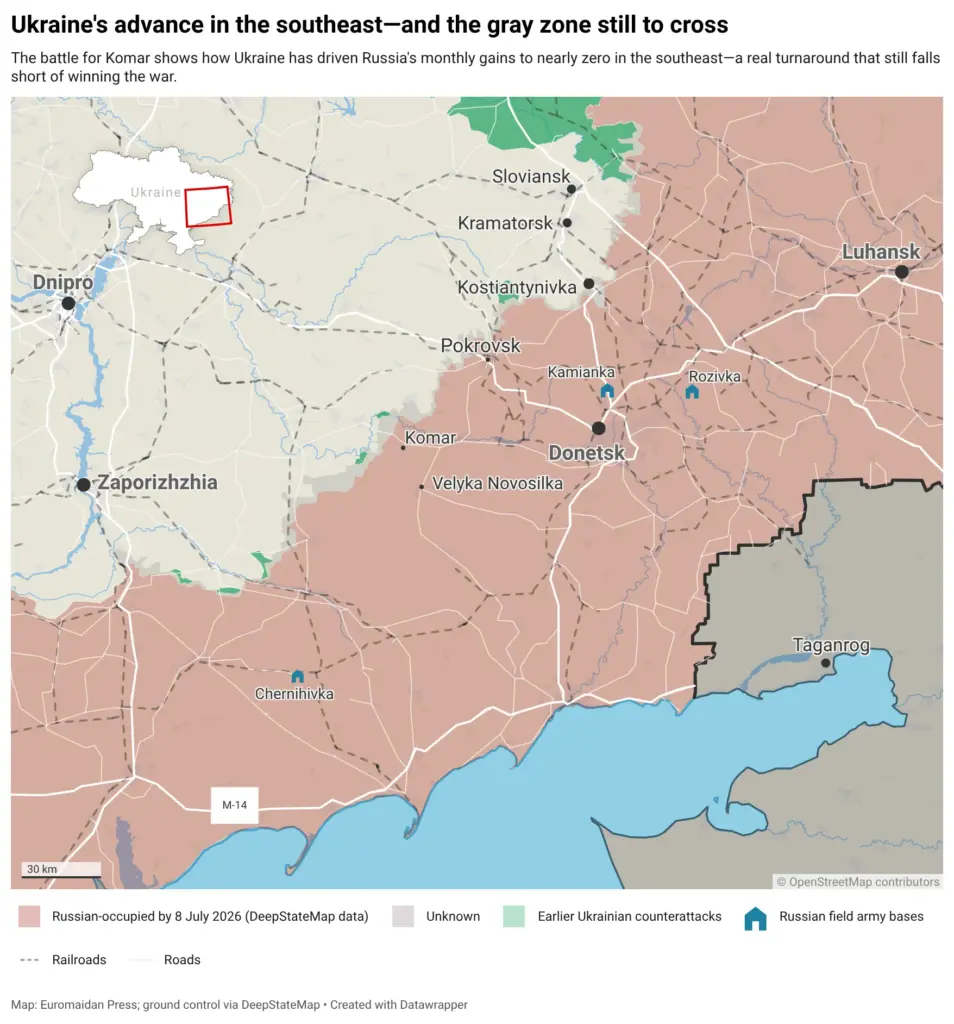
The town of Velyka Novosilka, in eastern Ukraine's Donetsk Oblast, is a major hub for supplies flowing east to west to Russian forces fighting in southeastern Ukraine.
The village of Komar, 14 km to the north, anchors Russian defenses along the road threading south toward Velyka Novosilka.
All that is to say, if Ukrainian forces can capture Komar, they can squeeze the supply lines through Velyka Novosilka, and by extension squeeze Russian regiments and brigades all along the southeastern front line.
Map: Euromaidan Press
And that's why, for months now, Ukrainian forces have been quietly probing for gaps in Russian defenses around Komar. Borrowing infiltration tactics from the Russians, the Ukrainians have been slipping forces across the wide, disputed gray zone, aiming to consolidate enough troops in key positions to nudge the gray zone far enough to the southeast to put Komar in play.
That won't win the wider war, however. Russia might be losing. But it hasn't lost.
The problem for the Ukrainians in the sector near Komar is the Mokri Yaly River, which flows around Komar and forms a natural barrier. The Ukrainians have succeeded in expanding the gray zone, but they haven't succeeded in capturing Komar. Yet. "For now, Komar is 100% Russian controlled," mapper Clément Molin noted.
But that doesn't mean the Russians are winning this battle, or the Ukrainians are losing it. In months of hard fighting, a mix of Ukrainian mechanized, air assault and marine brigades have crossed the Vovcha River, 13 km north of Komar and the Mokri Yaly River, and extended the zone of clear Ukrainian control in the direction of Komar and Velyka Novosilka.
That is to say, the Ukrainians have the momentum in the fight over supply lines in the southeast. It's just one of several axes where Ukrainian forces have the edge on the ground. Russian forces have the edge along other axes, but if you're wondering why overall monthly Russian gains have decreased to nearly zero in recent months, it's because of battles like that for Komar.
Yes, the Russians are marching through the ruins of Kostiantynivka, 90 km to the northeast, but the Ukrainians are successfully counterattacking elsewhere, resulting in a near zeroing out of Russian advances as the wider war grinds through its 53rd month.
How the Ukrainians have managed to turn the tables on the Russians in certain sectors is no secret. Ukraine has the advantage in the air over the gray zone and also over the logistical zone stretching 200 km behind the gray zone.
Ukrainian drones are hounding Russian supply convoys, throttling the flow of supplies to front-line units and weakening them before they can even being organizing an attack or defense.
Meanwhile, Russia's own drones sometimes struggle to even take flight owing to gaps in Russian command and control resulting from billionaire Elon Musk's war-changing decision, back in February, to throttle Russia's thousands of smuggled and stolen Starlink satellite terminals.
The air war shapes the ground war. And as long as Ukraine controls the air over and near the gray zone, it can find times and places to counterattack along the gray zone, even though Russian troops still outnumber Ukrainian troops in most sectors. "Middle-strike capabilities doing exactly what they were built for," the Ukrainian defense ministry boasted.
In nearly zeroing out Russian gains, Ukrainian troops have achieved a virtual stalemate in the wider war. Whether the stalemate lasts is anyone's guess, but for now it counts as a kind of victory for Ukraine.
Yes, liberating large swathes of Ukraine would be more desirable in Kyiv. But merely halting the Russians' overall progress represents a major turnaround for the Ukrainians, who as recently as last fall were losing hundreds of square km a month to the advancing Russians.
To achieve any of its strategic aims in Ukraine, up to and including regime change in Kyiv, Russia must advance. By contrast, Ukraine's own main aim is to survive as an independent state. By those standards, Ukraine has the edge.
To be clear, the war is far from over. "There is a fundamental difference between saying Russia has lost and saying Russia is currently losing," analyst Joni Askola stressed. "Factually, Russia is losing."
It'll take much more than a few modest Ukrainian counterattacks to turn "Russia is losing" into "Russia has lost," however. The Russians still have more infantry and more ballistic missiles. The Ukrainians still have too few infantry and too few missiles that can intercept the ballistics.
And so, despite Ukraine's improving fortunes, the war will grind on. Probably for a long time.
As a Partner and Co-Founder of Predictiv and PredictivAsia, Jon specializes in management performance and organizational effectiveness for both domestic and international clients. He is an editor and author whose works include Invisible Advantage: How Intangilbles are Driving Business Performance. Learn more...




0 comments:
Post a Comment