Ukraine's Stout Lyman Defense Thwarts Russia's 2026 Fortress Belt Hopes
The Kremlin's plan was to assault and take Ukraine's Fortress Belt this year. But as Germany's General von Moltke said before WWI, 'no plan survives first contact with the enemy.' Or, as boxer Mike Tyson intoned more graphically, 'everyone has a plan until they get punched in the face.'
Russia has actually endured several punches in the face this year - so far - including Ukraine's counterattacks which threw off first its winter offensive and then its spring-summer offensive. And now, the Ukrainian's formidable defense of Lyman has the Kremlin talking about assaulting Sloviansk, the first of the Fortress Belt cities...next year. But the relative battlefield performance of the Ukrainians versus the Russians already has military analysts wondering if even that delayed timetable can be achieved. JL
David Axe reports in Trench Art:
It has taken the Russians far longer than anyone anticipated to close the gap between Siversk, which they captured seven months ago, and Lyman. And time isn't necessarily on the Russians' side as Ukrainian drones strike deeper and harder. As recently as late last year, Russian commanders had planned to bypass Lyman from the north and south in order to form a "western claw"—one that could crush Lyman and then reach for Sloviansk as early as this year. The stout Ukrainian defense of Lyman, coupled with targeted Ukrainian counterattacks north of the city, broke the claw. Now the Russians need to build a new one, and hope for a fresh opportunity to assault Sloviansk next year. (But) Ukraine's drones can make Russia's advance so slow, and so costly, that Sloviansk stays free into 2027 and beyond. On the evidence so far, that's the likeliest outcome.
Seven months after capturing the city of Siversk in eastern Ukraine's Donetsk Oblast, Russian forces are inching toward their next objective on the hard road to the ultimate prize: Sloviansk and Kramatorsk, the last two big free cities in Donetsk.
The Russians' advance around the city of Lyman, 20 km northeast of Siversk, is both bad news and good news for Ukraine. Yes, the Russians are closer to Lyman and thus closer to Sloviansk. But it's taken them far longer than anyone anticipated to close that gap. And time isn't necessarily on the Russians' side as Ukrainian drones strike deeper and harder.
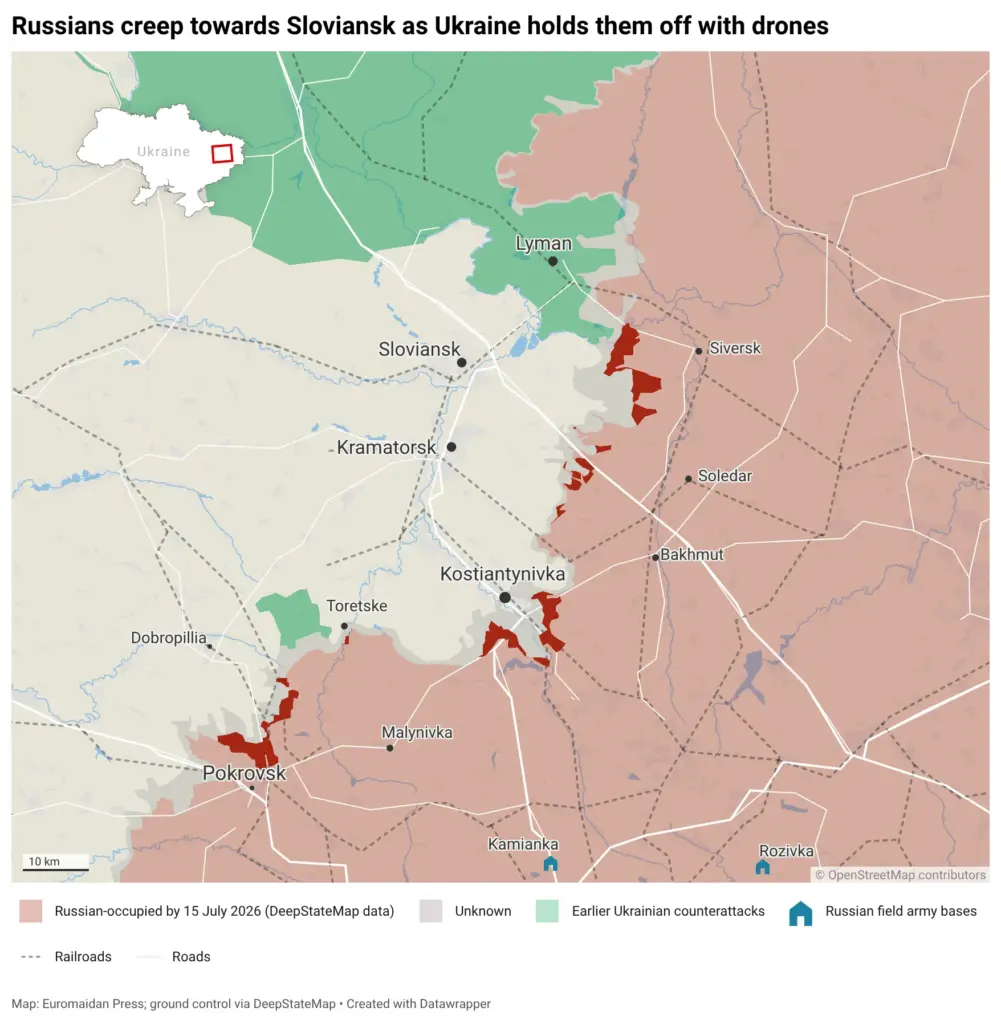
Since marching through the ruins of Siversk in mid-December, Russian attacks have nudged the disputed gray zone halfway toward Lyman, 20 km to the west. "The current situation is not very good for Ukraine in this direction," mapper Clément Molin noted. Having captured Siversk and, earlier, Soledar and Bakhmut, Russian commanders "have a very good accumulation possibility," Molin pointed out. That is, they have plenty of urban bases where they can hide troops and equipment. It helps that the Russians have also captured disused mine complexes that can function as secure, largely drone-proof bases. "It is therefore easier to have troops ready for assault at any moment," Molin explained.
The Russians' goal, Molin concluded, is to march through or around Lyman, consolidate control over the town of Mykolaivka and nearby Rai Oleksandrivka, and begin heavily bombarding Ukrainian supply lines no later than the end of the year. That could position the Russians to assault Sloviansk in 2027.
The attacks on Ukrainian supply lines around Lyman are already intensifying, forcing the Ukrainian garrison to rely on unmanned ground vehicles for much of its resupply. Recall that the Russian bombardment of supply lines into Kostiantynivka forced that city's garrison to switch to robotic resupply, too. The switch was a harbinger of the eventual Ukrainian retreat from Kostiantynivka in recent weeks.
But the Russians aren't the only ones attacking the enemy's supply lines. This spring, at the urging of sacked former defense minister Mykhailo Fedorov, Ukrainian drone units intensified their strikes on Russian trucks, trains, and ships hauling supplies to front-line regiments and brigades.
Russian advances near Sloviansk over two months. Map: Euromaidan Press
Logistics squeeze
The Ukrainian counterlogistics "middle strikes" have been most successful in southern Ukraine, where Russian supply lines are longest, most exposed, and most fragile. But they're having an effect in eastern Ukraine, too.
Just not very quickly. Russian logistics in the east "are hit very hard," Molin observed, "but it's obviously not enough to slow the momentum." For now.
But there's a silver lining inside the storm clouds gathering over Lyman and Sloviansk. As recently as late last year, Russian commanders had planned to bypass Lyman from the north and south in order to form what mapper Vitaly called a "western claw"—one that could crush Lyman and then reach for Sloviansk as early as this year.
The stout Ukrainian defense of Lyman, coupled with targeted Ukrainian counterattacks north of the city, broke the claw. Now the Russians need to build a new one, and hope for a fresh opportunity to assault Sloviansk next year. Kramatorsk would be next.
All that is to say, Ukrainian defenders in and around Lyman have bought time—time that Ukrainian drone units could use to escalate their counterlogistics campaign and weaken the grip of the new Russian claw forming around the city. Whether they can strike hard enough, and often enough, along the supply lines threading toward Siversk and the Lyman front to foil the Russians' 2027 plans is one of the most pressing questions of the war's 53rd month.
The drones can't stop the Russian advance on Lyman. But they can make it so slow, and so costly, that Sloviansk stays free into 2027 and beyond. On the evidence so far, that's the likeliest outcome.
As a Partner and Co-Founder of Predictiv and PredictivAsia, Jon specializes in management performance and organizational effectiveness for both domestic and international clients. He is an editor and author whose works include Invisible Advantage: How Intangilbles are Driving Business Performance. Learn more...




0 comments:
Post a Comment