In the South, Ukraine Has Rolled Back A Year Of Russian Advances
The Ukrainians' 'quiet offensive' as it is being called, has pushed the Russians back over 750 kilometers in the south, undoing years' worth of gains, primarily in the southern oblasts.
The implication is that Russia no longer has the troops or equipment to hold what they've taken, let along grab much more, while the Ukrainians are controlling the place and tempo of the fighting. JL
Michael Obelcz reports in Malcontent News:
Russia has struggled to maintain momentum during its summer offensive, despite Ukraine suffering manpower shortages. Almost all of the Russian advances over the last 12 months in Dnipropetrovsk and southwestern Donetsk have been rolled back since Ukraine started its offensive. Kyiv was maintaining tight operational security while local area Russian commanders were attempting to conceal the deteriorating situation through a series of false capture claims. Small groups of Russian troops dressed as civilians tried to advance past the line of contact, to briefly wave flags for drones flying overhead. The Russian groups made one-way trips. Some were captured, others eliminated by drone strikes and close combat. For now, the initiative belongs to Ukraine.
After months of tight operational security, the General Staff of the Armed Forces of Ukraine confirmed major advances in the Dnipropetrovsk, Donetsk, and Zaporizhzhia regions, including the liberation of 26 settlements. The announcement was made after Russian sources published videos showing Ukrainian forces had crossed the Mokri Yaly River near Komar and advanced to Rybne in the Zaporizhzhia Oblast.
“From January through August of this year, our warriors of the Airborne Assault Forces and other units carried out an effective offensive operation in the Oleksandrivskyi sector,” Ukraine’s President Volodymyr Zelenskyy said. “Over the course of the operation, 745 square kilometers of territory were liberated. Twenty-six villages in the Dnipro, Donetsk, and Zaporizhzhia regions were returned to Ukrainian control.”
The announcement reveals a major improvement in the operational situation compared to the beginning of 2026, when Russian forces were advancing toward Pokrovske [Not to be confused with Pokrovsk in the Donetsk Oblast - Ed.], reaching the Haichur River at Andriivka. They also had a significant presence in Ivanivka and Novopavlivka in the Dnipropetrovsk Oblast, and had infiltrated as far north as the Vovcha River at Orestopil and Novoselivka, and as far west as Iskara [Soviet name of Andriivka-Klevtsove - Ed.].
To support the announced advances, Ukraine released videos showing their forces freely moving in Yalta, Myrne, Voskresenka, Novomykolaivka, Krasnohirske, Rybne, Vyshneve, and Pryvillya. Recent Russian videos revealed Ukrainian soldiers were operating in Zirka, Maliivka, Berezove, and the critical high ground north of Solodke.
In late January, Ukraine started a localized tactical offensive, which accelerated after SpaceX blocked Russian access to Starlink on February 4. By the end of May, Russian forces were pushed back 15 kilometers from Pokrovske and were cleared from Ivanivka and Novopavlivka. Ukraine had also advanced on a wide front through Dnipropetrovsk, almost reaching the Zaporizhzhia Oblast border.
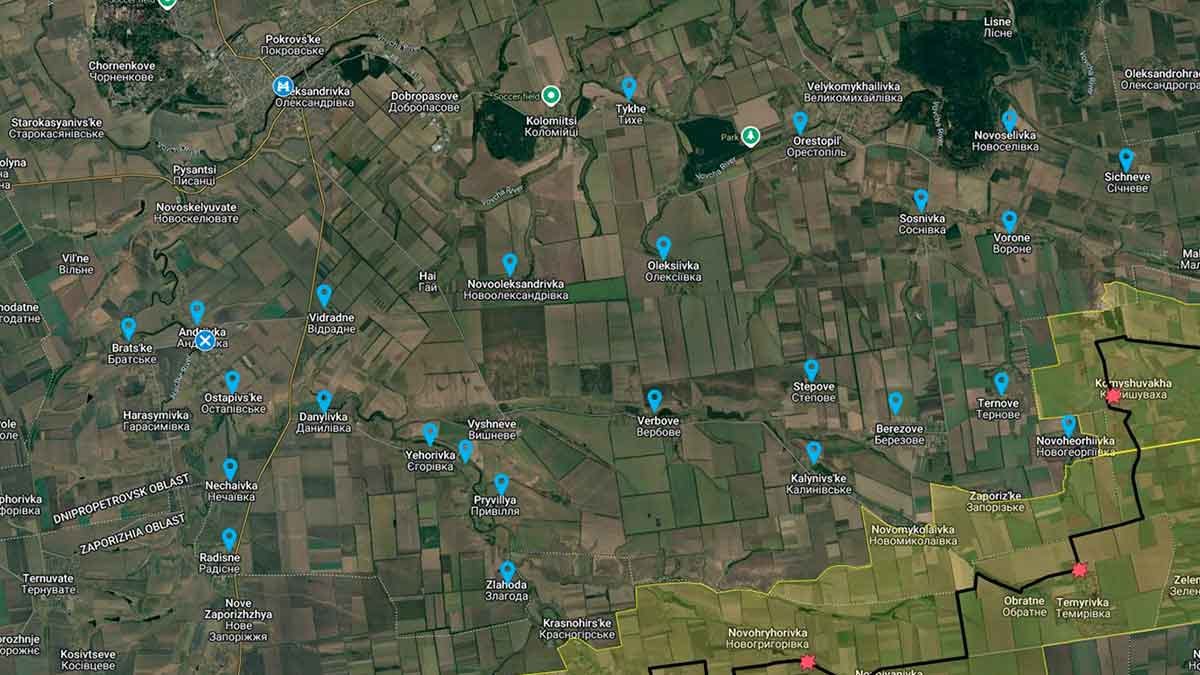
Settlements liberated by Ukrainian forces since January 1, 2026, in the Dnipropetrovsk Oblast. Base map copyright Google Maps, analysis by WBHG News - August 12, 2026.
Our analysts determined that 710.6 sqare kilometers of territory that was under Russian control or contested has been cleared by Ukrainian forces. That includes the liberation of 24 settlements since July 1. This closely aligns with the announcement made by Kyiv.
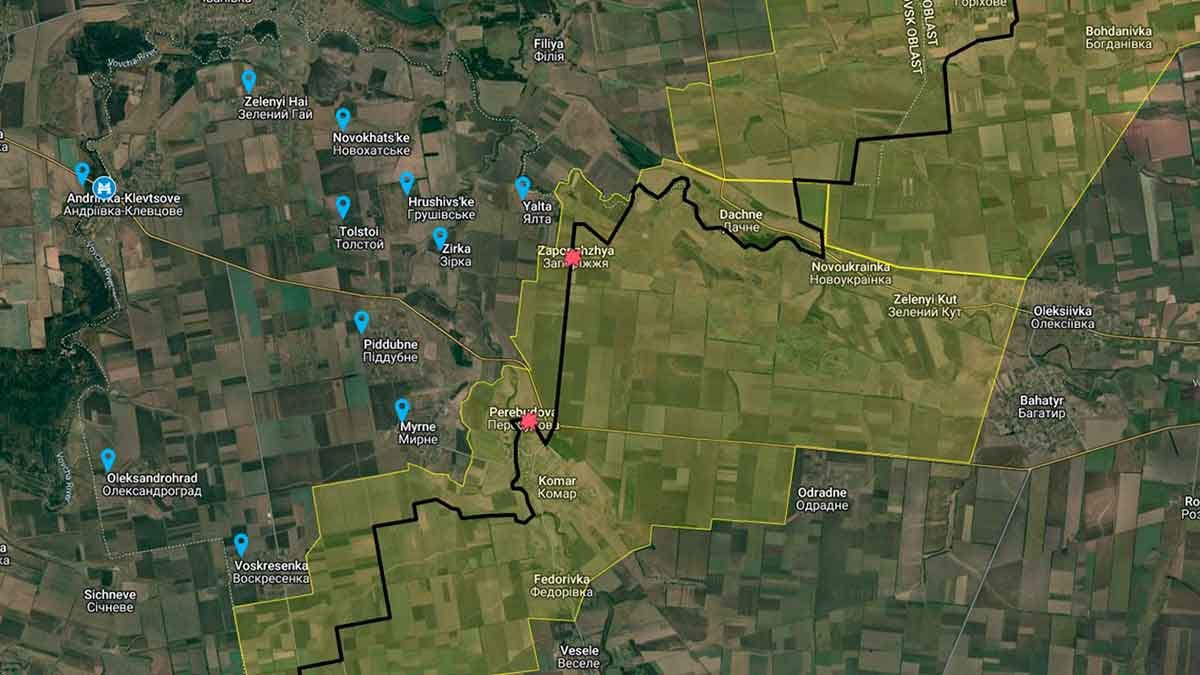
Settlements liberated by Ukrainian forces since January 1, 2026, in the southwestern part of the Donetsk Oblast. Base map copyright Google Maps, analysis by WBHG News - August 12, 2026.
Last month, Ukrainian forces established a bridgehead over the Mokryi Yaly River at Zirka, and have since advanced to the northern outskirts of occupied Komar. Velyka Novosilka, a critical Russian logistics hub and drone operations base, is now 15 kilometers from the line of contact (LOC), putting it within the so-called “kill zone” for Ukrainian drone operators.
Russia has struggled to maintain momentum during its summer offensive, despite Ukraine suffering manpower shortages. Almost all of the Russian advances over the last 12 months in Dnipropetrovsk and southwestern Donetsk have been rolled back since Ukraine started its offensive.
Until recently, neither Russia nor Ukraine had released a lot of information in this area. Kyiv was maintaining tight operational security while local area Russian commanders were attempting to conceal the deteriorating situation through a series of false capture claims. Small groups of Russian troops dressed as civilians used terrain to advance as far as 15 kilometers past the line of contact (LOC), to briefly wave flags for drones flying overhead. The Russian sabotage and reconnaissance groups made one-way trips. Some were captured, while others were eliminated by drone strikes and in close combat.
Ukrainian advances cut off a key Russian supply line
In the Zaporizhzhia Oblast, Russia’s offensive at Hulaiipole was supported by two supply lines. The first is south of the city from Kamianka, and the second was from the northeast at Velyka Novosilka. In April, Ukrainian forces were within 1,000 meters of the Velyka-Novosilka Road, essentially severing the northern route.
The Ukrainian advance has also reached the outskirts of another critical Russian logistic hub at Uspenivka. Located in a river valley west of the Yanchur River, its capture enabled Russia to start its Huliaipole offensive in the fall of 2025. Recent videos published by Ukrainian drone units show that Uspenivka and the surrounding settlements are now under fire control.
Further south, only one group of Russian forces has been geolocated beyond the railroad grade that passes west of Huliaipole since mid-July. The Ukrainian offensive to the north, combined with other issues, has brought the Russian offensive at Huliaipole to a halt.
What’s next
Russia forces have not been able to stabilize their defensive lines, and with Ukraine establishing a bridgehead over the Mokri Yaly River, Komar can be attacked in two directions. Liberating Komar provides Ukraine with defensible terrain for the winter while expanding the bridgehead.
In April, we assessed that the liberation of Uspenivka and the surrounding settlements was an operational goal for Ukraine, but it would require setting the right conditions.
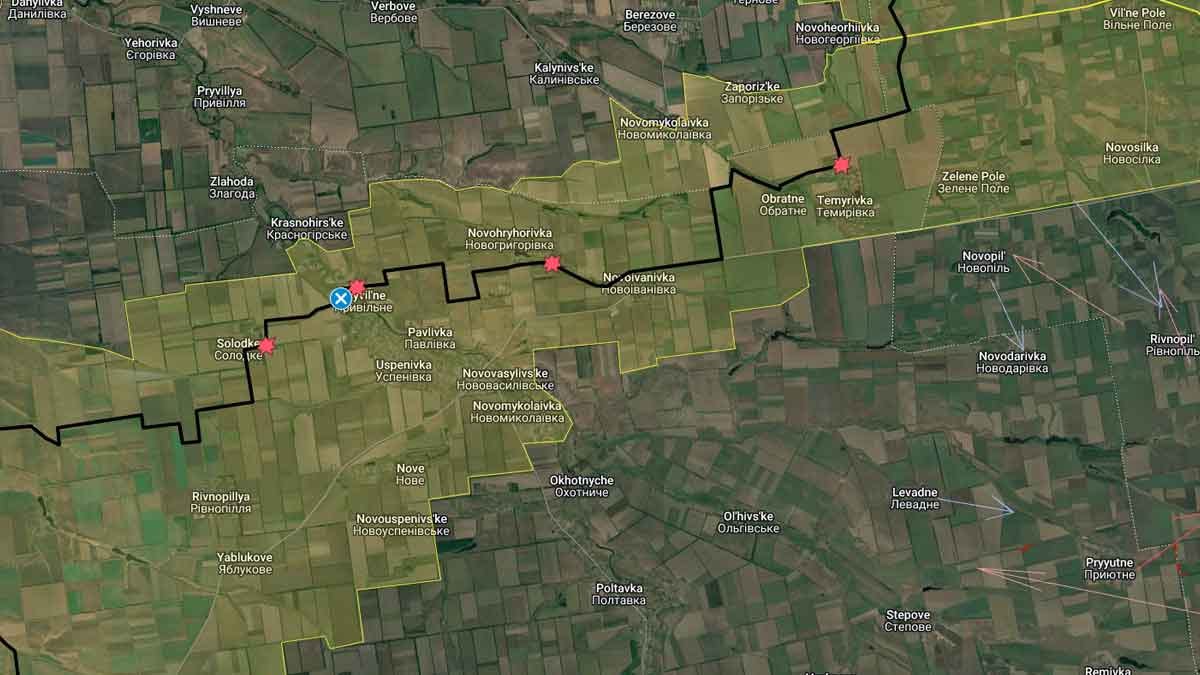
Current line of contact in the area of occupied Uspenivka, a critical logistics hub captured by Russia in 2025. Base map copyright Google Maps, analysis by WBHG News - August 12, 2026.
Located in a shallow river valley about 100 meters below the surround terrain, advancing into the settlement without taking the high ground from the west and east first would put Ukrainian forces in a kill box.
To set conditions, Ukraine needs to liberate Solodke and the 195-meter-high hill just south of the village. Northeast of Uspenivka, Ukraine needs to advance south of Temyrivka, which is still under Russian control, to the 210-meter heights. Russian forces also control a farm complex south of Novohryhorivka, which is closer to Uspenivka. From the high ground south of Temyrivka, Ukrainian forces could advance west toward Uspenivka or east toward Velyka Novosilka.
Currently, Ukraine holds the 176-meter hill northwest of Solodke, and the village itself is contested. They also hold static defenses about 1,500 meters west of Solodke. To the east, Kyiv claimed that Novohryhorivka is under Ukrainian control, while Russia has offered stiff resistance south of Ternove since April.
With a wave of new Russian videos showing Ukrainian forces have advanced to Rybne, Myrne, Zirka, and Yalta within the last week, Russian area commanders have started to publicly acknowledge the Ukrainian advance.
In the short-term, Russia’s options are somewhat limited. The VKS (Russian Aerospace Forces) is conducting about 270 airstrikes per day and recently deprioritized the Huliaipole area. Currently, Moscow is prioritizing the northeastern part of Donetsk and setting conditions for an offensive on Sloviansk and Kramatorsk. In order to increase airstrikes along the Mokri Yaly, the VKS will have to reduce airstrikes somewhere else.
Although the Russian offensive at Huliaipole has been halted, the deployed troops have not been drawn down. Our analyst team has noted significant chatter in closed Telegram groups about logistical problems, including fuel, ammunition, and first-person view drone shortages. Russia could redeploy some of the forces on the western outskirts of Huliaipole north, but the terrain is very unfavorable, and it doesn’t solve the supply problems.
For now, the initiative belongs to Ukraine, and Russia has an additional problem. Due to operational security, today’s announcement and videos did not reveal the full extent of Ukraine’s advances.
As a Partner and Co-Founder of Predictiv and PredictivAsia, Jon specializes in management performance and organizational effectiveness for both domestic and international clients. He is an editor and author whose works include Invisible Advantage: How Intangilbles are Driving Business Performance. Learn more...




0 comments:
Post a Comment