Targeting, Timing, Tech and Sabotage Destroyed Russia's Lyman Defense
As Ukraine's Operation Vivaldi continues to punish Russian forces in the Lyman and Luhansk areas while further exposing the Kremlin's military vulnerabilities, reports on the degree of planning and coordination make the accomplishments that much more impressive.
Among those efforts were the precise targeting of Russian command centers, drone launch sites and logistics - some as far as 250 kms in the rear - and the coordination of timing so that key positions and units were hit just before infantry and light armor began attacking. A textbook operation. JL
Yuri Zoria and Olena Mukhina report in Euromaidan Press:
In Operation Vivaldi, Ukrainian troops gathered for an assault the Russians never saw coming. They take ground not by force but by concealment, timing, and technology. Constant coordination with neighboring units, sharing information and lending aid helped. Kamikaze ground robots were dropped on Russian command nodes where they disrupted coordination, created panic and forced Russia to divert combat troops to guard its own headquarters, while a parallel campaign destroyed a diesel pipeline feeding half the daily fuel needs of Russia's entire West army. Ukrainian partisans disabled four relay cabinets on a rail line that carries military cargo to Russian forces, delaying ammunition to three regiments. Also, the Rubikon drone unit suffered such heavy losses in equipment and personnel, that a commander pulled the unit to the rear just as Ukraine's assault began. Those assaults were at set times so infantry could then advance unexposed.
Ukraine's Third Army Corps dropped kamikaze ground robots on Russian command nodes identified by reconnaissance during Operation Vivaldi, a corps intelligence officer told Radio NV. The strikes aimed to break command coordination and force Russia to divert combat troops to guard its own headquarters, while a parallel campaign destroyed a diesel pipeline that fed about half the daily fuel needs of Russia's entire West grouping. Ukrainian troops gathered for an assault on two Russian-held villages, and the Russians never saw them coming. A captain of the 60th Mechanized Brigade, with the callsign Akhmet, says the concealed buildup near Derylove and Drobysheve was what allowed his units to take the villages once Operation Vivaldi began, Suspilne reports.
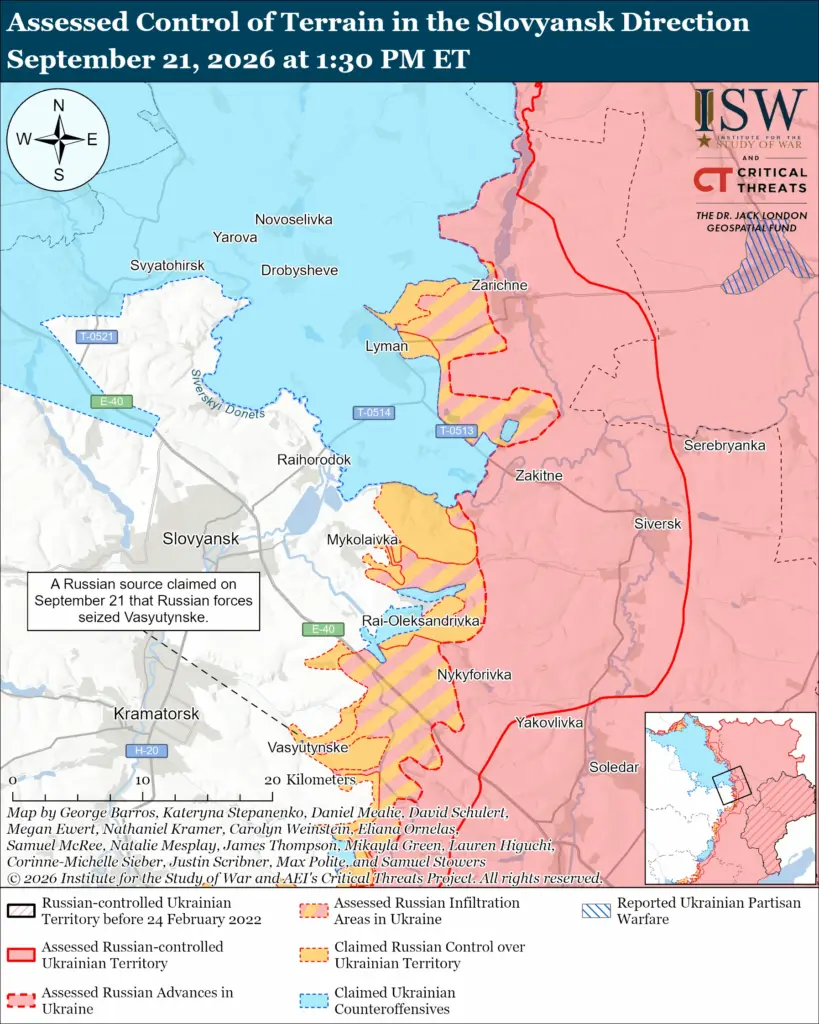
The account fills in how Vivaldi actually takes ground: not by overwhelming force but by concealment, timing, and technology. Only the first phase of the "Operation Vivaldi" counteroffensive, which the Third Army Corps is running near Lyman in northern Donetsk Oblast, has cleared 75 square kilometers of Russian infiltrators and liberated another 10 square kilometers of territory.
Concealment set up the assault
The brigade's task was to free Derylove and take control of Drobysheve. The key, Akhmet says, was accumulating forces as covertly as possible in Drobysheve and on the outskirts of Derylove, so the units could begin exactly on schedule.
The Russians, he believes, failed to spot the buildup because Ukraine had done its reconnaissance well during the planning and preparation. Constant coordination with neighboring units, sharing information, and lending help mattered too. The point was to keep the movement and massing hidden until the appointed hour, so nothing tipped the Russians off before the assault opened.
As a battle captain, Akhmet oversaw the tasks set by brigade command and the work of several strands at once: reconnaissance, drones, electronic warfare, and air defense.
"We determine where the enemy sits, we inflict fire damage on Russian soldiers, and we cover our groups on the ground," he said.
The job was to find the Russians, strike them, and shield the assault teams as they moved up.
Timing cleared the infantry's path
The brigade also located where Russian drones were taking off and hit those launch points at set times, to keep enemy operators from scouting and firing on the Ukrainian troops working below. Getting the timing right was the whole point, Akhmet explains, so the infantry could move to its positions and reach cover without being caught in the open.
The two villages were a piece of a larger aim: the Institute for the Study of War has assessed that Vivaldi disrupted Russia's plan to encircle the fortified belt of Donetsk cities.
Russia's full-scale war against Ukraine is now in its fifth year, with Moscow pushing simultaneously along the front and striking cities behind it with drones, cruise and ballistic missiles, and glide bombs. The Vivaldi operation is the first time Ukraine has publicly shown how a reconnaissance-to-robot strike chain works against command nodes without risking infantry, a method that could be replicated across other sectors where Russia's coordination depends on forward headquarters within drone range.
Reconnaissance identified command nodes, robots hit them
One of the tasks set by corps commander Brigadier General Andrii Biletskyi was to disrupt command and communications in the Russian chain of command, the officer said. Brigade and corps reconnaissance identified areas where a strike could break Russian control.
"Reconnaissance of the brigades and the corps identified such areas that could affect the disruption of enemy command. It was into these areas that robots were dropped to create panic, disrupt command, and prevent the enemy from being effective," the officer told Radio NV.
To protect their command posts from the robots, Russian forces had to pull in additional personnel—troops that could not then be used to resist the Third Corps' ground assault.
Map: ISW
The Third Corps announced on 20 September that heavy bomber drones delivered kamikaze ground robots more than 10 km behind Russian lines, calling it a world first.
The same intel operation identified a frontline diesel pipeline
The same intelligence operation uncovered a pipeline running from Voronezh Oblast to temporarily occupied Luhansk Oblast. The pipeline carried finished diesel, not crude oil, and supplied about 50% of the daily fuel needs of Russia's forces on the direction, the officer said.
The corps struck both the intake point where fuel entered the pipeline and the output point where it was loaded onto tankers. The strikes forced Russia to dismantle the pipeline entirely. Russian forces now truck fuel from Voronezh Oblast, a 400 km supply run.
The pipeline's destruction affected not just the Lyman direction but the entire West grouping, including the Kupiansk and Borova directions, the officer said. The logistical disruption left frontline Russian drone units unable to refuel generators to charge batteries, and electronic warfare systems had to operate in a reduced mode.
Ukrainian partisans sabotaged the railway signaling that keeps Russian troops supplied on the Lyman front. The ATESH movement reports that its agents disabled four relay cabinets on a line through Voronezh Oblast that carries military cargo to Russian forces there, delaying ammunition to three regiments.
The strike was timed to help Ukraine's Operation Vivaldi, the counteroffensive the Third Army Corps is running near Lyman in northern Donetsk. In its first phase, the operation cleared 75 square kilometers of Russian infiltrators and de-occupied another 10.
Cutting the rail line that feeds the Russian units facing that offensive is, by ATESH's account, part of the same fight, targeting the supply line rather than the front.
The sabotage hit a rail corridor running through the Voronezh, Novovoronezh, Liski, and Ostrogozhsk areas of Voronezh Oblast, a route ATESH says Russia uses to move military cargo toward the Lyman axis.
Relay cabinets house the switching gear that runs a line's automatic signals. Knocking them out can freeze traffic on a stretch of track without a single explosion, and ATESH says its agents disabled four of them. As with the movement's other claims, the account could not be independently verified.
Ammunition backs up
The signaling failure delayed shipments of ammunition and engineering materiel to the 1st and 15th Guards regiments and the 254th Motor Rifle Regiment. Russian commanders, it said, had to rush in repair crews and divert resources to guard the infrastructure. A delayed shipment, far behind the front, can be felt at it, where an assaulted position waits for the ammunition that does not arrive.
Repair bases struck, 250 km logistics detour
Third Corps intelligence also located the repair base of Russia's 20th Army and its 144th Division. Ukrainian strikes during the preparatory phase forced Russia to relocate the base to Voronezh Oblast, increasing the repair route to 250 km.
Russia's 20th Army and its 144th Division, reinforced by assault detachments from the First Tank Army, remain the main strike force on the Oskil-Sviatohirsk direction, the officer said. The First Tank Army has been sending additional assault units to stabilize the Russian defensive line after Vivaldi, but these reinforcements are taking critical losses on logistics routes before reaching the combat zone.
Rubikon pulled out, Russian drone units at 70–90% strength
The officer said the corps headquarters specifically targeted Russia's most effective drone formations. During the preparatory phase, the elite Russian drone unit Rubikon was identified as a critical threat that could isolate the area of operations and obstruct Ukrainian maneuver.
Ukrainian reconnaissance located and passed targeting data to strike assets. Rubikon suffered heavy losses in equipment and personnel, and a senior Russian commander—misjudging the Third Corps' offensive potential—pulled the unit to rear areas for recovery at what turned out to be the worst possible moment, just as Ukraine's assault began.
Russian drone units on the direction are now staffed at 70–90%, the officer said. The corps is working to degrade their capability through targeted strikes on launch sites, pilot positions, and logistics in the second and third echelons.
Four seasons, two public
The officer said Russia's current task is to stabilize its defensive line, restore its observation network, and bring in additional reserves for counterattacks. Russia does not have enough personnel and will have to pull troops from training grounds before they finish their courses, shortening training cycles.
Operation Vivaldi has at least four "seasons," of which only the first two have been made public. The operation's name refers to Italian baroque composer Antonio Vivaldi, and The Four Seasons is his best-known set of four violin concerti.
Biletskyi confirmed the liberation of Shandryholove, Derylove, and full control over Drobysheve on 20 September, bringing the total to 40 km² of freed territory in the second season alone. Russian losses have reached an estimated 3,000 personnel overall, over 12,000 drones in the first season, and hundreds of vehicles, according to the Third Corps. ISW assessed that the operation disrupted Russia's plan to encircle the fortress belt of Donetsk cities—Sloviansk, Kramatorsk, Druzhkivka, and Kostiantynivka.
As a Partner and Co-Founder of Predictiv and PredictivAsia, Jon specializes in management performance and organizational effectiveness for both domestic and international clients. He is an editor and author whose works include Invisible Advantage: How Intangilbles are Driving Business Performance. Learn more...




0 comments:
Post a Comment