How the Rebuilt 125th Mech Brigade Helped Lead Operation Vivaldi
Once scorned as poorly led and motivated, with a reputation for desertions and abandoned posts, new leaders at the 125th Heavy Mechanized Brigade, rebuilt the unit, convinced 1.500 AWOL soldiers to return and became one of the salient elements in the Vivaldi offensive.
A key focus of this effort was demonstrating to skeptical troops that new leadership meant better tactics, equipment - and performance. JL
David Axe reports in Trench Art:
One reason for Operation Vivaldi's success was that the 3rd Army Corps managed to nearly fill out at least one of its five line brigades. The 125th Heavy Mechanized Brigade's main units—three infantry and tank battalions, which make up half the overall brigade—have filled between 95% and 100% of their allotted billets. The unit not only has nearly all of its allotted infantry, it also has an abundance of heavy equipment including M2 Bradley infantry fighting vehicles and Leopard tanks.1,500 troops who had gone absent without leave returned and rejoined. That helped drive a 430% increase in unit manning,
In four months of deft maneuver, the Ukrainian 3rd Army Corps cleared Russian troops from 277 sq km of northern Donetsk Oblast, inflicting—according to the corps—8,000 casualties on the Russian 20th and 25th Combined Arms Armies and chasing the armies back across a key terrain feature, the Zherebets River.
There are many reasons for the success of the 3rd Army Corps' Operation Vivaldi—which the corps declared finished on 19 October, though elements reportedly keep pushing across the Zherebets to the river's eastern bank.
Map: Euromaidan Press
But one reason is becoming clearer. Bucking a worrying trend, the 3rd Army Corps under its former commander Brig. Gen. Andrii Biletskyi actually managed to nearly fill out at least one of its five line brigades. The 125th Heavy Mechanized Brigade's main units—three infantry and tank battalions, which make up around half the overall brigade—have filled between 95% and 100% of their allotted billets, the brigade says.
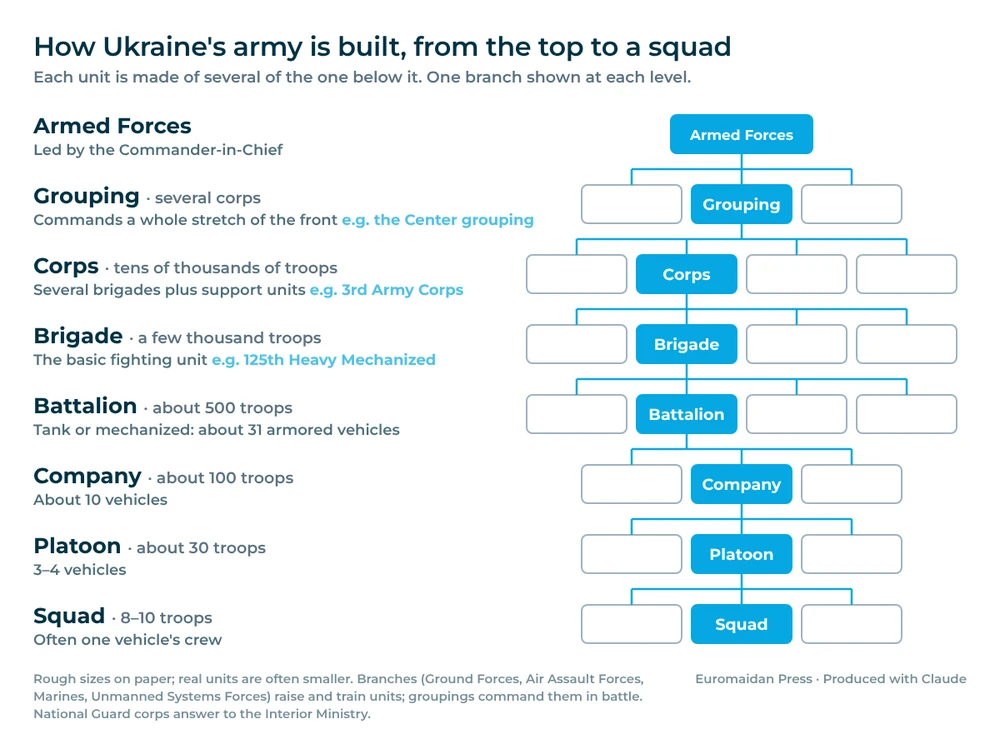
That means the brigade rolls into battle with as many as 1,500 infantry and vehicle crew. (A battalion typically has around 500 personnel.)
That's highly unusual. Almost all of the roughly 150 ground combat brigades in the Ukrainian armed forces have too few infantry. “Ukraine faces manpower shortage and still does not have a single brigade that is fully manned,” analyst Giorgi Revishvili wrote in June. Some brigades are effectively battalions given their stubbornly low manning.
The 125th Heavy Mechanized Brigade—commanded by Maj. Volodymyr Fokin—may be one exception to that truism. And if you believe the brigade's own claims, the unit not only has nearly all of its allotted infantry, it also has an abundance of heavy equipment including American-made M2 Bradley infantry fighting vehicles and German-made Leopard tanks. (It's unclear whether they're Leopard 1s or heavier Leopard 2s.) The 125th Heavy Mechanized Brigade's line battalions should possess around 90 armored vehicles between them.
"3rd Army Corps is built different," observer Moklasen quipped. The corps grew out of the 3rd Assault Brigade, whose soldiers described it as a new army modeled on the freedom-loving Cossacks rather than on the regulations.
Graphic: Euromaidan Press
Turnaround
The brigade wasn't always so fit. Indeed, as recently as a year ago it was just 17% manned and lacked heavy equipment, the brigade says, making it more typical of the younger Ukrainian brigades including the notoriously "poor" 29th Heavy Mechanized Brigade.
The 125th Heavy Mechanized Brigade stood up in 2022 as a lightly equipped territorial defense brigade, transferred to the army in 2024 as a mechanized brigade and thereafter underwent reorganization to the new vehicle-centric heavy mechanized structure.
But it took Fokin's strong leadership to actually fill out that structure, the brigade stated. Fokin and his staff "started changing things instead of looking for excuses," according to the brigade's official Telegram account.
"Within just one year, the unit has risen to the top ranks in terms of enemy attrition, mine-laying, artillery operations, air defense, unmanned ground systems, and reconnaissance. Among heavy mechanized brigades, it has held the top spot for three consecutive months."
Success bred success. Increasingly confident in the 125th Heavy Mechanized Brigade's leadership, some 1,500 troops who had gone absent without leave returned and rejoined the fight, according to the brigade. That helped drive a 430% increase in unit manning, by the brigade's count, until its main units were essentially fully manned.
"The unit no longer fights with unarmed personnel," the 125th Heavy Mechanized Brigade reported. "Today, the brigade is active and conducting successful offensive operations. Its arsenal ranges from unmanned systems, unmanned ground vehicles and electronic warfare assets to armored personnel carriers, armored combat vehicles and artillery. It also boasts high-quality medical support, robust rear-echelon logistics, and a cadre of professional commanders."
Brigade troopers and their vehicles and drones underwent a baptism of fire as part of Operation Vivaldi. Robots led the way, but armored vehicles and infantry followed. The 125th Heavy Mechanized Brigade and the other assault and mechanized brigades under the 3rd Army Corps banner advanced steadily, exploiting gaps in the overextended 20th and 25th Combined Arms Armies and pushing back the bigger Russian formations.
"Operating as part of the corps, our units are once again liberating Ukrainian territory, safeguarding their personnel and continuing to evolve," the 125th Heavy Mechanized Brigade stated. Its success, the brigade says, began with strong leadership that inspired confidence in its rank-and-file soldiers—and motivated them to stay and fight.
As a Partner and Co-Founder of Predictiv and PredictivAsia, Jon specializes in management performance and organizational effectiveness for both domestic and international clients. He is an editor and author whose works include Invisible Advantage: How Intangilbles are Driving Business Performance. Learn more...




0 comments:
Post a Comment