The 5th Year of War Promises Stronger Ukraine, No Russian Breakthroughs
The harsh reality for the Kremlin is that the new year promises no significant differences from the previous year. Despite going all in to try to take Pokrovsk in an effort to convince Donald Trump that its victory was 'inevitable,' the Russian military faltered, once again, in the face of determined and innovative Ukrainian resistance.
With hindsight, that now appears to have been the Kremlin's last and possibly, best shot. In the two months since the start of the new year, the Russians have not only failed to score any real advances, but are actually losing ground in the south where an initially tactical Ukrainian clearing operation has turned into a counteroffensive thanks to Russia's declining abilities. The rest of the year offers Russia no hope for change, but could provide a convincing demonstration that Ukraine is now the more capable military. JL
Igor Kossov reports in Euromaidan Press:
The fifth year of the invasion is a race. Both sides are fighting to convince the world they're winning. They're competing to widen the drone kill zone around the front line, each pushing its boundaries deeper into enemy territory. The front line is no longer a line, it is a kill zone, where drones hold sway. And it’s poised to grow in the coming year. It is no longer a strip between opposing positions, but a fuzzy mass that extends beyond defenses, ranging from 10 to 30 kilometers. (To survive in it) both sides are advancing autonomous weapons that ignore electronic countermeasures. Unlike Russia, Ukraine boasts new types of army units that explicitly broke with Soviet command culture to prevail in the new war. Both are scaling up industry while wearing down the opponent's, until one of them breaks.
The fifth year of the full-scale invasion is, in many ways, a race.
Both sides are fighting to convince the world they're winning, trying to shift international pressure onto their enemy.
They're competing to widen the drone kill zone around the front line, each pushing its boundaries deeper into enemy territory.
They're sprinting toward truly autonomous weapons that don't care about electronic countermeasures—weapons that threaten to change warfare forever.
And they're scrambling to scale up industry while wearing down the opponent's economy, until one of them breaks.
But when both sides race at the same speed, the result is a slog — a brutal war of attrition, one kilometer at a time, while Russian drones and missiles hurtle overhead killing civilians and destroying the things they depend on.
What breaks the deadlock is which system of war works better: Ukraine's flawed democracy, with its thousands of startups and decentralized innovation, still struggling to shake off its post-Soviet hangover—or Russia's autocratic machine, built on centralized command, Soviet-scale production, and the willingness to feed men into the grinder indefinitely.
Here are the battles — technological, industrial, and institutional — that may decide the war in 2026.
Russian losses escalate
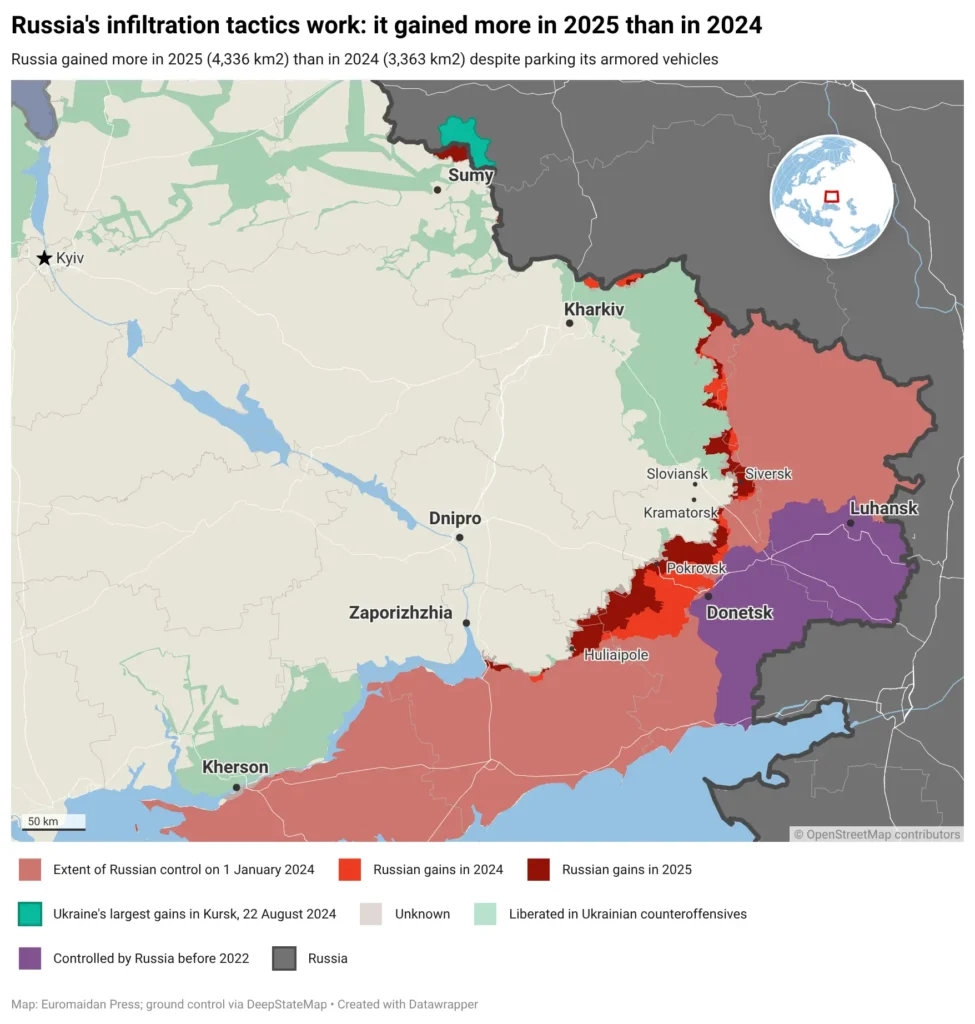
The Russians have gained ground faster in 2025 than they did in 2024, capturing 0.8% of Ukrainian territory. According to the Institute for the Study of War (ISW), Russian forces took or infiltrated 462 square kilometers in December and 364 square kilometers in January.
NATO General Secretary Mark Rutte has likened the pace of the advance to the “stilted speed of a garden snail.” The Ukrainians are regularly counterattacking and reclaiming parts of captured territory across the line.
Meanwhile, the Russians have bled and died for every patch of soil, taking about 35,000 casualties in December and 31,000 in January — that’s 76 and 87 casualties per square kilometer, respectively, per the ISW’s estimate. The numbers could be greater.
Commander-in-Chief Oleksandr Syrskyi reported that Russia's January losses exceeded the number of troops Moscow managed to recruit in the same period.
“Ukraine’s situation on the battlefield is difficult but not critical,” ISW wrote.
“While Russia remains dangerous, a collapse of Ukrainian defenses is unlikely… both sides are locked in positional warfare with little capacity for rapid maneuver.”
Towards the second half of 2025, the Russians have started to rely more heavily on infiltration as a way to gain ground. Infiltrators sneak through gaps in Ukrainian defenses, then slowly strengthen their positions and bring in progressively heavier equipment.
With personnel shortages on the Ukrainian side and heavy casualties on the Russian side, this tactic is likely to remain a factor for the foreseeable future.
Russia’s battlefield priorities
Considering all of the above, the Russians lack the strength to conduct more than one major assault operation at any one time, Andriy Zagorodnyuk, the head of the Center for Defense Strategies, told Euromaidan Press.
While Russian forces are likely to continue pushing in the south towards Zaporizhzhia, their primary focus is likely to stay in the East — their pushes in Donbas and Kharkiv oblast. Rob Lee, a front line researcher, agreed.
Christina Harward, Russia Deputy Team Lead at ISW, told Euromaidan Press that Russia's strategy has been to "maintain some pressure throughout the entire frontline" to tie up the Ukrainians.
Russian attacks towards Hulyaipole and Oleksandriivka over the past few months appear to be more than opportunistic, planned weeks in advance. Ukraine's ground lines of communication in the area are an important target, and Harward received reports that attacks in the south are likely starting in the spring.
“That being said, I do think their priority will be as it has been for a long time in Donetsk, in order to take the rest of the region,” she said.
Convincing the world
Russia's battlefield choices aren't purely military. “They have this interim strategy to show everybody that they’re winning,” Zagorodnyuk said. “So they would most likely continue in Donbas, because the ‘liberation of Donbas’ has been announced as an interim strategic goal.”
If Russia is able to succeed there, the results would be useful to show strength to both domestic and international audiences. Not that the Russians wouldn’t spin the story that way regardless, as Harward pointed out.
“Putin is trying to show his elites, because if he gives the impression that he doesn't control the situation, the question of mutiny would be again on the table,” Zagorodnyuk said. “The military leadership is trying to impress their leaders so they're not demoted.”
Illustrative photo: Trump and Putin shaking hands. Photo: White House via Wikimedia Commons
On the international stage, the show of power and control is partly for China, India, and smaller countries in the Global South, who have relations with Moscow.
But it’s also partly for Washington, where US President Donald Trump has been eager to repeat Russia’s notion that Ukraine doesn’t stand a chance. Trump’s convictions, if he has any, seem to be a matter of indifference. His leverage over Ukraine matters much more.
“Trump wants any kind of deal he can get that results in a ceasefire, hoping this will be evidence for his Nobel Peace Prize campaign,” John Bolton, one of Trump’s first-term national security advisers, told Huffington Post. “He doesn’t care about the substance of an agreement, just getting one.”
The Kremlin’s goal is to get Trump to squeeze Ukraine as much as possible in the coming year. The US is the source of most advanced weapons Ukraine uses, though they’re now paid for by European allies.
The kill zone
Whatever Moscow's messaging goals, the battlefield itself has changed. The front line is no longer a line.
Squatting between the opposing armies like an inoperable tumor is the kill zone, where the drones hold sway. This zone has already squeezed out mechanized assaults as a concept, according to Ruslan Muzychuk, spokesperson for the National Guard of Ukraine. And it’s only poised to grow fatter in the coming year.
This zone is no longer just a well-defined strip between opposing positions, but a fuzzy mass that extends beyond defensive lines, ranging from 10 to over 30 kilometers in some places.
Like a reverse tug-of-war, both sides are trying to expand this zone towards their enemy. Ukrainian military officials have made multiple statements that this is a priority.
“Of course, there will be a massive battle for deepening the kill zone,” Zagorodnyuk said. “Essentially the question is who controls more of the enemy's territory.”
A Ukrainian soldier with a drone. Source: The General Staff
While Ukrainian FPVs and bombers are able to hold the line, defenders are falling behind in mid-range attacks in some parts of the country. Russia’s elite drone units have pulled ahead, hitting Ukrainian airfields, trucks, and trains up to 200 kilometers behind the lines.
This is not because Ukraine lacks those capabilities. Mid-range attack drones are more expensive to develop and scale in production, Lyuba Shipovich, head of the military support fund Dignitas, told Euromaidan Press.
Also, drones are being used to make up for Ukraine’s manpower shortage, leading corps to prioritize shorter-range solutions as a matter of survival, according to Robert Brovdi, the commander of Ukraine's Unmanned Systems Forces.
ISW's Harward said that Ukrainians have identified this gap and are "significantly increasing their efforts" to target logistics and headquarters in the Russian rear. “That said, these campaigns do take time to build up" and display visible consequences.
The machine war
Controlling the kill zone means controlling the drones. And that contest is evolving faster than either side expected. It is one of the reasons why the technological race for drones looks like it will be more important than ever in the fifth year of the invasion.
“From what I see, the war was humans vs humans. Then it was humans vs drones,” Shipovich said. “Now it’s mostly drones vs drones.”
Machines are fighting each other in the air, on the ground, and in the water. FPV drones target recon UAVs and UGVs, drone interceptors are targeting Shaheds. Naval drones, in tandem with UAVs, are simulating entire combined-arms operations on the Black Sea.
Ukrainian unmanned ground vehicles (UGVs) on display during a Ukrainian Ground Forces demonstration. Photo: David Kirichenko
Russia has pulled ahead of Ukraine in some areas, for example, with fiber optic drones — in some parts of the front, up to 50% of Russian UAVs use fiber, Lee told Euromaidan Press. Ukraine’s percentage is significantly lower.
In 2025, unmanned ground vehicles became increasingly prominent. Troops are even more likely to rely on them this year, as a way to deal with troop shortages. Previously, Ukrainians have mostly used them for logistics and casevac, but UGVs are increasingly fitted with weapons and launch cradles for UAVs. The Russians are also growing their use of this tech.
“I would say this year will be a year for ground robots,” Shipovich said. Others added that Ukraine must also maintain naval drone supremacy in the Black Sea to keep the suppressed and weakened Russian fleet there from bouncing back, a timely task given the Russians’ plans to develop their own naval drone — and counter-naval drone fleet.
Still, experts pointed out that it's dangerous to get carried away with drones and forget the importance of conventional capabilities, such as artillery, which remain critical for Ukraine.
The race for battlefield AI
Drones still require skilled operators to make best use of their potential. But military observers have said that the real race is to develop truly autonomous systems: AI-powered drones, whose connection to a human pilot is optional.
In the EW-choked battlefields of Ukraine, the side which is first able to deploy and scale this tech, will not just claim an advantage over their foe. They will be at the forefront of a very scary military revolution.
Once proper autonomous weaponry is on the field, “then the situation may completely change,” Zagorodnyuk said.
AI isn’t poised to disrupt just weapons, but also command and control. By analyzing the terabytes of battlefield data collected daily, AI can create a “situation in which the velocity of a single decision can be faster than the natural human ability to keep pace,” retired US Army officer Christopher Ghorbani said at the Cyber Resilience forum in Kyiv.
AI can magnify the impact of a single commander’s decision, he added. This is a double-edged sword, potentially allowing commanders to act faster and more decisively, but also risk losing sight of important decisions the AI might miss.
The air war
While both sides race toward autonomy on the front line, Ukraine faces a more immediate crisis overhead.
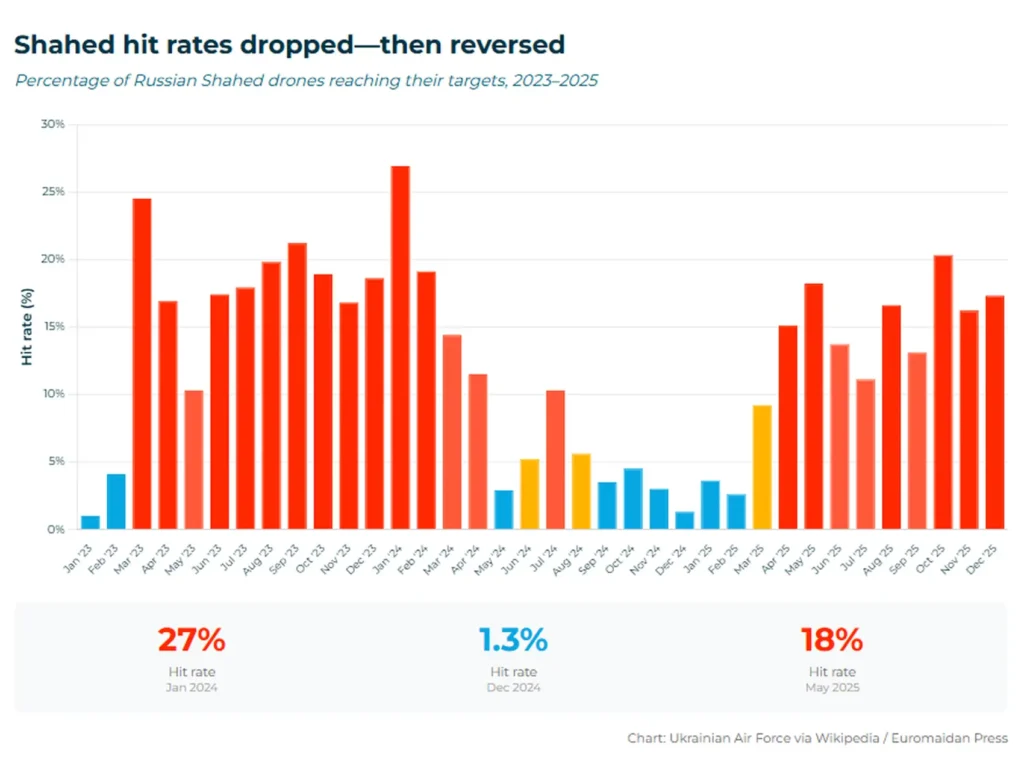
In January 2025, Ukraine intercepted 96.5% of Russian drones. By December, that number had dropped to 82.7% — and hasn't risen above the 80s since April.
Ukraine learned to down Russia's Shahed attack drones by autumn 2024, but then something changed. Chart: Euromaidan Press
Russia's air campaign has intensified sharply through 2025 and into 2026, causing repeated energy crises over the past winter, and experts told Euromaidan Press they expect the trend to continue.Russia is producing more and more drones and missiles, with the intent of using them against Ukraine.
There are multiple reasons for these trends. The Russians have improved on their tactics. The numbers consume Ukraine’s anti-air munitions. The drones started flying faster, while continuing to pepper the mix with decoys. There have been many strikes on areas close to the front line, allowing for shorter flight times and efficient route planning. Russia is also iterating on its Shahed-lineage drones, such as with faster, jet-powered versions.
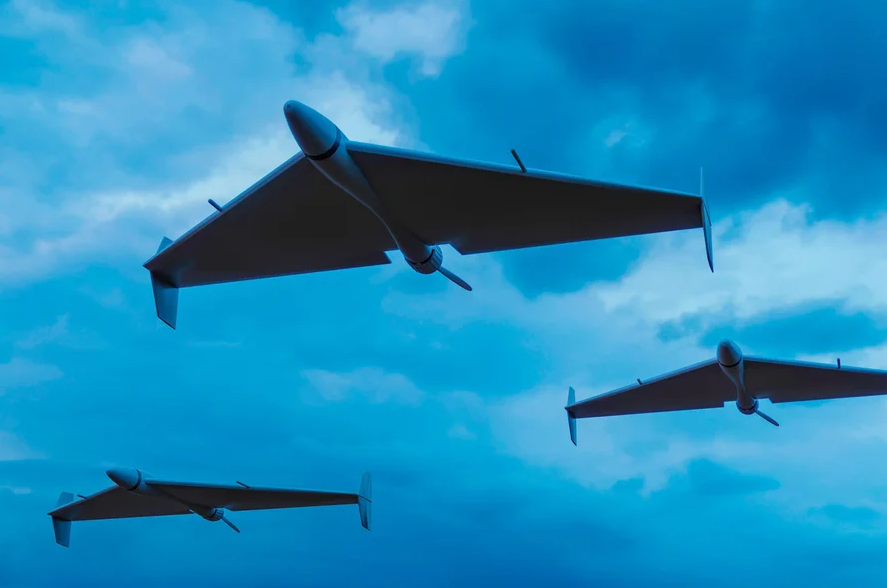
Visualization of Shahed drones flying. Russia has been mounting Starlink devices on some of their one-way attack drones. (Image: Incheol, via Roboflow)
Russia has also advanced its navigation systems, allowing drones to better counteract electronic warfare, and the integration of cameras and modems allowing real-time trajectory adjustment and evasive maneuvers. Part of this was achieved with Starlink — Ukraine’s move to ban unauthorized accounts has set the Russians back, but they will find other options.
The Russians have also taken advantage of “ceasefires” to stockpile their missiles and launch them en masse at Ukraine once the brief moratoria end, Harward said.
Insufficient training, as well as doctrinal, organizational, and tactical decisions also play a role. President Volodymyr Zelenskyy recently announced that air defense units in parts of the country will be restructured. Ukraine needs to make better use of its available resources, to better defend its civilian infrastructure from the storm of metal and flame.
It will also need continued support from allies in the form of Patriot missiles, which can deal with Russia’s ballistic attacks.
The industrial race
Defending against Russia's air campaign burns through munitions. Building drones burns through components. Both point to the same bottleneck: Another expected trend in 2026 will be “the movement of the center of gravity to industry,” Zagorodnyuk said. “Basically the fate of the front in many cases will not be decided on the front but actually in the workshops.”
The ability to not just maintain industrial output, but to scale it up will be critical to Ukraine’s performance in the coming phase of the war.
While Ukraine has often outperformed Russia in innovation, the Russians are stronger at scaling and standardization, before using these advantages to overwhelm the defenders.
It would also behoove Ukraine to reduce component dependence on countries like China as much as possible. In November, Kyiv launched an initiative to support domestic component producers. Its performance will impact the war effort.
Effective leadership
And finally, Ukraine’s performance will also depend on how well its leadership and military hierarchy works, from the president and the commander-in-chief, down to the junior officers.
While Ukraine has tried to move away from its past, the Soviet specter still haunts the military, just like in Russia. For example, there is limited delegation of responsibility, and breaking the rules risks harsh punishment or removal. This approach stunts initiative in the ranks and slows down the system.
Multiple military insiders have told Euromaidan Press that the system is still top-heavy, relying on out-of-touch generals deciding things that should be delegated to captains and lower-ranking officers.
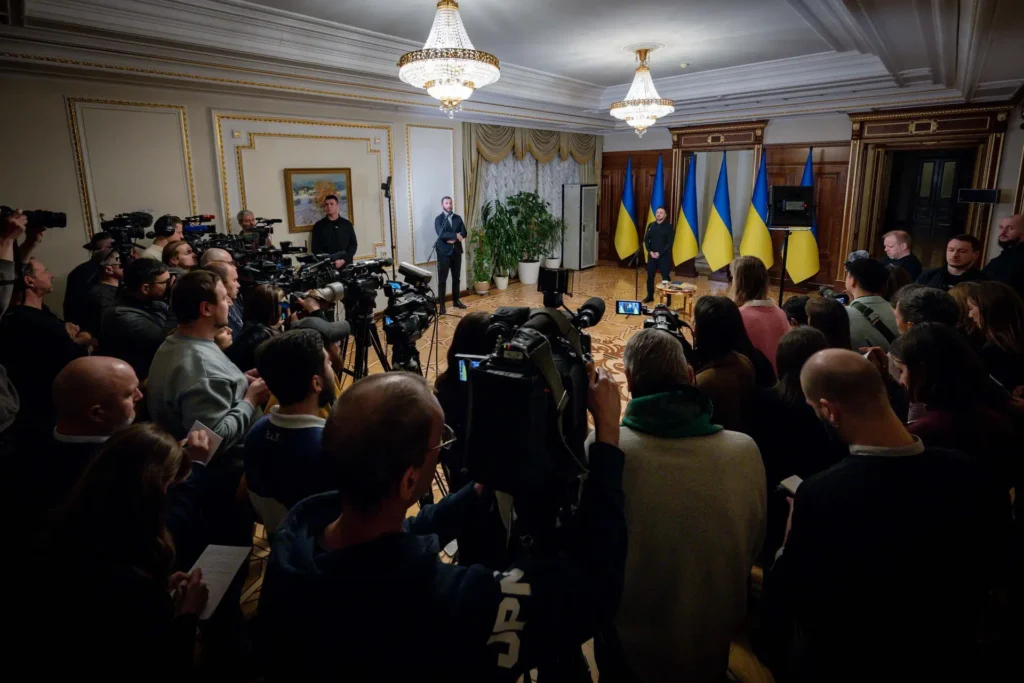
Ukrainian President Volodymyr Zelenskyy during a press briefing on 3 January 2026. Photo: Zelenskyy's TG
Political paranoia also plays a role. In a recent interview, former top commander Valeriy Zaluzhnyi said that Zelenskyy had him investigated and didn’t commit enough resources to the stalled Ukrainian counteroffensive of 2023.
Zelenskyy subsequently had him removed — multiple reports suggested that the president was threatened by Zaluzhnyi’s popularity and saw him as a potential rival in future presidential elections.
Even at the lower levels, personal pride and inertia against change often interferes with implementing best doctrinal and tactical practices, according to a senior master sergeant, who spoke extensively to Euromaidan Press on condition of anonymity.
Some sources, including Shipovich, said they are optimistic about the defense ministry appointment of Mykhailo Fedorov, formerly the Minister of Digital Transformation. As a tech-minded civilian and early drone pioneer, who was broadly seen as successful in his previous role, he may bring a fresh perspective to how the war is prosecuted.
As well, unlike Russia, Ukraine boasts new types of army units that explicitly broke with the old Soviet command culture. The 3rd Assault, Azov, and Khartiia brigades have been elevated to corps level as part of Ukraine's armed forces overhaul, and are now training subordinate brigades in their methods. If their model takes hold, Ukraine stops being a small Soviet army fighting a large one—and starts being a different kind of army altogether.
But the speed of adaptation is at least as important as the direction. Russia is producing more drones, more missiles, more glide bombs than at any point in the war. Ukraine is building robots, training AI pilots, and trying to reform a command structure that still thinks in Soviet hierarchies — all while under daily bombardment.
“Time is an enormously critical element,” Zagorodnyuk said. “Are we adapting quickly enough? That’s all that matters right now.”
As a Partner and Co-Founder of Predictiv and PredictivAsia, Jon specializes in management performance and organizational effectiveness for both domestic and international clients. He is an editor and author whose works include Invisible Advantage: How Intangilbles are Driving Business Performance. Learn more...






0 comments:
Post a Comment