As Ukraine Counterattacks, Russia's 2026 Plans Are Slipping Away
Prussian Field Marshal Helmuth von Moltke famously intoned that, in war, 'no plan survives first contact with the enemy.' World Heavyweight Boxing Champion "Iron Mike" Tyson more colorfully averred that 'everyone has a plan until they get punched in the face.'
In 2026, the Kremlin is being confronted by the wisdom of both von Moltke and Tyson. The first contact with the enemy in 2026 was Ukraine's surprise counteroffensive. The punch in the face came with the ongoing success of those assaults, which not only derailed Russia's winter offensive, but has disrupted the Russian spring-summer offensive plan to the extent that troops intended for that effort have now been forced to redeploy to defend against the Ukrainian attacks. Welcome to reality, comrade. JL
David Axe reports in Trench Art:
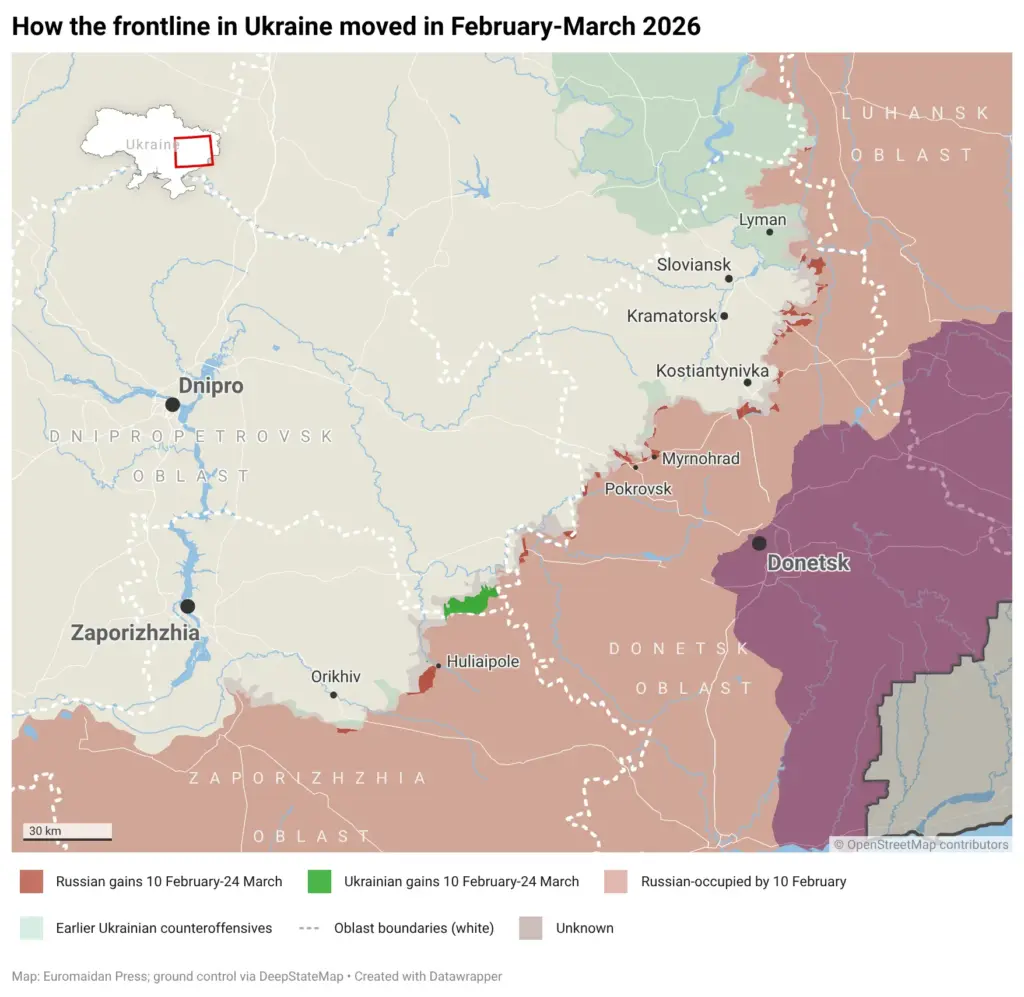
Plans are just that: plans. The Russians suffered tens of thousands of casualties marching toward Pokrovsk and Myrnohrad; their exhaustion is evident in the sharp slowdown in assaults since late last year. The aims of the 700,000-strong Russian force in Ukraine are to advance toward the left bank of the Dnipro River in southern Ukraine while also pushing toward the twin free cities of Sloviansk and Kramatorsk in eastern Ukraine. Both are much easier planned than done. Ukrainian forces' stiff defense is impeding the planned march on Sloviansk and Kramatorsk in the east. (And) Ukraine's southeastern counteroffensive has stalled any Russian advance towards the Dnipro."Russia’s plans in Zaporizhzhia are being blocked. It needed to capture Orikhiv within a month. That’s not going to happen."
As the weather warms and Russian forces become more active on the ground and in the air following a long winter hibernation, Moscow's objectives for the fifth year of wider war are becoming clearer.
The main aims of the 700,000-strong Russian force in Ukraine are to advance toward the left bank of the Dnipro River in southern Ukraine while also pushing toward the twin free cities of Sloviansk and Kramatorsk in eastern Ukraine.
The former objective would consolidate Russian control over most of the Ukrainian Black Sea coast. The latter objective could result in full Russian control of Donetsk Oblast.
Both are much easier planned than done. Ukraine's southeastern counteroffensive has stalled any Russian advance toward the Dnipro. And Ukrainian forces' stiff defense of two key towns—Kostiantynivka and Lyman—is impeding the planned march on Sloviansk and Kramatorsk.
But a long spring-to-fall fighting season looms. Russian field armies are once again mobilizing heavy forces that mostly idled for much of the past year. Russian aerial bombardment is intensifying along the most critical sectors.
And while the Ukrainians are killing and maiming more Russians than ever and thoroughly wrecking the season's initial Russian mechanized assaults, Russian troops and vehicles still greatly outnumber Ukrainian troops and vehicles.
Plans are just that: plans. The coming months could make a mockery of Russian objectives, or reveal the same objectives as unnecessarily conservative. The only thing anyone can say with any certainty is that the fighting will be brutal. And losses will be painful for both sides.
The war in Ukraine has a seasonal rhythm. The Russians push hardest, often with mechanized forces, when the weather is warm and the ground is dry. When the weather is cold and wet, infantry take over—creeping across the wide, contested "gray zone" in order to destabilize Ukrainian positions and potentially even capture a city or two.
Last winter, Russian infantry succeeded in capturing Pokrovsk and neighboring Myrnohrad in Donetsk Oblast in the east, seeming opening a southern path toward Kramatorsk and Sloviansk, 50 km to the north. They also marched westward across Dnipropetrovsk and Zaporizhzhia Oblasts in the southeast, ultimately capturing Huliaipole and setting conditions for a future push toward Orikhiv, the last major Ukrainian strongpoint between the Russians and Zaporizhzhia city, on the Dnipro's left bank 80 km west of the gray zone.
But the Russians suffered tens of thousands of casualties marching toward and eventually capturing Pokrovsk and Myrnohrad; their exhaustion is evident in the sharp slowdown in Russian assaults since the two settlements fell late last year. Kostiantynivka holds.
And in the southeast, a Ukrainian counteroffensive—timed to take advantage of a collapse in Russia's front-line communications—not only halted the Russian march on Orikhiv, it reversed it. The Russians are falling back in Dnipropetrovsk and Zaporizhzhia Oblasts at the time plans call for them to lunge forward.
That doesn't mean the Russians won't resume their slow grind across Ukraine in the coming months. The Russian air force has escalated its aerial bombardment of Ukrainian positions around Kramatorsk and Sloviansk in the east and west of Huliaipole in the southeast, aiming to weaken the Ukrainian defense ahead of renewed Russian offensives along both axes.
Mapper Clément Molin observed 4,000 Russian air strikes along the Kramatorsk-Sloviansk axis since 2024 and 900 Russian air strikes around Huliaipole in the same timeframe. A follow-on Russian ground offensive is taking shape in the east. "The current offensive actions are slowly increasing from Lyman to Pokrovsk," Molin noted.
The first few Russian mechanized assaults toward Lyman ended in disaster for the Russians, with heavy losses in vehicles and personnel. But the Russians spent much of 2025 replenishing its depleted armored forces: it's possible there are now more tanks and other armored vehicles on the Russian side of the gray zone than at any point in the 50-month wider war.
All that is to say, the Russian pressure on Sloviansk and Kramatorsk will only increase.
In the southeast, the Russians must first defeat the Ukrainian counteroffensive before they can resume their westward march. Analyst Andrew Perpetua is skeptical that it'll happen any time soon—although not for a lack of violence.
"Overall, Russia’s plans in Zaporizhzhia are being blocked," Perpetua wrote. "Their advance on Orikhiv’s eastern side has slowed a lot because of Ukrainian counterattacks and strong defenses."
"If Russia wants to focus its summer campaign on the [Dnipro] riverbank as planned, they would need to capture Orikhiv within about a month," Perpetua wrote recently. "That’s not going to happen. More likely, they’ll spend the summer trying to take Orikhiv, which might fail, and never reach their yearly goal of capturing the bank."
If the most optimistic predictions for the Ukrainians come true, the Russians may make only limited progress toward Kramatorsk and Sloviansk in the east and Orikhiv in the south. In that case, the Kremlin's objectives for 2026 could roll into 2027 as the wider war grinds on.
As a Partner and Co-Founder of Predictiv and PredictivAsia, Jon specializes in management performance and organizational effectiveness for both domestic and international clients. He is an editor and author whose works include Invisible Advantage: How Intangilbles are Driving Business Performance. Learn more...




0 comments:
Post a Comment