After 5 Years, 1000s of Russian Dead, Ukraine Defies Kremlin At Mala Tokmachka
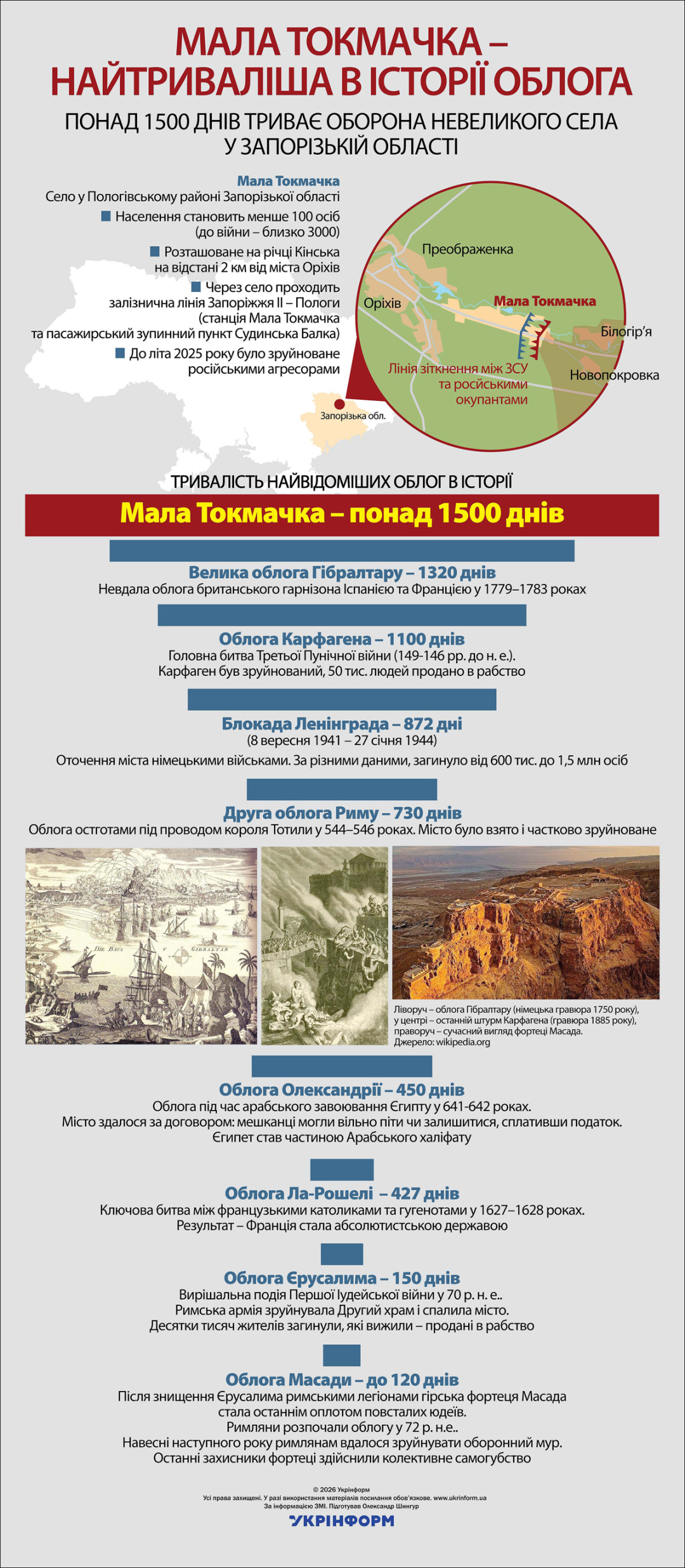
Russia's siege of Ukrainian forces at Mala Tokmachka, in Zaporizhzhia oblast is already the longest of the Russian invasion, certified as such by the government in Kyiv. But it may also be one of the longest in recorded history, surpassing Troy, Carthage, Verdun, Leningrad and others in the annals of warfare.
The Ukrainians have held out against everything the Russians could throw at them. In the process they have destroyed dozens of Russian armored vehicles and killed thousands of Russian troops. In this, the defense of Mala Tokmachka is emblematic of Ukraine's ability to thwart the Russians, especially now that global recognition of Putin's military failure in Ukraine has become the dominant narrative. JL
Olena Mukhina reports in Euromaidan Press, Myroslav Liskovych reports in Ukrinform:
Ukraine's 118th Mechanized Brigade received the country'sBook of Records certification for its defense of Mala Tokmachka in Zaporizhzhia Oblast, recognizing the longest-held front-line position of the war. Ukrainian forces have held it continuously for 1,500 days under assault, artillery, aviation, and drone fire.The front line in the village has barely shifted. Occasionally Russian troops enter the eastern outskirts but are destroyed by drones and cleared out by assault units as operations in this sector have been refined to the point of automation. The largest assault took place on October 20, 2025, when Russia's 71st Motor Rifle Regiment attacked with two motorized rifle companies supported by 26 armored vehicles, including tanks. 21 vehicles were destroyed and dozens of troops killed. Russian losses in repeated attempts to capture Mala Tokmachka exceed two thousand personnel.
Russia has been trying to capture one small Ukrainian village for longer than Rome besieged Carthage.
Ukraine's 118th Separate Mechanized Brigade has reported receivingBook of Records of Ukraine certification for Mala Tokmachka in Zaporizhzhia Oblast, recognizing the village as one of the longest-held front-line positions of the modern Russian-Ukrainian war.
Mala Tokmachka sits on the approaches to the city of Orikhiv, a key node of Ukrainian defense on the Zaporizhzhia direction. Russian capture would have strengthened pressure on Orikhiv and opened further assault corridors deeper into the oblast.
Ukrainian forces have held the position continuously for more than 1,500 days under constant assault, artillery, aviation, and drone fire.
Mala Tokmachka, before the full-scale war, was home to more than 3,000 people, with a brick factory and several small enterprises. By various estimates, up to a hundred residents remain today.
Most streets are destroyed buildings, aerial-bomb craters, and burned yards, surrounded by tree belts and fields through which Russian forces have been attempting to break through toward Orikhiv for years.
Despite its small size, the village is one of the largest settlements in the district, a local transport node where roads from several surrounding communities converge.
City's defense now outlasts some of history’s most famous sieges
The Russian effort at Mala Tokmachka has now exceeded several of history's most-cited sieges by significant margins, Telegraf reports. The Roman siege of Carthage, which destroyed the city in 146 BC, lasted approximately 1,100 days.
The 1627–1628 siege of La Rochelle, the French fortified port city, lasted 457 days. The Roman siege of Jerusalem in AD 70 lasted several months.
Ukrainian defense of Mala Tokmachka has now run continuously for more than 1,500 days, and Russian forces still do not control the village, according to ArmyInform.
"Complete liberation" without celebration
Russian military communications and Kremlin-aligned media have for months repeatedly reported the alleged "complete liberation" of Mala Tokmachka, the 118th Brigade noted in its Facebook post.
The front line in the village has barely shifted. The disconnect between Russian reporting of capture and the Ukrainian flag still flying has turned the village into a viral meme in Ukrainian and broader social media, with hundreds of videos mocking Russia's inability to advance.
In early March 2022, Mala Tokmachka briefly fell under occupation. By May of the same year, it had been liberated. Since then, the front line has stabilized roughly 1.5–2 kilometers from the village.
Today, the area is defended by the 118th Separate Mechanized Brigade as part of the 10th Army Corps under the command of Colonel Oleh Dmytryshyn. The Brigade’s press officer, known by the callsign “Fake,” refers to his troops as the “cyborgs of Mala Tokmachka,” drawing a parallel with the defenders of the Second Battle of Donetsk Airport.
According to a drone operator with the callsign “Mars,” even when poor flying conditions occasionally allow Russian troops to enter the eastern outskirts of the village, they are destroyed by drones and cleared out by assault units the very next day. He says operations in this sector have been refined almost to the point of automation. Apparently, the enemy has achieved a kind of automation there as well — only with the opposite outcome.
The largest assault took place on October 20, 2025, when enemy units from the 71st Motor Rifle Regiment attacked from the direction of Verbove and Novoprokopivka. The attack involved up to two motorized rifle companies supported by around 26 armored vehicles, including tanks, infantry fighting vehicles, armored personnel carriers, and Tigr armored vehicles. The result: 21 vehicles destroyed and more than 30 troops killed. Overall Russian losses in repeated attempts to capture Mala Tokmachka have long since exceeded two thousand personnel.
HOW MALA TOKMACHKA EXPOSED THE ABSURDITY OF RUSSIAN PROPAGANDA
In the public discourse, this section of the front has acquired an almost comical significance of its own.
For nearly a year, so-called Russian war correspondents and official resources of the Russian Ministry of Defense regularly reported “successes” on the Orikhiv axis. The blogger “Deceived Russian” compiled these reports and identified a simple pattern: the same “captures” — first the eastern part of the village, then the southern sector, then the southeastern outskirts — were repeated with absurd regularity, almost every week.
The climax of this cycle came in November 2025, when Russian Defense Minister Andrey Belousov triumphantly announced the “complete liberation” of Mala Tokmachka, describing it as “a significant step toward achieving the goals of the special military operation.” The spokesperson for Ukraine’s Southern Defense Forces, Vladyslav Voloshyn, responded laconically: neither during the previous day nor the day before had any enemy assault operations been recorded that could indicate the capture of the settlement. A few days later, Russian sources themselves were once again reporting “heavy fighting,” effectively contradicting their own minister.
The internet reacted exactly as one would expect to absurdity. Hundreds of memes spread online: “Whoever controls Mala Tokmachka controls the world.” It even reached the point where students at some Russian universities were reportedly threatened with expulsion for publicly joking about the village. The fact itself is revealing: a tiny settlement in Zaporizhzhia Oblast became such a sensitive issue for the system that it began responding to satire with disciplinary measures. Even some Russian commentators acknowledged the area as “the most famous deadlock on the front” — a rather telling admission for an army that once claimed its “strategic operation” would last only a few weeks.
MALA TOKMACHKA ON THE SCALE OF MILITARY HISTORY
To grasp the scale of what is happening, it is worth comparing the numbers with some of history’s best-known sieges.
As of May 2026, the defense of Mala Tokmachka has lasted more than 1,500 days. The Siege of Carthage — involving a city of roughly 700,000 inhabitants protected by massive walls and a powerful fleet — lasted around 1,100 days. Mala Tokmachka has already surpassed that by roughly 400 days. The Great Siege of Gibraltar (1779–1783), the longest siege in British military history, lasted 1,320 days — also less. The Siege of La Rochelle during the era of Richelieu lasted around 430 days; for the defenders of this sector, that represents only about a quarter of the road already traveled.
Even some of those writing from the enemy’s side have taken notice. Russian propagandist Lev Vershinin wrote: “Mala Tokmachka is something like Troy — or, in more modern terms, Verdun.”
An army that once planned to “take Kyiv in three days” has now spent a fifth year unable to capture an area of just eight square kilometers. Perhaps that is the most concise and accurate description of the real state of affairs.
As a Partner and Co-Founder of Predictiv and PredictivAsia, Jon specializes in management performance and organizational effectiveness for both domestic and international clients. He is an editor and author whose works include Invisible Advantage: How Intangilbles are Driving Business Performance. Learn more...




0 comments:
Post a Comment