How Ukraine's Ground Robots Have Stopped Russians At Kostiantynivka
Ukrainian forces defending Kostiantynivka and other positions in Donbas are being supported by an army of ground drones (UGVs) that carried out 10,300 logistics and other missions last month alone. The UGVs can deliver hundreds of kilos of supplies (vs tens of kilos for aerial drones) while also capable of defending positions and attacking Russian troops.
Warfighting will always require some humans, but the Ukrainians are demonstrating that they can reduce casualties without sacrificing military capabilities. JL
Euromaidan Press reports:
The the Ukrainian 1st Azov Corps and adjacent units have dug in in Konstyantynivka, and aren't inclined to give up . And they have help from a legion of ground robots that keep garrison in Kostiantynivka supplied with food, fuel and ammunition. The roads into Kostiantynivka are too dangerous for routine travel by human beings, so the unmanned ground vehicles—some of the 25,000 UGVs Ukrainian industry expects to produce this year—have taken over. The Ukrainians performed 10,300 resupply and evacuation missions by UGVs in April, a fourfold increase in unmanned ground logistics ops compared to six months ago. A garrison resupplied by machines can hold out much longer than one resupplied by human beings whose deaths impose much greater stress on the overall force. And who are more expensive to recruit, train, deploy and support than any UGV.
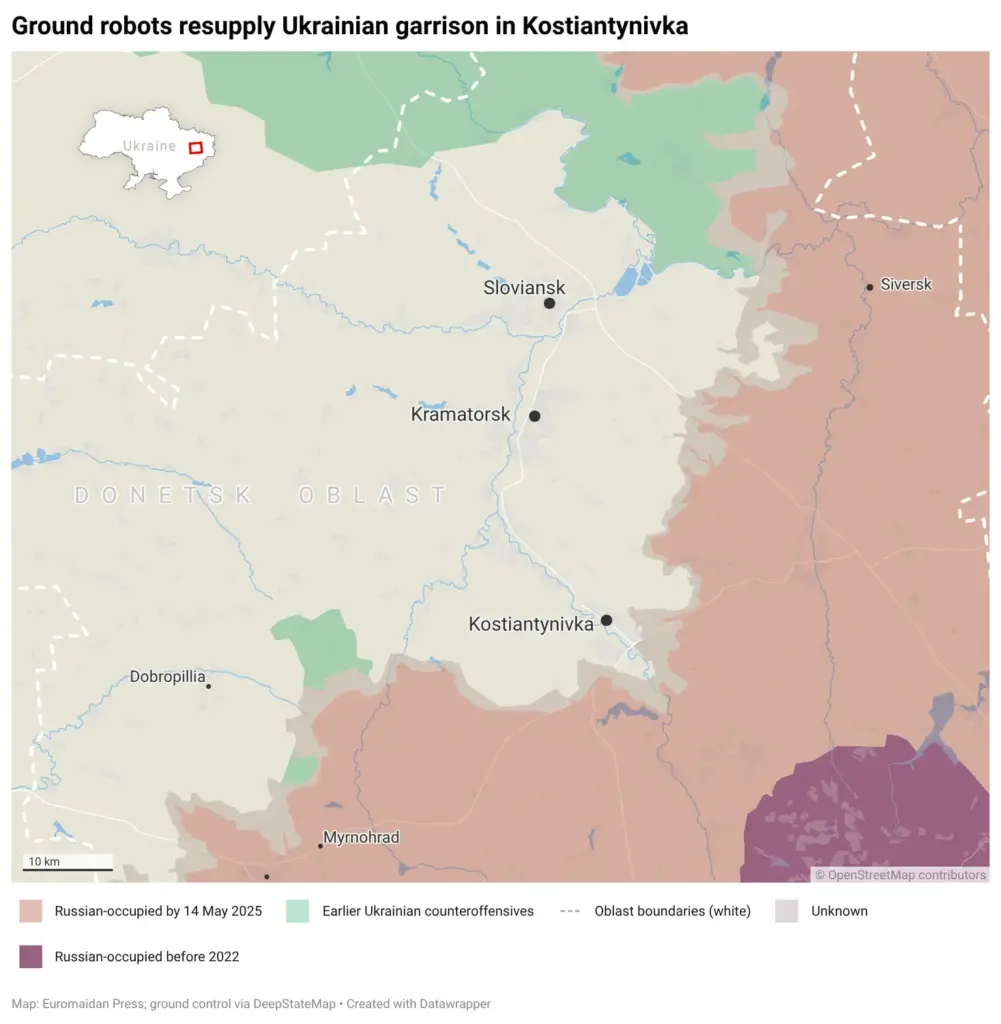
Russia's Center Group of Forces is determined to open a path toward the twin cities of Kramatorsk and Sloviansk, the last big free settlements in eastern Ukraine's Donetsk Oblast.
There's more than one possible path. The Russians could advance through Siversk, 30 km east of Sloviansk. Or they could attempt to advance on the twin cities from the ruins of Pokrovsk, 40 km to the southwest.
The southern route, through the fortress city of Konstyantynivka just east of Pokrovsk, is the shortest for the Russians: just 18 km. But there's a problem for the Russians: the Ukrainian 1st Azov Corps and adjacent units have dug in in Konstyantynivka, and aren't inclined to give up the critical city.
And they have help from a legion of ground robots that keep garrison in Kostiantynivka supplied with food, fuel and ammunition. The roads into Kostiantynivka from the north are too dangerous for routine travel by human beings, so the unmanned ground vehicles—some of the roughly 25,000 UGVs Ukrainian industry expects to produce this year—have taken over.
Yes, it's also possible to resupply the Kostiantynivka garrison by air with heavylift drones. But a ground robot might carry hundreds of kilograms of supplies versus the tens of kilograms a drone might carry. UGVs "are the main resupply method" for Kostiantynivka, analyst Moklasen noted. The same 'bots evacuate wounded troops out of the city.
There are so many of the remote-controlled, wheeled resupply UGVs rolling back and forth along the Kryvyi Torets River threading through Kostiantynivka that Russian first-person-view drone operators are deliberately hunting them. According to Moklasen, there are no fewer than 50 wrecked UGVs on the roads running along both banks of the Kryvyi Torets.
Fifty UGVs, each costing a few tens of thousands of dollars, is a small price to pay to keep the Kostiantynivka garrison fed, fueled and armed. Manpower-starved Ukrainian forces can't afford to lose drivers on the roads into Kostiantynivka, but they can afford to lose a few robots.
Robot resupply
In pivoting to UGVs for resupply, the Ukrainians are hoping to thwart Russia's normal strategy for defeating entrenched Ukrainian garrisons in urban areas. Time and again, Russian field armies have opted to starve Ukrainian garrisons in the best-fortified cities and towns before directly assaulting them.
A focused Russian campaign targeting Ukrainian trucks preceded the final Russian counterattack that finally dislodged Ukrainian troops occupying Russia's Kursk Oblast in the spring of 2025. Russian glide bombs, drones and artillery pummeled the supply routes into Pokrovsk for months before the Center Group of Forces finally captured the city back in December.
In a desperate bid to prevent that from happening again, Ukrainian forces massively scaled up their deployment of UGVs. According toThe Telegraph, the Ukrainians performed nearly 10,300 resupply and evacuation missions by UGVs in April, a nearly fourfold increase in unmanned ground logistics ops compared to six months ago.
A garrison resupplied by machines can hold out much longer than one resupplied by human beings whose deaths impose much greater stress on the overall force. And who are more expensive to recruit, train, deploy and support than any UGV.
If there's a weak link in Ukraine's increasingly unmanned logistics, it's that the infantry, gunners and drone operators who actually hold ground in and around Konstyantynivka must still get into and out of the city during rotations. These rotations are when Ukrainian units suffer their worst casualties.
Robotic resupply prolongs Ukraine's defense of Kostiantynivka but only significant human reinforcements can decisively win the battle and close off the most direct route toward Kramatorsk and Sloviansk. A massive deployment of Ukrainian assault troops could allow the 1st Azov Corps to go on the offensive and relieve Kostiantynivka for good.
Map: Euromaidan Press
But where would those assault troops come from? Ukraine's reserves are nearly if not fully committed holding the line around Siversk and Pokrovsk while also pushing back against Russian field armies in the southeast.
"The closest analogy to the current situation is a dam that is at its cracking phase and might soon either suddenly give up or slowly continue to crack until all the water seeps out," analyst and mapper Playfra explained. "That is, we might see a big but very unlikely Russian breakthrough in the city or a moderate advancement of Russian infiltration groups in the city ... repeating the process until Kostiantynivka is eventually lost."
As a Partner and Co-Founder of Predictiv and PredictivAsia, Jon specializes in management performance and organizational effectiveness for both domestic and international clients. He is an editor and author whose works include Invisible Advantage: How Intangilbles are Driving Business Performance. Learn more...




0 comments:
Post a Comment