1960s Soviet Armor Has Been Turned Into Lethal Threat By Ukraine
In addition to innovating and creating new weapons and tactics, the Ukrainians have demonstrated that they are masters at making do with what is at hand.
The use of antiquated Soviet era armored personnel carriers and huge rolling explosive devices and of 1960s era T-62 tanks as mobile artillery firing from a distance has turned large hunks of metal once considered little better than scrap into lethal weapons. JL
Euromaidan Press reports:
Bulgaria gave Ukraine 110 BTR-60 armored personnel carriers. They are 1960s vehicles, too thinly armored to carry infantry near a front patrolled by drones. So Ukraine's 3rd Corps found another use for them during Operation Vivaldi. Fill it with anti-tank mines, rig it for remote control, drive it at a Russian bunker, and set it off. Packing dozens of TM-62 anti-tank mines, the speedy BTR-60s become vehicle-borne improvised explosive devices, or VBIEDs. (Similarly) Ukrainian units have operated at least 45 T-62Ms that Ukrainian troops captured. The 40-ton, four-person T-62M is still a vehicle of the early Cold War, (but) these days, many tanks on both sides function as mobile artillery, angling their guns high to fire a few rounds at targets kilometers away. They rarely close with the enemy. The threat from tiny explosive drones has pushed armor back from the gray zone, and at that distance a T-62M is not much less effective than a far more precious Leopard 2, or M-1.
Bulgaria gave Ukraine 110 BTR-60 armored personnel carriers. They are 1960s vehicles, too thinly armored to carry infantry anywhere near a front line patrolled by explosive drones. So Ukraine's 3rd Army Corps found another use for them during Operation Vivaldi, its counteroffensive north of Lyman. Fill one with anti-tank mines, rig it for remote control, drive it at a Russian bunker, and set it off.
Packing potentially dozens of TM-62 anti-tank mines, the speedy BTR-60s become what's called vehicle-borne improvised explosive devices, or VBIEDs. Once a favorite weapon of insurgents battling US forces in Iraq and Afghanistan, VBIEDs have found a new niche in Russia's wider war on Ukraine as unmanned demolition systems.
"To break through the enemy's defenses, the 3rd Army Corps employed its own invention, Soviet BTR-60s converted into robotic kamikaze complexes," the corps stated. "They were used to demolish the enemy's strongest fortifications." If an enemy strongpoint is too heavily protected to bomb from the air but exposed to attack from the ground, send in a VBIED.
The Russians were the first to deploy vehicular IEDs in the current war, but the Ukrainians may have mastered the tactic. It's one thing to rig an explosives-filled MT-LB tractor or T-55 tank to roll straight forward without direct human control, as the Russians once did. It's another to rig an explosive BTR-60 to maneuver before going off, as the 3rd Army Corps' VBIEDs clearly did.
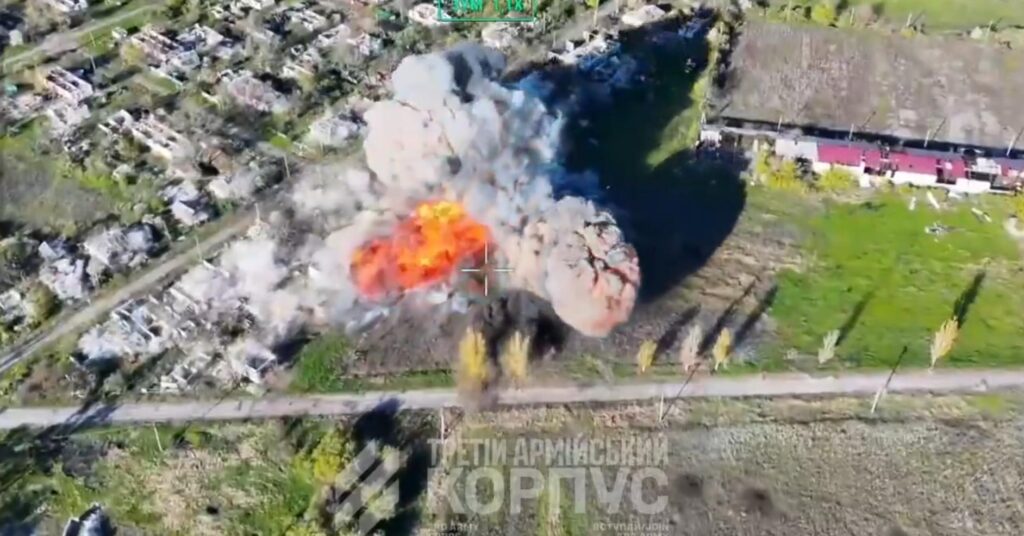
On 28 September, announcing the close of Vivaldi's third phase, the 3rd Army Corps released drone footage depicting one of the explosive BTRs blasting a Russian strongpoint north of the town of Lyman. The sheer scale of the explosion is testimony to the VBIED's destructive potential. And the trail the BTR leaves in the grass in the heavily edited video indicates the Ukrainians can steer their VBIEDs around obstacles and guide them to precision strikes.
A BTR-60 VBIED explodes. 3rd Army Corps capture.
Why it gets there
A slow wheeled vehicle crossing open ground toward a fortified position should not survive the trip. In most sectors it would not. What makes the tactic work north of Lyman is a condition the 3rd Army Corps built into Vivaldi before its assault groups moved: Ukrainian air defense and electronic warfare threw a protective dome over the battle area, blinding Russian drones so they could not read the operation's design or strike what was moving through it.
Ukraine liberates area above Lyman in Operation Vivaldi. Map: Euromaidan Press
Robots have played critical roles in each phase of Vivaldi. Surveillance drones have watched from overhead. One-way attack drones have pummeled Russian positions and supply lines. Heavy bomber drones have not only dropped bombs, they've also airlifted explosive unmanned ground vehicles into position so the UGVs can roll right through the front doors of Russian bunkers.
The self-exploding BTR-60s are too big to airlift, but that's the point. A small UGV might carry a few tens of kilograms of explosives. A remote-controlled BTR-60 can easily haul hundreds of kilograms.
It's not impossible to take out a VBIED before it strikes, of course. Mines, anti-tank missiles, and even concentrated gunfire can stop a vehicular bomb in its tracks. But losing one of the aged BTR-60s costs Ukraine very little. The vehicles are too thinly armored for use as front-line infantry transports anyway. You might as well convert them into bombs.
That is the whole case for the tactic. A manned fighter jet lobbing a precision glide bomb is the preferred approach to bunker-busting. But it costs tens of thousands of dollars an hour to keep a jet in the air, and a single glide bomb can cost tens of thousands or even hundreds of thousands of dollars. It's unclear how much it costs to convert a BTR into a VBIED. It could be just a few thousand.
And it reduces Russian fortifications without risking any Ukrainian lives. That's the philosophy underpinning all of the 3rd Army Corps' robot-first tactics. "This is exactly the direction of the corps' development set by Brig. Gen. Andrii Biletskyi," the corps stated, "to reduce the number of fighters in the most dangerous areas and replace them with robots."
Vivaldi began in mid-April under an information blackout that held for five months. The corps says it has regained control of 176 sq km across three of a planned four phases, around half of that de-occupied outright, and taken more than 250 Russian prisoners. Those figures are the corps' own and have not been independently verified.
Sometimes the robots doing that work are 60-year-old APCs modified for an explosive one-way mission.1960s-vintage, Soviet-made T-62Ms aren't the oldest tanks in the Ukrainian inventory. That dubious honorific belongs to Ukraine's ex-Slovenian M-55S tanks, which are based on Soviet-made T-55s from the 1950s.
The T-62M hasn't gotten better. The job has changed. These days, many tanks on both sides function as mobile artillery, angling their guns high to fire a few rounds at targets kilometers away. They rarely work as tanks, closing with the enemy and firing directly from a few hundred meters. The threat from tiny explosive drones has pushed armor back from the gray zone, and at that distance a T-62M is not much less effective than a T-64BV. Or, for that matter, than a far more precious Leopard 1, Leopard 2, or M-1.
That is one reading of a war that has changed shape, and nobody has published a study of it. Ukraine's T-64, Leopard, and Abrams fleets have all taken heavy documented losses. Oryx, which logs a loss only where photos or video exist, lists no Ukrainian T-62Ms at all.
These tanks, all captured from the Russians, are also available. And that matters in a military struggling to sustain its tank force. As Russia's war on Ukraine grinds through its 56th month, Ukraine is running low on its newest and best tanks. Older and less capable ones fill in ... for lack of a better alternative.
Observer Stevius, who closely tracks developments in the Ukrainian armor corps, recently highlighted the ongoing importance of former Russian T-62Ms to the Ukrainian war effort. "Captured T-62Ms still out there!"
Specifically, Stevius noted an ex-Russian T-62M belonging to the Ukrainian National Guard's 19th Brigade participating in a recent competition for best tank crew in the National Guard. According to Stevius, at least two other Ukrainian units have operated the survivors of at least 45 T-62Ms that Ukrainian troops have captured. Most of the captures took place during the Ukrainian counteroffensives in eastern and southern Ukraine in late 2022.
The 40-ton, four-person T-62M is Ukraine's second-oldest tank, and where the slightly older M-55S got a deep upgrade in 1990s Slovenia, the T-62M has not. In its DNA it is still a vehicle of the early Cold War. The Ukrainian army's 110th Mechanized Brigade temporarily operated T-62Ms before swapping them out for much newer and more capable T-64BVs. Where the T-62M has a 115-millimeter main gun loaded by hand by a fourth crew member, the T-64BV has a more powerful 125-millimeter gun loaded by a fast mechanical autoloader.
The fast-firing capability of the made-in-Ukraine T-64BV was central to the Ukrainian 1st Tank Brigade's successful defense of the city of Chernihiv during the early weeks of the wider Russian invasion starting in February 2022. The Ukrainian tanks engaged passing Russian tanks at point-blank range, and out-shot them.
That is the kind of fight the T-62M would lose. It is a kind of fight fewer tanks now get.
Surely some of the 60-something-year-old T-62Ms in Ukrainian service have been withdrawn owing to wear and tear and a possible shortage of spare parts. But there's a good chance most of the 45 Ukrainian T-62Ms are still in, or near, the action.
But not all are still tanks. Seeing the value in the thickly protected hull and reliable chassis that carries the T-62M's turret and gun, Ukrainian volunteers and units have converted some captured T-62Ms into specialist vehicles that benefit from the tanks' sturdy bottoms but don't need their obsolescent tops.
A few ex-Russian T-62Ms have undergone conversion into recovery vehicles by losing their turrets and guns and adding a heavy-duty winch for towing other armored vehicles. Volunteers working with the Serhiy Prytula Charity Foundation turned another into a heavy infantry fighting vehicle. The recipe is simple. Just pop off the existing turret and replace it with a smaller one fitted with a 30-millimeter autocannon, in this case one pulled from a captured Russian BMP-2.
Potentially dozens of Ukrainian T-62Ms are still T-62Ms, however, and still adding bulk and firepower to units that otherwise might struggle to deploy any tanks at all.
As a Partner and Co-Founder of Predictiv and PredictivAsia, Jon specializes in management performance and organizational effectiveness for both domestic and international clients. He is an editor and author whose works include Invisible Advantage: How Intangilbles are Driving Business Performance. Learn more...




0 comments:
Post a Comment