Kremlin Again Tries Attacks With Aging Armor As Troop Losses Exceed Replacement
In the past year, Russian commanders tried attacking with armor, which was quickly and easily dispatched by Ukrainian drones. Not having much more armor to lose - especially of less than 50 years old - the Kremlin reverted to infantry attacks by small squads and motorcycle troops. Those resulted in such carnage - 282,000 casualties since the beginning of the year - that the Russians are trying armor again, since there are only 3 or 4 crewmen in a tank versus 12 in an infantry squad.
But - to absolutely no one's surprise - the latest armored attacks, mostly fielding Soviet era T-64s - have met with disaster as Ukrainian surveillance and FPV drones, backed up by artillery have created an iron carpet of destroyed vehicles interspersed with the bodies of dead Russian soldiers. A breakthrough anywhere along the front remains unachievable - once again - for the Kremlin. JL
David Axe reports in Trench Art:
In early 2025, Russian forces in Ukraine stopped attacking with armored vehicles. Instead, they sent in infantry. (But) With 282,000 casualties since January exceeding recruitment capacity, Russia is choosing to trade steel for flesh—tanks have three crew versus infantry squads of 12 soldiers. It's a trade that accelerates the drain on vehicle reserves - which are very low - analysts warn could force a fundamental change by 2026. Russian mechanized attacks in recent days have resulted the same way each time. Dozens of tanks and other vehicles roll out, in the company of bike troops. Ukrainian surveillance drones spot them coming—and explosive FPV drones and artillery take aim. Prelaid mines add to the carnage. "Moscow has not achieved a breakthrough despite Ukrainian manpower issues."
In early 2025, Russian forces in Ukraine essentially stopped attacking with armored vehicles. Instead, they sent in infantry—on foot or on motorcycles.
There were tactical reasons for the switch. It’s possible fast-moving bike troops and widely scattered infantry stand a better chance of avoiding detection by the tiny explosive drones that are everywhere all the time over the 700-mile no-man’s-land in Ukraine.
Russia has scraped down to its last 2,478 tanks—nearly all of them rusted 50-year-old hulks needing expensive, time-consuming restoration before they can fight.
The tank crisis arrives as Russia pivots back to mechanized assaults after catastrophic infantry losses.
That strategic shift exposes Moscow's dilemma. With 282,000 casualties since January exceeding recruitment capacity, Russia is choosing to trade steel for flesh—tanks have three crew versus infantry squads of 12 or more soldiers. But it's a trade that accelerates the drain on vehicle reserves analysts warn could force either mobilization or a fundamental change in approach by 2026. Catastrophic infantry losses may explain the return to form. According to one leaked document, Russian forces suffered 282,000 casualties, including at least 87,000 fatalities, between January and September. The losses may exceed the Kremlin's ability to recruit fresh troops.
"A return to classic mechanized attacks makes sense in this new context," Jompy explained.
A tank is no less vulnerable to Ukrainian drones, artillery, and mines than is an infantry squad with similar combat power, but a tank has just three crew. An infantry squad may have a dozen soldiers.
Russia may be shifting back to mechanized assaults in a bid to reduce its manpower losses. The price, of course, will be more vehicle losses. And that may set a clock ticking. Vehicle reserves are very, very low.
The 2026 inflection point
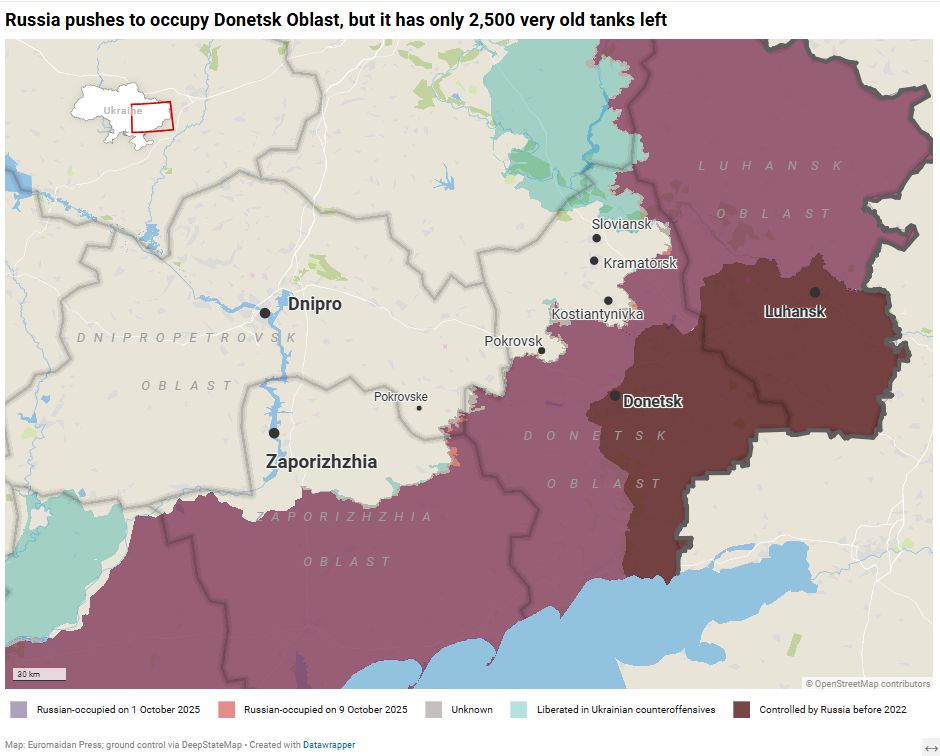
Map of Russia's advances in Donbas
It's for that reason and others that some analysts sense an inflection point approaching.
"In order to capture all of the Donetsk Oblast (which is of questionable actual strategic value for Russia)," wrote Rob Lee, an analyst with the Foreign Policy Research Institute in Philadelphia, "Moscow may need to conduct another mobilization or otherwise change its current approach, which has not achieved a breakthrough despite Ukrainian manpower issues."
Infantry-led infiltration tactics "will likely be less effective over the winter, as well," Lee added. "Ukrainian deep strikes are increasing the costs of the war for Russia, and increased support from the US could further strain Russia's ability to sustain the war."
"If Moscow decides to continue the war well into 2026," Lee concluded, "it will be demonstrating that it is willing to accept growing risks of lasting damage for questionable strategic gains."
There was another strategic reason, as well. The Kremlin was planning for what Ukrainian drone operator Kriegsforscher described as a “last, final battle” for eastern Ukraine’s Donetsk Oblast. And it expected all those tanks and other armored vehicles it had saved up to lead the way.
The armored assaults began weeks later than Kriegsforscher and other observers expected. And they may have begun too late. Kriegsforscher warned that the coming winter, and the dying leaves on a billion trees still clinging to life in shell-pocked Donetsk, would deprive the Russians of concealment.
Sure enough, a drumbeat of Russian mechanized attacks in recent days has resolved the same way each time. Dozens of tanks and other vehicles roll out, often in the company of scores of bike troops. Ukrainian surveillance drones spot them coming—and explosive first-person-view drones and artillery take aim.
Pre-laid mines add to the carnage. As night falls, bomb-dropping vampire drones hunt the survivors.
A Thursday afternoon assault on the village of Shakhove, buttressing Ukrainian defenses along the eastern corner of a chaotic 25-square-mile salient just north of Pokrovsk, was horrifically typical. (See video at top.)
The best fishing rods give you the perfect mix of power, balance, and sensitivity for smooth and accurate casting. They’re built to handle different fish types while staying lightweight and durable. Brands like Ugly Stik, KastKing, and St. Croix are trusted by anglers for their top performance and reliability.
As a Partner and Co-Founder of Predictiv and PredictivAsia, Jon specializes in management performance and organizational effectiveness for both domestic and international clients. He is an editor and author whose works include Invisible Advantage: How Intangilbles are Driving Business Performance. Learn more...




2 comments:
The best fishing rods give you the perfect mix of power, balance, and sensitivity for smooth and accurate casting. They’re built to handle different fish types while staying lightweight and durable. Brands like Ugly Stik, KastKing, and St. Croix are trusted by anglers for their top performance and reliability.
Vevor promotion coupon are a great way to save money on a wide range of industrial and commercial equipment
Post a Comment