"I Forget I Lost A Leg:" How Wounded Ukrainians Return As Drone Operators
In the Ukrainian military - if not in the Russian - losing a limb generally qualifies for an exemption to not have to serve anymore. But many Ukrainian soldiers prefer to volunteer to return to service.
They have a number of options to do so, but one that is increasingly popular is joining a drone unit either as a pilot, operator or as an intelligence, recon, surveillance or target acquisition specialist. It is an important way to continue to apply one's knowledge and experience. JL
Zoriana Katola reports in the Euromaidan Press:
A former air-assault soldier, stepped on a anti-personnel mine in July 2025 during a combat mission in Kharkiv Oblast. Another lost part of his lower leg after stepping on a petal mine in the same oblast. Both underwent amputations, rehabilitation, and prosthetic fitting, then chose to return to keep serving in ISTAR (intelligence, surveillance, target acquisition, and reconnaissance). The operator watches drone feeds, tracks friendly and enemy positions, and passes targets to strike teams. Over 100,000 amputations have been performed in Ukraine over four years of war. These two men show one route back into the war for soldiers who cannot return to the ground: the screens of a drone-saturated battlefield, where what they learned on foot still counts.
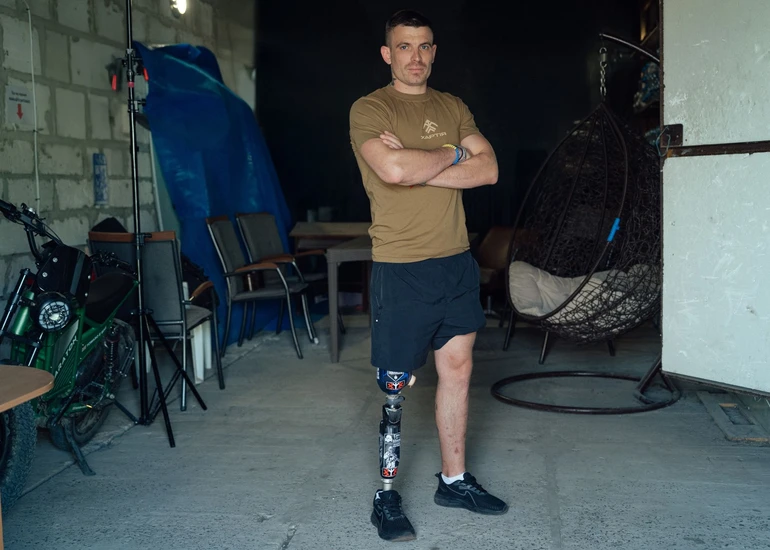
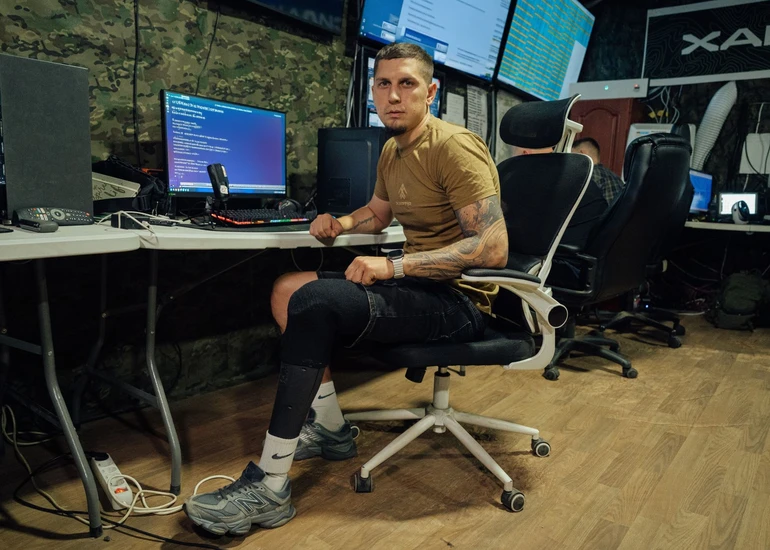
Callsign Bilyi, a former air-assault soldier, stepped on a PMN-2 anti-personnel mine in July 2025 during a combat mission in Kharkiv Oblast. Callsign Terri, a former industrial worker from Kharkiv Oblast, lost part of his lower leg after stepping on a petal mine near a position in the same oblast shortly before. Both underwent amputations, rehabilitation, and prosthetic fitting, then chose to return to Khartiia, the National Guard formation they had served with, according to Ukrainska Pravda.
Over 100,000 amputations have been performed in Ukraine over four years of war, and the fighting has added as many as 390,000 disabilities, according to the World Health Organization. While the figure does not distinguish soldiers from civilians, these two men show one route back into the war for soldiers who cannot return to the ground: the screens of a drone-saturated battlefield, where what they learned on foot still counts.
Both men could have been discharged, they told Ukrainska Pravda, and chose instead to keep serving in ISTAR (intelligence, surveillance, target acquisition, and reconnaissance). The operator watches drone feeds, tracks friendly and enemy positions, and passes targets to strike teams.
Bilyi's path back to service
Bilyi says the job needs what he already had: "An ISTAR operator should have combat experience, to understand where things are, to know what a position looks like. If you come in without it, they show you a picture. But if you have never felt what that is, it is not the same."
He moved to Khartiia at the end of 2024 and was wounded on his first mission with the unit. His tourniquet remained on his leg for two days before scouts carried him out. Bilyi returned to Khartiia on 12 May 2026, less than a year later, fitted with an electronic Allux prosthesis.
Bilyi. Photo: Vladyslav Klymenko / Khartiia
"I've gotten used to it. Sometimes I forget I don't have a leg," Bilyi said.
Part of why he returned was to set an example for the men in his unit: "He serves on a prosthetic, so why should I be down? You can keep moving forward."
From the trenches to the monitors: Terri's shift in perspective
Terri was wounded on his third frontline mission at the end of June 2025. His tourniquet was on for 25 hours before his amputation, and the next day, he refused when a doctor suggested removing his knee as well. He returned this summer, choosing ISTAR over a posting with ground robots.
Terri. Photo: Vladyslav Klymenko / Khartiia
Sitting at the screens changed how he understood the war. As a foot soldier, he had felt frustrated with drone crews when resupply failed.
"Back then I thought, why aren't they dropping us water," he said. "But when I sat down at the monitors and saw how it all works, I realized we'd blamed the guys for nothing."
As a Partner and Co-Founder of Predictiv and PredictivAsia, Jon specializes in management performance and organizational effectiveness for both domestic and international clients. He is an editor and author whose works include Invisible Advantage: How Intangilbles are Driving Business Performance. Learn more...




0 comments:
Post a Comment